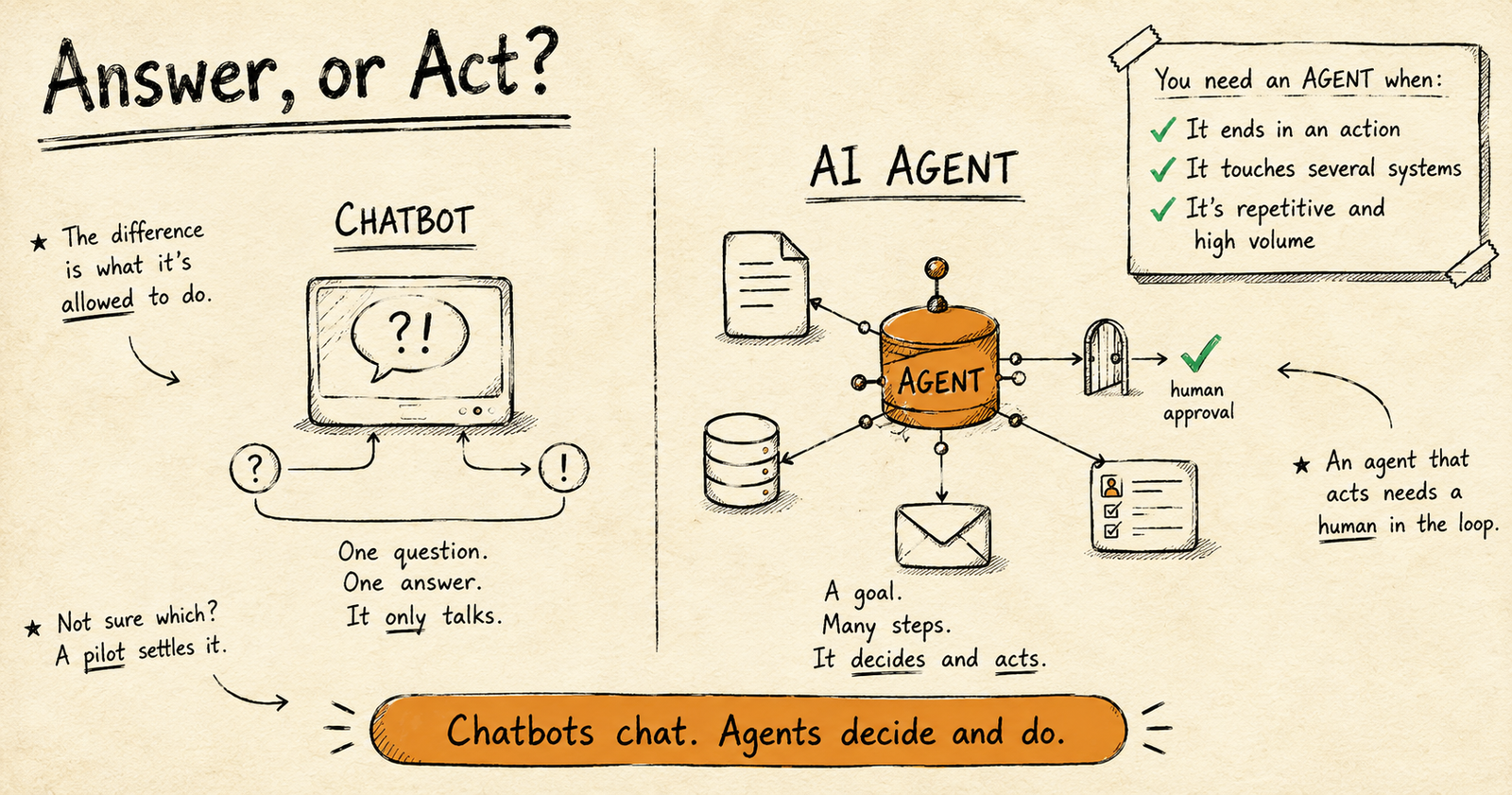
The difference between an AI agent and a chatbot is what each one is allowed to do. A chatbot answers questions: it recognises what you asked and returns a scripted or retrieved reply. An AI agent goes further, reasoning through a goal, deciding the next step, and taking multi-step actions inside your systems, usually with a human checkpoint and an audit trail. Put simply: chatbots chat, agents decide and do.
New to agents? Start with what an AI agent is, then read on.
That one distinction changes your budget, your risk, and the outcome you can expect. This guide explains the difference in plain terms, gives you a side-by-side comparison, and helps you self-diagnose which one your business actually needs. We will also be honest about the cases where a chatbot is genuinely enough and an agent would be overkill.
What a chatbot actually is
A chatbot is a conversational interface over a fixed body of knowledge. The good ones today are powered by large language models and retrieval, so they sound natural and can pull answers from your documentation, help centre, or product catalogue. But the job is still fundamentally the same: someone asks, the bot responds.
A chatbot is excellent at a specific set of jobs:
- Answering frequently asked questions
- Deflecting repetitive support tickets
- Pointing people to the right page, form, or human
- Capturing a lead's details and qualifying intent
- Explaining a policy, price, or process
What a chatbot does not do is act. It will tell a customer their refund policy. It will not process the refund, update the CRM, notify the finance team, and log the reason. The moment the task requires a decision and an action across more than one system, a pure chatbot hits its ceiling.
What an AI agent actually is
An AI agent is built around a goal, not a single question. Given an objective, it plans a sequence of steps, chooses tools or systems to use, executes those steps, checks its own work, and adapts if something changes. Andrew Ng, founder of DeepLearning.AI and former head of Google Brain, describes this through four agentic design patterns: reflection, tool use, planning, and multi-agent collaboration. In his framing, an agent that can iterate, revise its work, and call external tools produces markedly better results than a model that simply answers in one shot.
In practical business terms, an agent can:
- Read an incoming document, extract the fields that matter, and file them in the right system
- Triage a support request, resolve the routine part, and escalate the rest with context attached
- Reconcile data between two systems that were never designed to talk to each other
- Draft, check, and queue an action for a human to approve before it goes live
IBM defines an agentic workflow as one that approaches a problem in a multistep, iterative way, breaking a process into smaller parts so the system can plan, research, revise, and act. That is the core mechanical difference. A chatbot has one step. An agent has many, and it decides how they connect.
The word that matters most here is decides. An agent exercises judgment inside a boundary you set. That is powerful, and it is also exactly why governance is not optional — we catalogue what actually goes wrong when an agent decides unsupervised.
AI agent vs chatbot: the side-by-side comparison
| Dimension | Chatbot | AI Agent |
|---|---|---|
| Core job | Answer a question | Achieve a goal |
| Capabilities | Recognise intent, retrieve or script a reply | Reason, plan, choose tools, execute multi-step tasks |
| Decisions | None, or fixed decision-tree branches | Makes judgment calls within a defined boundary |
| Actions taken | Replies with text; may hand off | Reads, writes, and updates records across your systems |
| Systems touched | Usually one (the chat surface) | Multiple (CRM, email, docs, ERP, ticketing) |
| Memory / state | Session-bound, mostly stateless | Carries context across steps and, if designed to, across sessions |
| Governance need | Low (it only talks) | High (it acts, so it needs oversight and an audit trail) |
| When to use | FAQ deflection, lead capture, self-service | Repetitive multi-step work you want done, not just answered |
| Cost shape | Lower build, lower ongoing risk | Higher build, higher value, needs guardrails and monitoring |
| Failure mode | Wrong or unhelpful answer | Wrong action, unless a human checkpoint catches it |
The last row is the one buyers underrate. A chatbot that gives a bad answer annoys a customer. An agent that takes a bad action can change your data. That is not a reason to avoid agents. It is the reason governed implementation matters, and it is the difference between a demo and something you can trust in production.
How to self-diagnose which one you need
You do not need a vendor to tell you this. Answer three questions honestly.
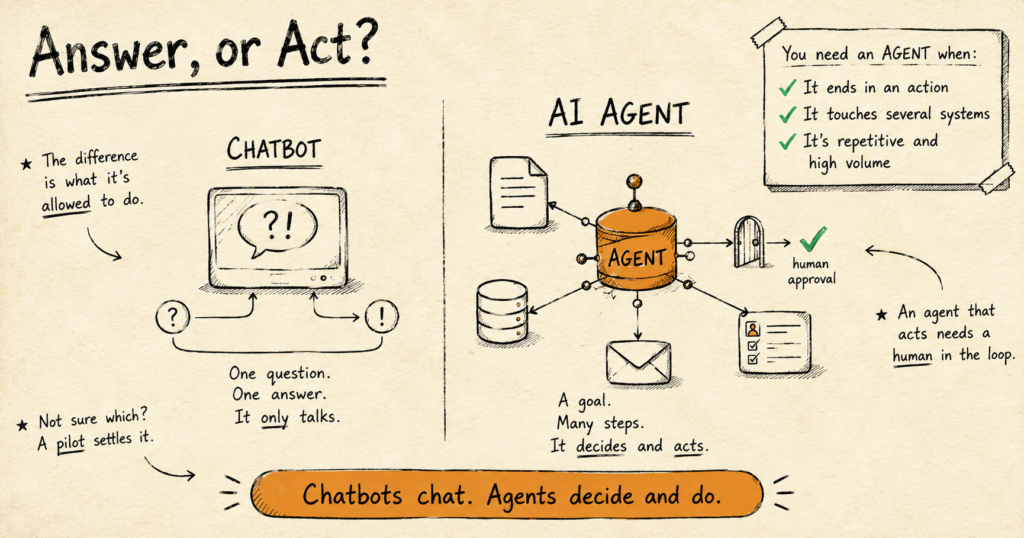
1. Does the task end in an answer, or in an action? If the outcome you want is that the customer knows the answer or the lead is captured, a chatbot is likely enough. If the outcome is that the invoice is reconciled, the ticket is resolved, or the record is updated, you are describing an agent.
2. Does it touch one system or several? Single system, single surface, mostly a chatbot job. If the work only counts as done when two or three systems agree, that coordination is agent territory.
3. Is the work repetitive, rule-heavy, and high-volume? A chatbot saves people from asking the same question. An agent saves people from doing the same multi-step task hundreds of times. If a capable new hire could learn the task from a one-page SOP and it recurs constantly, that is the strongest signal for an agent.
If you answered answer, one system, low volume, a chatbot is the right, cheaper call. If you answered action, several systems, high volume, you have an agent-shaped problem, and a chatbot will frustrate you by looking close but never closing the loop.
Want a Realistic Plan for Your Project?
No sales pitch. We will give you an honest read on what your situation actually needs, what it should cost, and whether AI is even the right tool here.
Book a Discovery Call →The honest part most vendors skip
Here is what a lot of AI agencies will not say out loud: most businesses that ask for an AI agent would be well served, at least first, by a good chatbot, and a meaningful share of agent projects should never have been agents at all.
The data backs the caution. Gartner predicts that over 40% of agentic AI projects will be cancelled by the end of 2027, citing escalating costs, unclear business value, and inadequate risk controls. Anushree Verma, Senior Director Analyst at Gartner, put it bluntly: "Most agentic AI projects right now are early stage experiments or proof of concepts that are mostly driven by hype and are often misapplied." (See the Gartner press release.)
So we will say it plainly. An AI agent is not the right fit if all you need is FAQ deflection, lead capture, or self-service answers; in that case a chatbot is cheaper, faster to ship, and genuinely fine. Do not pay for an agent to do a chatbot's job. As KORIX founder Shishir Mishra puts it, the skill is not buying the most advanced thing, it is matching the tool to the outcome, and reaching for an agent only when the work genuinely involves decisions and actions across systems.
Where agents are the right call, the value is real and the direction is clear. Gartner projects that 33% of enterprise software applications will include agentic AI by 2028, up from less than 1% in 2024, and that at least 15% of day-to-day work decisions will be made autonomously through agentic AI by 2028. Deloitte's 2025 Predictions report expects 25% of companies using generative AI to launch agentic AI pilots in 2025, rising to 50% by 2027. The shift is happening. The question is whether you adopt it where it earns its keep, or where it just sounds impressive.
What "governed" adds, and why it is the real decision
Once a system can act, the interesting question stops being chatbot or agent and becomes how do we deploy an agent we can actually trust. This is where most of the risk in that Gartner cancellation number lives, and it is the part KORIX is built around.
A governed agent has four things a demo usually lacks:
- Human oversight at the points that matter. The agent drafts and prepares; a person approves the consequential action. You decide where the checkpoint sits.
- An audit trail. Every decision and action is logged, so you can answer why did it do that after the fact. Regulated and finance-adjacent teams cannot operate without this.
- It runs inside your existing software. Rather than forcing you onto a new platform, a governed build works within the stack you already own and pay for. We call this approach Bring Your Own Software, and you can read how it works on our BYOS page. We did not invent the idea; we are simply one of its more disciplined practitioners.
- You own the build. No lock-in, no dependency on a vendor's proprietary black box. If we walked away tomorrow, your agent keeps running.
To make this concrete: one KORIX document-processing agent runs at roughly 2,800 documents processed at 98.3% accuracy, inside the client's own stack, with a human checkpoint on the exceptions. That is not a chatbot answering questions about documents. It is an agent doing the work, with a trail that shows exactly what it did. On cost, a focused chatbot build often lands in the low thousands of dollars; a governed agent is a larger fixed-scope engagement, and our AI Pilot starts from around $10,000 and puts a governed agent live in about 21 days so you can judge it on your own data before committing further.
If you are still comparing providers, our companion guide to AI agent companies walks through what to look for and the questions that separate a real implementation partner from a demo.
Bottom line
A chatbot answers. An AI agent decides and acts. That is the whole difference, and it maps cleanly onto what you are trying to achieve. If your goal ends in an answer, on one system, at modest volume, buy the chatbot and spend the savings elsewhere. If your goal ends in an action, across several systems, at high volume, you have an agent-shaped problem, and a chatbot will only ever get you halfway.
The mistake to avoid is treating AI agent as a status symbol. Gartner expects more than 40% of agentic projects to be cancelled by 2027, largely because they were reaching for an agent where a simpler tool, or a clearer problem, would have served better. The businesses that win with agents are the ones that pick a real, repetitive, multi-step workflow, deploy a governed agent inside their existing software with a human in the loop, and prove it on their own data before scaling.
If that is the workflow you have in mind, the fastest way to know for sure is to run it, not debate it. A governed AI Pilot puts one live in about 21 days, on your systems, with the audit trail from day one. Bring us the single task your team keeps doing by hand, and we will show you whether it is an agent's job or a chatbot's, honestly, before you spend on the wrong one.
A chatbot answers. An AI agent decides and acts.
If your goal ends in an answer, on one system, at modest volume, buy the chatbot and spend the savings elsewhere. If it ends in an action, across several systems, at high volume, you have an agent-shaped problem, and a governed pilot on your own systems is the fastest way to prove it before you scale.
AI agents and tools: the full series
This article is part of our AI agents and tools series. The pillar guide covers the whole topic; the others each go deeper on one part.
- Pillar guideWhat is an AI agent?Start here: an agent perceives, decides and acts toward a goal, unlike a chatbot or a fixed automation.
- AI agents vs Zapier, Make and n8nWhen you need an agent that decides versus a workflow that connects.
- AI workflow automation tools comparedEight tools compared on real total cost, and where each one breaks.
- AI stacks that reach productionFive stacks that ship, and how to match yours.
- Best no-code AI platformsWhat no-code AI platforms can and cannot do, and when you will outgrow them.
- Best document processing toolsAI document extraction tools compared, and how to pick one for your workflow.
- OpenAI vs open-source modelsHow to choose on cost, control, privacy and performance.
- GPT-6 Astra: enabling it safelyWhat a regulated firm should settle before switching it on.
Continue learning —
go deeper.
Is an AI agent better than a chatbot?
Not universally. An AI agent is more capable, but better depends on the job. For answering questions and deflecting support tickets, a chatbot is often the better choice because it is cheaper and lower risk. For work that requires decisions and multi-step actions across your systems, an agent is better because a chatbot cannot close the loop. Match the tool to the outcome, not to the hype.
Do I need an AI agent or a chatbot?
Ask whether your task ends in an answer or an action, whether it touches one system or several, and whether it is repetitive and high volume. Answer, one system, low volume points to a chatbot. Action, multiple systems, high volume points to an agent. When you are unsure, a short pilot on a single real workflow will settle it faster than any sales conversation.
AI agent vs chatbot for customer service: which should I use?
Often both, in layers. A chatbot handles the front line of FAQs, order status, and simple self-service. An agent sits behind it to resolve requests that require action, such as processing a change or coordinating a refund across billing and CRM, and escalates the genuinely complex cases to a human with full context attached. Start with the chatbot layer if your volume is mostly questions; add the agent when unresolved actions become the bottleneck.
Can a chatbot become an AI agent?
Not by upgrading the chatbot itself. They are different architectures. A chatbot is built to respond; an agent is built to plan and act. What you can do is keep the chatbot as the conversational surface and connect it to an agent that does the work behind it. That is a common, sensible pattern, but it is a new build behind the familiar chat window, not a setting you switch on.
Are AI agents safe to let loose on business systems?
Only with governance. An ungoverned agent acting on live systems is a real risk, which is part of why Gartner expects many agentic projects to be cancelled. A governed agent, with human approval on consequential actions, a full audit trail, and clear boundaries on what it can touch, is safe enough to run in production. Safety is a design choice, not a property of the technology.
How much does an AI agent cost compared to a chatbot?
A chatbot is cheaper to build and run because it carries less risk and touches less of your stack, often landing in the low thousands. An agent costs more upfront and needs monitoring, but it does work rather than just answering, so it is measured against labour saved. Our governed AI Pilot is a fixed-scope engagement from around $10,000; see the AI Pilot page for current pricing.