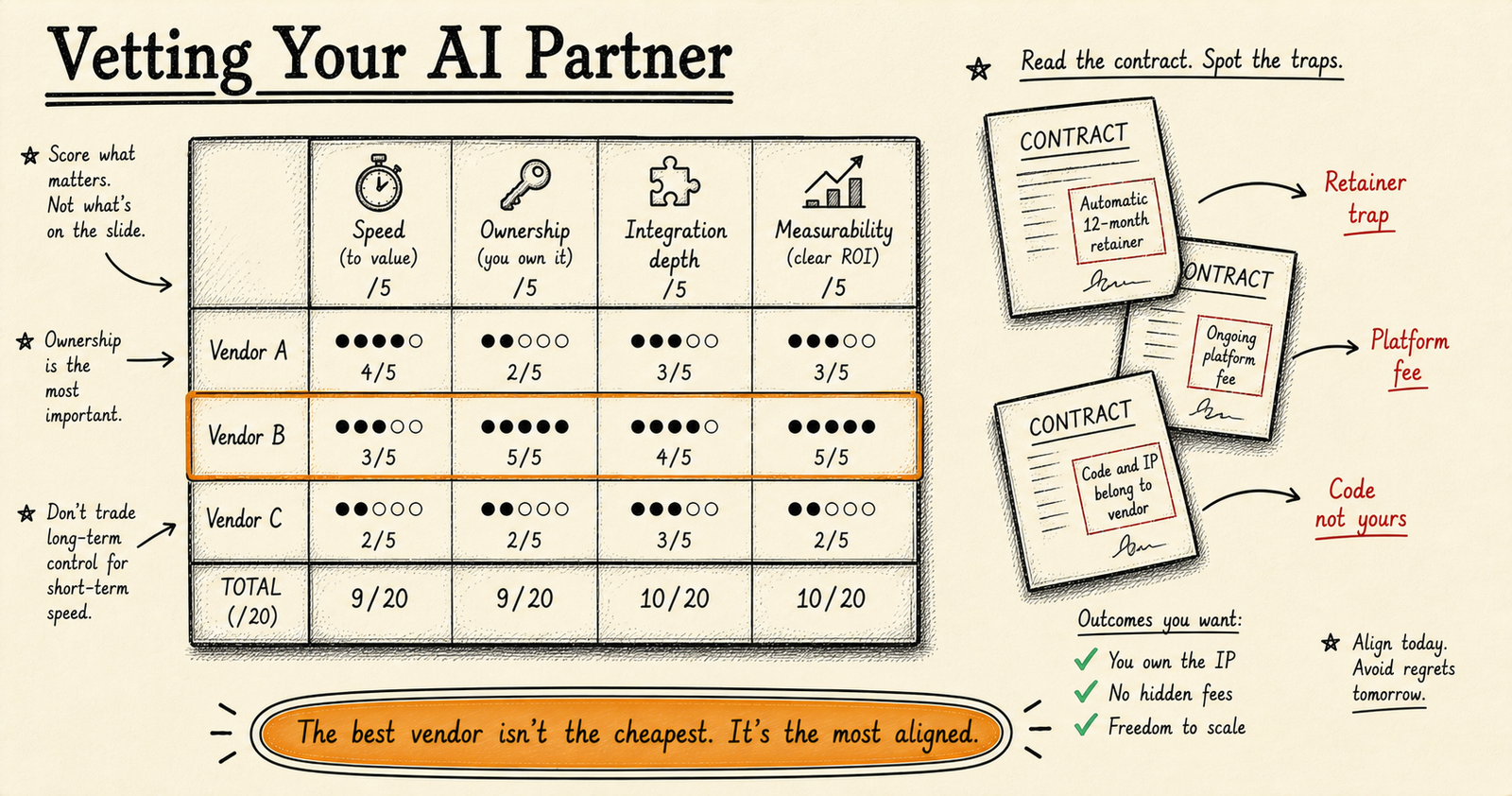
How do you evaluate an AI implementation partner? Focus on 8 criteria: governed systems thinking, production references, problem-first approach, post-handover support, failure handling, willingness to challenge assumptions, team structure transparency, and verifiable references. Most businesses evaluate AI partners on the wrong criteria—team size, client logos, technology buzzwords. Here is what actually matters when you are choosing someone to build AI systems that will run in your production environment.
I have been on both sides of this conversation. As someone who has spent 19 years building enterprise AI systems, I have been the person being evaluated. I have also helped clients recover from partnerships that looked great on paper but failed in practice. The gap between a good sales pitch and a good delivery partner is enormous, and it is not always obvious which one you are looking at.
This framework is designed to help you tell the difference. It works whether you are evaluating KORIX or any other AI implementation partner.
Before you shortlist anyone, it helps to understand governed AI vs a traditional AI consultancy.
Why Choosing the Wrong AI Implementation Partner Is Expensive
Choosing the wrong AI implementation partner typically costs 3-5x the original budget to fix, plus 6-12 months of lost time. Beyond the financial impact, failed partnerships erode internal trust in AI adoption, making future initiatives harder to approve.
We took over a retail analytics AI project where the previous vendor had spent about eight months building prediction models but never connected them to the client’s actual inventory system. The AI looked good in demos but produced useless insights in production because the data pipeline and governance were missing. We rebuilt the system around clean data pipelines, real-time integration, and clear decision outputs instead of just models. That rebuild cost the client roughly three times what the original project should have cost if it had been designed correctly from the start.
Before getting into how to choose well, it is worth understanding what happens when you choose badly. This is not theoretical—I have inherited projects from other vendors and seen the damage first-hand.
The cost of rebuilding
When an AI implementation fails, you do not just lose the original investment. Rebuilding typically costs 3–5x the original budget because the new partner has to unpick decisions that were baked into the architecture. Bad data pipelines need to be torn out. Ungoverned models need to be retrained with proper audit trails. Integrations built without error handling need to be rebuilt from scratch. The original vendor’s “quick and cheap” approach becomes the most expensive option in retrospect.
Lost time
A failed AI partnership typically costs 6–12 months. That is 6–12 months where your competitors are moving forward with their own AI implementations. That is 6–12 months where the business problem you were trying to solve continues to cost you money. Time is the one resource you cannot get back, and a bad partner wastes more of it than almost any other business decision.
Team trust erosion
This is the cost nobody talks about. When an AI project fails, your internal team becomes sceptical of AI itself. The next time you propose an AI initiative—even with a better partner—you face internal resistance from people who remember the last time. Rebuilding organisational trust in AI adoption takes longer than rebuilding the technology.
Pressure-test any partner against the AI compliance checklist: ask how they handle each control.
8 Criteria That Actually Matter When Evaluating an AI Implementation Partner
Evaluate an AI implementation partner on these 8 criteria: governed systems thinking, production references, problem-first approach, post-handover support, failure handling, willingness to challenge you, team structure, and verifiable references.
These are the criteria I would use if I were hiring an AI partner for my own business. They are deliberately practical—designed to surface the information that actually predicts project success.
1. Do they build governed systems or just models?
This is the single most important question. A model is a component. A governed system includes the model plus audit trails, rollback capabilities, monitoring, access controls, and compliance documentation. Any competent ML engineer can train a model. Far fewer can build the production infrastructure around it that makes the model safe and reliable.
Ask to see their governance architecture. If they cannot show you how they handle model versioning, data lineage tracking, and automated monitoring—they are building prototypes, not production systems.
2. Can they show you production systems, not just demos?
Demos are easy. A demo runs on clean data, with no edge cases, no concurrent users, and no real-world variability. Production is hard. Ask your potential partner: “Can you show me a system that has been running in production for 6+ months?” If the answer is no, they are still learning on their clients’ projects. Check their portfolio for systems that are actually deployed, not just delivered.
3. Do they start with your problem or their technology?
A good AI partner opens the conversation by asking about your business problem, your current workflows, and what success looks like for you. A bad one opens by talking about their technology stack, their proprietary framework, or the latest model they have been experimenting with. Technology is a means, not an end. If the partner is more excited about the tech than about solving your problem, that excitement will come at your expense.
4. What happens after handover?
AI systems are not “build and forget” products. Models drift. Data patterns change. Edge cases emerge. Ask your potential partner what their post-deployment support looks like. Do they offer monitoring? Retraining? Bug fixes? Knowledge transfer to your internal team? If the answer is “we hand it over and you are on your own,” that is not a partner—that is a contractor who disappears when things get difficult.
5. How do they handle failure?
Every AI project hits problems. Models underperform. Data turns out to be messier than expected. Integrations break in unexpected ways. The question is not whether problems will occur, but how the partner responds when they do. Ask for a specific example of a project that went wrong and what they did about it. A partner who claims every project has gone perfectly is either lying or has not done enough projects to have encountered real problems.
Ask every potential partner: “Tell me about a project that failed or a client you disappointed.” The ones who give you a thoughtful, specific answer are the ones you can trust. The ones who deflect or claim perfection are the ones who will surprise you later.
6. Do they challenge your assumptions?
A good AI partner will push back on your ideas when they are wrong. If you come in asking for a custom-trained LLM when a well-engineered RAG system would solve the problem at a tenth of the cost, the right partner tells you that—even though the custom LLM would be a bigger contract. If every answer is “yes, we can do that,” you are talking to a sales team, not a technical partner.
A company approached us wanting to implement AI for customer support automation across their business. During the assessment we found that their support requests were poorly categorised and most answers were not documented consistently. Instead of deploying AI immediately, we recommended first standardising their knowledge base and ticket classification so automation could actually deliver reliable results later. That engagement started with us saying “not yet” — and the client respected us more for it.
7. What does their team structure look like?
Ask who will actually be working on your project. Not the senior partner who presents in the sales meeting—the people who will write the code, engineer the data pipelines, and deploy the system. Ask about their experience levels. Ask whether they will be working on your project full-time or splitting across multiple clients. Ask whether the person you are talking to will be involved in delivery, or just in sales.
8. Can they give you references you can actually call?
Case studies on a website are marketing material. References you can call are evidence. Ask for 2–3 clients in a similar industry or with a similar project scope that you can speak to directly. Ask those references specific questions: Did the project come in on budget? Did the partner communicate proactively when problems arose? Would you use them again? A partner who cannot provide references is either too new or has unhappy clients.
Some firms send their A-team to the pitch meeting and their junior staff to do the work. Always ask: “Will the people in this room be the people building my system?” Get the answer in writing.
Want to See How We Measure Up?
We are happy to answer every question on this list. Book a 30-minute discovery call and evaluate us the same way you would any partner.
Book a Discovery Call →Red Flags When Choosing an AI Implementation Partner
The biggest red flags when choosing an AI implementation partner are: claiming expertise in everything, having no production references, reluctance to discuss governance or rollback procedures, and offering fixed-price quotes before discovery.
A mid-sized logistics company came to us after their previous AI vendor kept promising “accuracy improvements” but never showed how the system would integrate into operations. The entire project was model-focused with no workflow design or accountability. They ended up with a dashboard nobody used and no measurable ROI. That is what happens when a partner optimises for model metrics instead of business outcomes.
Beyond the 8 criteria above, there are specific warning signs that should end a conversation immediately. Any one of these on its own is enough to disqualify a partner.
“We can do anything”
No legitimate AI practice can do everything. If a partner claims expertise in NLP, computer vision, robotics, quantum computing, and blockchain-based AI, they are either lying or they are a body shop that staffs projects with whoever is available. The best AI partners have a clear specialisation and are honest about the boundaries of their expertise.
No production references
If they cannot point you to a single system that has been running in production for more than 6 months, they are still in the prototype phase of their business. You do not want to be their learning experience. Ask to see something live, with real data, serving real users.
Reluctance to discuss governance or rollback
If your potential partner looks uncomfortable when you ask about model governance, data lineage, or rollback procedures, that tells you they have not built systems that need these capabilities. In regulated industries, this is disqualifying. In any industry, it is a sign that they build demos, not production systems.
Fixed-price quotes without discovery
Any partner who gives you a fixed price before understanding your data, your systems, your compliance requirements, and your team capacity is guessing. And that guess will either be too low (meaning scope will be cut later) or too high (meaning you are overpaying for padding). A responsible partner insists on a discovery phase before committing to a price. Read more about how pricing actually works in our AI implementation cost guide.
Questions to Ask an AI Implementation Partner in Your First Call
In your first call with an AI implementation partner, focus on governance, ownership, and failure handling. Ask who will actually build your system, how they handle model drift, and what happens when things go wrong. The answers reveal more than any sales deck.
One of our best engagements started because the CTO asked in the first call, “How will this system affect how our team makes decisions every day?” That question immediately shifted the conversation from tools to operational design. It told us the leadership cared about adoption and governance, not just deploying AI. When a client asks how AI changes their people’s daily work, you know they understand what successful implementation actually requires.
Here are 10 specific questions you can ask any AI implementation partner in your first conversation. The answers will tell you more about their capabilities than any sales deck.
- “What percentage of your AI projects reach production?” Industry average is around 13%. If they claim 100%, push back. A realistic answer is 40–70%.
- “Can I speak to a client whose project did not go as planned?” This tests honesty more than competence. Every practice has had difficult projects.
- “How do you handle model drift after deployment?” If they do not have a clear answer, they have not maintained production systems.
- “What is your approach to data governance?” Look for specific frameworks, not buzzwords.
- “Who on your team will actually build my system?” Get names and look them up.
- “What would you talk me out of doing?” A good partner will have an opinion. A bad one will say yes to everything.
- “How do you handle scope changes mid-project?” Clear change management process = mature practice.
- “What does your testing look like before deployment?” Look for edge case testing, load testing, adversarial testing—not just “we test it.”
- “How will you transfer knowledge to my team?” Documentation, training sessions, pair programming—specifics matter.
- “What happens if AI is not the right solution for my problem?” The best answer: “We will tell you and help you find the right approach.”
If you want a structured way to assess your own organisation’s readiness before these conversations, our AI readiness assessment gives you a clear picture of where you stand.
Ready to have this conversation? Book a discovery call and use every question on this list. We welcome the scrutiny.
How KORIX Approaches Partner Evaluation
KORIX is a governed-AI-first practice that welcomes scrutiny. We offer a 21-Day AI Pilot so you can evaluate our capabilities with your real data before committing to a longer engagement.
Full transparency: I am writing this as the founder of an AI implementation practice. So apply the same critical eye to us that I am recommending you apply to everyone else. Here is how we stack up against our own criteria:
- Systems-first, governance-first. Every system we build includes audit trails, rollback capabilities, and monitoring as standard—not as add-ons. This is our core offering, not a checkbox.
- Production references available. We can point you to systems that have been running in production across multiple industries. We can also introduce you to clients who will give you an unfiltered assessment of working with us.
- The 21-Day AI Pilot as proof mechanism. Rather than asking you to trust a sales pitch, our AI Pilot is designed to prove our capabilities with your real data, in your real environment, in 21 days. If we cannot deliver value in 21 days, we should not be asking you for a 6-month contract.
- Honest about limitations. KORIX is a focused practice, not a 200-person agency. We specialise in governed AI for mid-market businesses. If your project needs computer vision expertise or you are a 50,000-person enterprise, we will tell you that and help you find a better fit.
We are not the right partner for everyone. But we are committed to being honest about when we are and when we are not. That commitment starts with conversations like the one you can have with us at a discovery call—no pitch, no obligation, just straightforward guidance on your specific situation.
Frequently Asked Questions
Evaluate AI partners on what they build, not what they say.
Focus on governed systems, production references, and honest communication. Ask hard questions early. The right partner will welcome the scrutiny—and the wrong one will reveal themselves in how they respond. A bad choice costs 3–5x the original budget and 6–12 months of lost time. Take the evaluation seriously.
Choosing an AI partner: the full series
This guide is the starting point for Choosing an AI partner. Each article below goes deeper on one part of it.
- Best AI implementation partners in the UKPartners working in the UK side by side, and the criteria that actually separate them.
- AI agent development companies reviewedAn honest review on price, code ownership, governance and production record.
- AI agency vs in-house vs consultancyCost, speed, ownership and risk compared, and when each route is the wrong fit.
- AI consultancy vs AI deploymentTwo different products, and a four-question test for which one you need.
- How to write an AI project RFPThe requirements, questions and scope to include so you can compare vendors fairly.
- Buyer's guide to custom softwareHow to scope the work, brief a partner, and control cost and risk.
- Build vs buy AI agentsBuy the commodity; build only what touches your data or regulated actions.
- Build vs buy softwareA framework for when to build, when to buy, and the real total cost of each.
- Custom AI vs off-the-shelf toolsWhen a packaged product is enough and when you need something built.