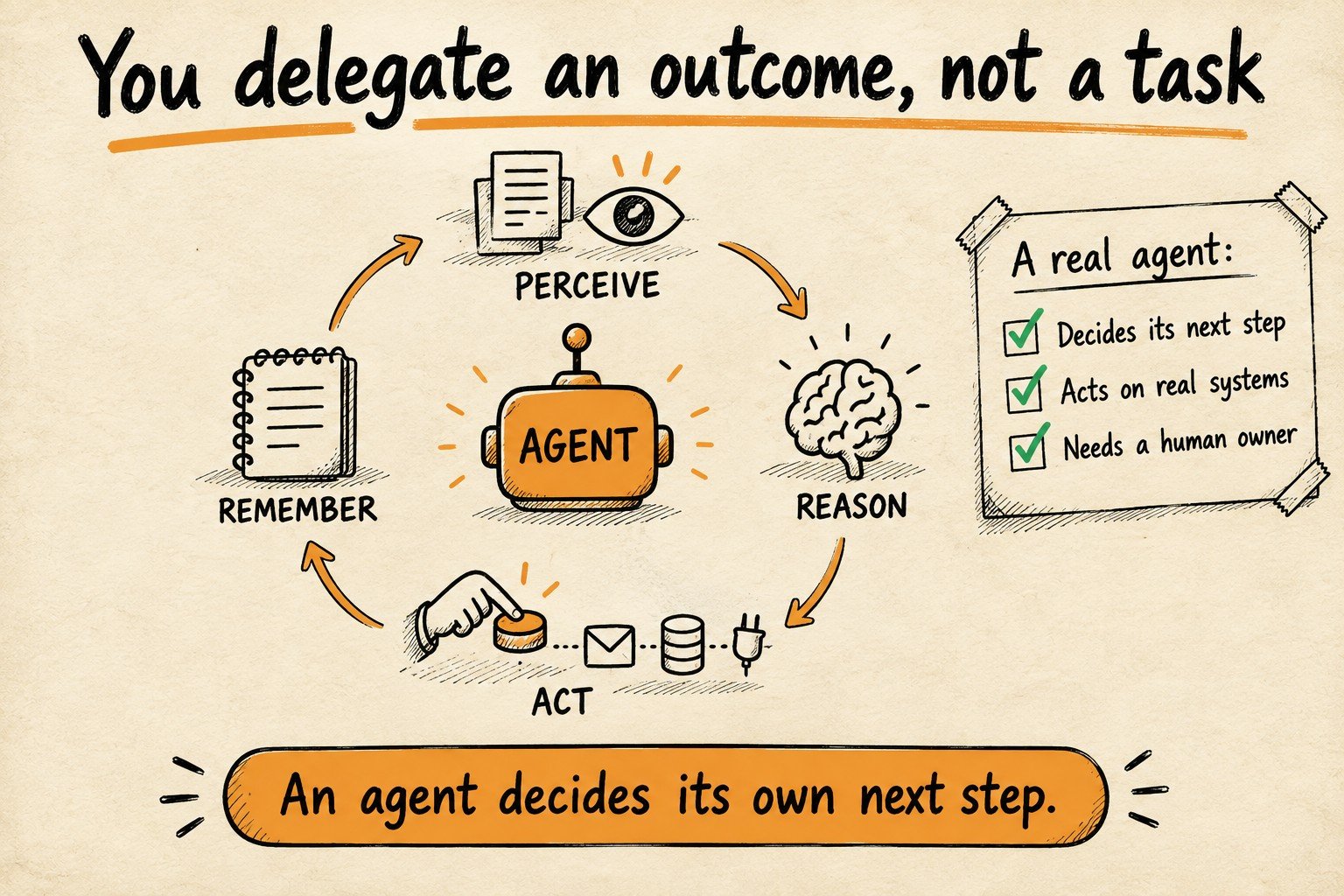
An AI agent is software you hand a goal, not a task. It reads the situation, decides the next step on its own, takes the action, and adjusts when the result changes, with little or no step-by-step instruction. A chatbot only answers. An automation only follows the fixed rules you wrote in advance. An agent decides and acts. That one difference changes what it can do, how it breaks, and what it costs.
We build and run AI agents in production, including for clients like Proteinverse. So this is the definition from the inside, not from a launch deck.
The word "agent" is now stamped on almost every AI product. Most of it is a chatbot with a nicer name, or a workflow with a chat box bolted on. That matters. The three behave differently, break differently, and cost differently. Buy the wrong one and you either overpay for autonomy you cannot control, or you underbuy and wonder why your "agent" cannot handle anything you did not script.
This guide gives you the builder's definition, the one distinction that decides which tool you need, what agents do well today, and an honest read on when not to build one. By the end you will look at any "AI agent" pitch and know what you are really being sold.
What is an AI agent?
KORIX defines an AI agent as software you delegate an outcome to, not a task. You give it a goal. It works out the steps itself, using the tools and systems it can reach, until the goal is met or it hits a limit you set. The point is not the model or the chat box. It is agency: the software picks its own next move.
This is a real shift, not marketing. Andrew Ng, founder of DeepLearning.AI and former head of Google Brain, argues that agentic workflows, where an AI plans, acts, and revises across many steps, will drive more of the next wave of progress than bigger models alone. Andrej Karpathy, a founding member of OpenAI and former head of AI at Tesla, calls the large language model a new kind of operating system, with agents as the programs that run on it and act in the world. The market agrees. Gartner predicts that by 2028, 33% of enterprise software applications will include agentic AI, up from less than 1% in 2024.
The anatomy of an AI agent: perceive, reason, act, remember
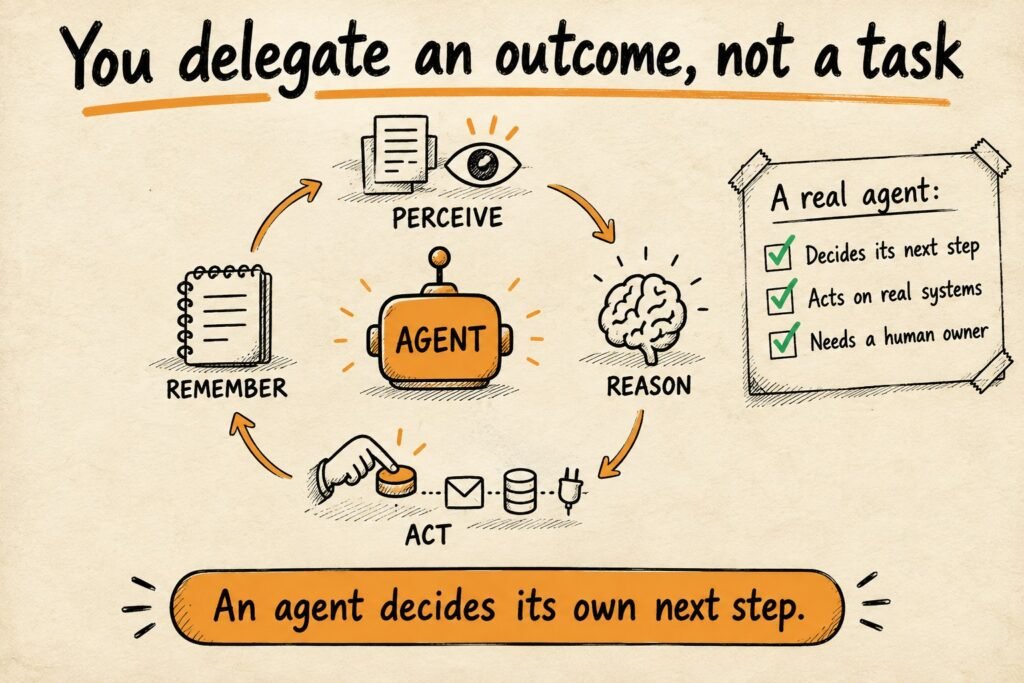
Strip the branding and every real agent runs one loop, four parts:
- Perceive: it reads the goal and the current state, a ticket, a document, a database row, the result of its last move.
- Reason: it decides what to do next. It chooses from the actions open to it, instead of following a fixed script.
- Act: it uses tools. It calls an API, updates a record, sends an email. This is the part a chatbot does not have.
- Remember: it holds context across steps, so step four knows what happened in steps one to three.
The loop is the whole point. A chatbot runs once and stops. An agent runs the loop again and again until the goal is met or it hits a wall. Take away the acting and you have a chatbot. Take away the deciding and you have an automation.
AI agent vs chatbot vs automation: the difference that matters
This is the distinction that decides which tool your job needs. These are not three points on one scale. They are three different kinds of software.
| Property | Chatbot | Automation (Zapier, Make, n8n) | AI agent |
|---|---|---|---|
| What it does | Answers a message | Runs a fixed path you wrote | Pursues a goal, choosing steps itself |
| Who decides the steps | You, one message at a time | You, in advance | The software, at runtime |
| Acts on other systems | Rarely | Yes, but only as scripted | Yes, and it chooses which action |
| Handles unplanned cases | No | No | Yes |
| Predictability | High | Very high | Lower, needs guardrails |
| Best for | Q&A, FAQ, deflection | Fixed, repeatable pipelines | Decision-heavy, variable work |
The honest read: autonomy is not free. The same thing that lets an agent handle a case you never scripted also lets it take an action you never intended. That is why a real agent needs governing. We go deeper in AI agents vs chatbots and agents vs Zapier, Make and n8n.
What an AI agent can actually do today
The wins that hold up in 2026 are narrow and bounded, not general. An agent earns its place when the job is repetitive, decision-heavy, and easy to measure. The patterns we see work in production:
- Support resolution: it reads the ticket, checks the order in your system, takes the routine action (a refund, a reschedule, a status update), and escalates the rest to a person.
- Document processing: it pulls the fields from invoices, claims, or contracts, files them correctly, and routes the exceptions a human needs to see.
- Lead qualification: it enriches an inbound lead, scores it against your rules, and books or routes it, so your team only touches the ones worth their time.
- Reconciliation: it compares two systems that never agreed and flags the mismatches with the evidence attached.
The failure pattern is the opposite: a vague "AI assistant that does everything." Vagueness is why most pilots stall. MIT's NANDA research found that roughly 95% of enterprise generative-AI pilots deliver no measurable business return. The gap is rarely the model. It is the missing system around it: no clear job, no data access, no plan for the cases the model gets wrong.
Want a Realistic Plan for Your Project?
No sales pitch. We will give you an honest read on what your situation actually needs, what it should cost, and whether AI is even the right tool here.
Book a Discovery Call →What separates a production agent from a demo
A demo agent works once, on a clean input, in front of an audience. A production agent runs unattended against messy reality. The difference is governance, not intelligence. This is where most 2026 projects die. Gartner expects more than 40% of agentic AI projects to be scrapped by the end of 2027, mostly because teams shipped autonomy with no controls to run it safely.
Four controls make an agent safe enough to trust with real work:
- Observability: every decision and action is logged, so you can see what it did, why, and prove it later.
- Least-privilege access: it can reach only the systems and actions the job truly needs. Nothing more.
- Human-in-the-loop: anything costly or hard to reverse waits for a person to approve it.
- A named owner: one accountable human, not "the AI," answers for what it does.
Shishir Mishra, KORIX founder, puts it plainly: "An ungoverned agent is a fast worker with no supervisor. It will do what it infers you want, at scale, including the things you did not intend. The controls are not paperwork. They are the difference between an agent you can run on Monday and one you have to switch off by Friday." These four controls are what KORIX ships by default in every agent we run, not an upsell. We go deeper in what governed AI means and the failure modes in AI agent risks.
Do you need an AI agent? Often, not yet
Here is the part most vendors skip. An agent is the right tool for one shape of problem, and the wrong tool for many others. An agent is not for you if any of these is true:
- The task is rare or one-off. The build cost never pays back.
- A fixed automation already handles it well. Do not add autonomy you then have to govern.
- A wrong action would be costly and hard to reverse, and you are not ready to put controls around it.
- You cannot yet say what success and failure look like. With no definition of done, an agent cannot know when to stop.
The downside of agents is real. They are less predictable than the automation they often replace. They need monitoring and maintenance. And the red flag on any pitch is a vendor who talks about the demo and not about what happens when the agent is wrong. Before you buy, ask four questions. How will I see what it did, and why? What can it not touch? What happens when it gets something wrong? Who owns its behaviour? A vendor who cannot answer all four is selling you a demo. Deloitte expects roughly 25% of companies already using generative AI to run agentic pilots in 2025, rising toward 50% by 2027. The ones that succeed almost always start narrow.
What an AI agent costs
Cost is the question vendors dodge, so here it is straight. A production agent build with KORIX runs 15,000 to 40,000 USD, depending on scope and how many of your systems it touches. Runtime is the cheapest line, often around 100 USD a month for a simple agent, more for complex, high-volume ones. The build is the big number. Maintenance is the line most people underestimate. Runtime is the smallest. We break the full economics down in how much an AI agent costs.
Have a specific, bounded job in mind? The fastest way to know if an agent fits is a scoped pilot with a clear definition of done. KORIX builds agents that run inside the tools you already use, governed from day one, and live in about 21 days instead of a six-month custom build. See how we build and run governed agents on our AI agents page, or start a fixed-scope 21-day pilot built around one measurable outcome.
An AI agent does not just answer, it decides and acts toward a goal, and that is exactly why it needs governing.
Chatbots reply. Automations follow fixed steps you wrote. An agent chooses the steps itself to reach an outcome. That autonomy is the value and the risk, which is why a production agent needs observability, hard limits, and a human owner from the first day it runs.
AI agents and tools: the full series
This guide is the starting point for AI agents and tools. Each article below goes deeper on one part of it.
- AI agent vs chatbotChatbots answer questions; agents decide and act inside your systems.
- AI agents vs Zapier, Make and n8nWhen you need an agent that decides versus a workflow that connects.
- AI workflow automation tools comparedEight tools compared on real total cost, and where each one breaks.
- AI stacks that reach productionFive stacks that ship, and how to match yours.
- Best no-code AI platformsWhat no-code AI platforms can and cannot do, and when you will outgrow them.
- Best document processing toolsAI document extraction tools compared, and how to pick one for your workflow.
- OpenAI vs open-source modelsHow to choose on cost, control, privacy and performance.
- GPT-6 Astra: enabling it safelyWhat a regulated firm should settle before switching it on.
Continue learning —
go deeper.
What is an AI agent in simple terms?
An AI agent is software you can hand an outcome to instead of a task. It perceives its situation, decides the next step on its own, takes the action using tools or systems it can reach, and adjusts based on the result, with little or no step-by-step human instruction. A chatbot waits to answer your next message. An agent keeps working toward the goal until it is done or it hits a limit you set.
What is the difference between an AI agent and a chatbot?
A chatbot responds to one message at a time and stops when it has replied. An AI agent pursues a goal across many steps, deciding for itself what to do next and acting on external systems to get there. In practice, a customer-support chatbot answers a question; an agent reads the ticket, checks the order in your system, issues the refund, and updates the customer, then closes the loop.
What is the difference between an AI agent and automation like Zapier?
Automation follows a fixed path a human wrote in advance: when X happens, do Y, then Z. It cannot handle a case you did not script. An AI agent decides the path itself at runtime, so it can handle inputs nobody planned for. The trade-off is predictability: an automation does exactly what you built, while an agent needs guardrails because it can choose to do something you did not foresee.
What can an AI agent actually do for a business?
The reliable wins in 2026 are narrow and bounded: triaging and resolving support tickets, processing documents (invoices, claims, contracts) and routing exceptions to a person, qualifying inbound leads, reconciling records across systems, and drafting work a human approves. The pattern that works is a specific, measurable job with a clear definition of done, not a general assistant that does everything.
Does my business need an AI agent?
Often, not yet. You need an agent when a job is repetitive, high-volume, decision-heavy, and expensive in staff time, and when you can define success and failure clearly. If the task is rare, if a fixed automation already handles it, or if a wrong action would be costly and hard to reverse, an agent is the wrong tool. Start from the job, not from the technology.
How much does an AI agent cost to build and run?
A production agent build typically runs in the 15,000 to 40,000 USD range depending on scope and the systems it must touch. Runtime is usually the cheapest line, often around 100 USD a month for a simple agent and more for complex ones. The build is the large cost, ongoing maintenance is the one most people underestimate, and model runtime is usually the smallest.
What makes an AI agent safe to run in production?
Four controls separate a production agent from a demo: observability (every decision and action is logged and reviewable), least-privilege access (it can only reach the systems and actions it truly needs), human-in-the-loop on high-stakes steps (a person approves anything costly or irreversible), and a named owner accountable for its behaviour. Without these, an autonomous agent is a fast worker with no supervisor.