
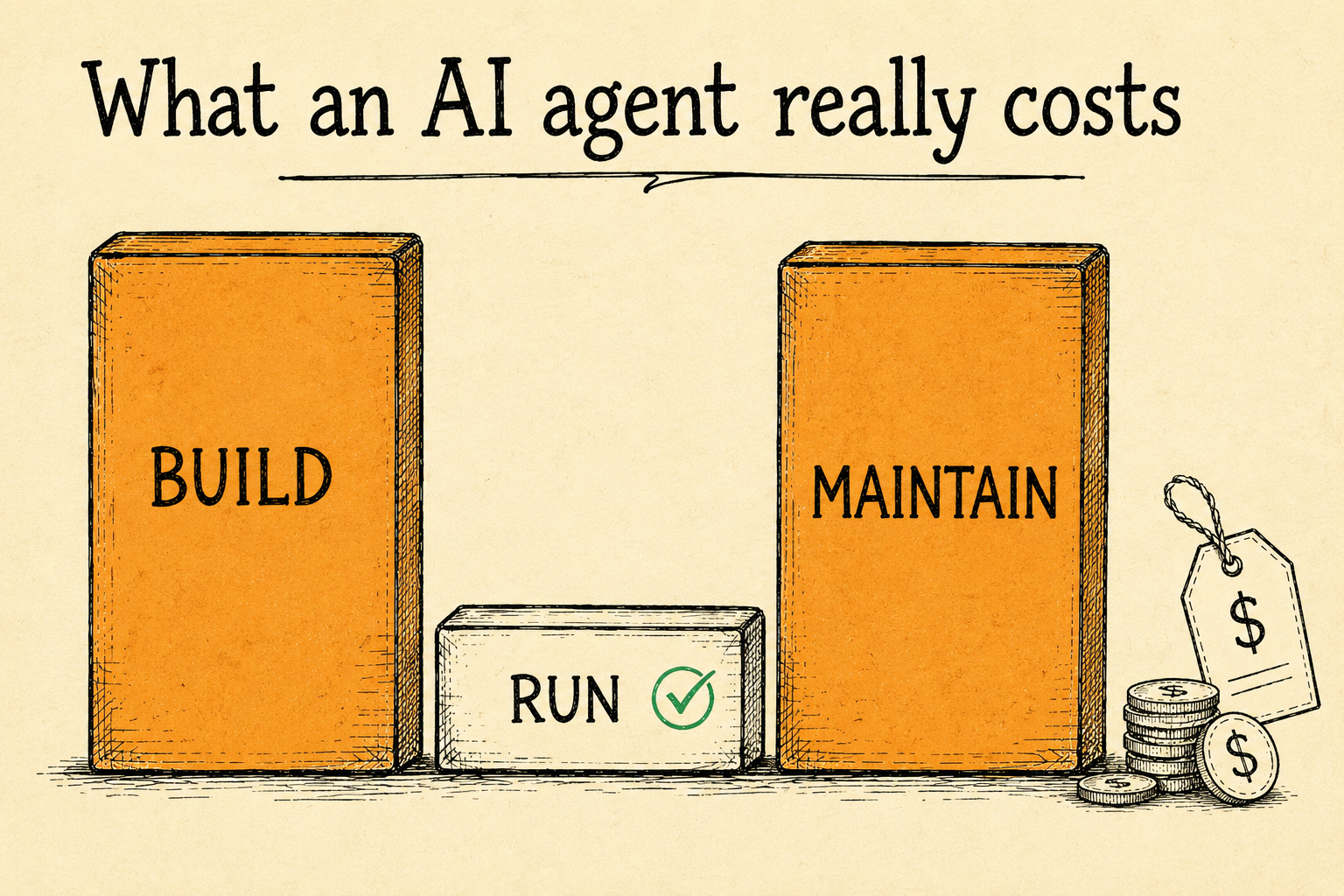
Here's the honest answer most vendors won't give you: an AI agent's cost is mostly in the build and the upkeep, not the runtime. A production-grade custom agent is a low-five-figure build (our 21-day pilot runs $15K–$40K), usually under $100 a month to run because tokens are cheap, and then a recurring maintenance line — drift, monitoring, governance — that quietly runs forever. Budget the build and the upkeep first; the run cost is the easy part.
I get asked "what does an AI agent cost?" almost weekly, and the honest reply is a question back: cost to build it, cost to run it, or cost to keep it working? Those are three different numbers, and the one people fixate on — the run cost — is usually the smallest. The expensive surprises live in the other two.
So this isn't a single price tag. It's the real cost structure of an agent, the figures from our own production agents (which I can quote because we built and run them), and a simple way to budget your own — before a vendor quotes you a number that only covers the demo.
The three real costs of an AI agent: build, run, maintain
A normal software cost is mostly upfront. An agent's cost is spread across its whole life, in three buckets that behave very differently:
- Build — design, the prompts, wiring the agent into your tools, and the evaluation harness that proves it works. This is the biggest one-time line, and the eval harness is the part cheap builds skip.
- Run — inference (LLM tokens), monitoring, and the orchestration layer if multiple agents coordinate. This scales with usage, every day it runs. It's rent, not a one-time cost — but it's usually the smallest of the three.
- Maintain — when the underlying model updates, agent behaviour shifts (drift), so it needs re-testing; plus the governance and audit trail for anything that takes an action. This recurs forever and is the line people forget when they sign off a budget, a classic cost a mismatched partner leaves out.
A generic AI implementation cost guide stops at the build number. For an agent, the build is only the first third — and not always the biggest third over two years. That difference is the whole point of this article.
What drives the number up or down
Two agents can differ by 50× in total cost of ownership. Five levers explain almost all of the spread:
- Autonomy. An agent that only reads and summarises is cheap. One that acts — sends, refunds, updates a record — needs review, audit and governance, which adds real recurring cost. Autonomy is the single biggest swing.
- Volume. Run cost scales almost linearly with how often the agent fires. Ten calls a day and ten thousand are different budgets entirely.
- Tool integrations. Each system the agent touches (CRM, helpdesk, database) adds build time and a maintenance surface that can break when those systems change.
- Data sensitivity. Proprietary or regulated data pushes you toward a self-hosted build instead of a cheap platform — more upfront, but the only safe option for some workloads.
- In-house vs partner. Building with no AI team means hiring or a long ramp; a partner build trades a fixed engagement cost for speed and a handover.
What an AI agent costs to build, run, and maintain — our real numbers
This is the part a competitor can't write, because it requires running agents in production and reading the bill. Last year I built seven AI agents to run KORIX's own operations in about six days — and they're still running. Here's what each part actually costs.
What does it cost to build an AI agent?
A production-grade custom agent is a low-five-figure build — our 21-day AI Pilot runs $15K–$40K and ships a governed agent on your stack. Simpler internal agents cost far less. The ones we built for ourselves are deliberately single-purpose, so the Lead Monitor agent — which watches our inbound and escalates anything unprocessed past two hours — took 1 hour 47 minutes end to end, and most of the seven landed in a one-to-four-hour range. Be honest about why that's fast, though: those are internal monitoring agents, not customer-facing, action-taking ones. A governed agent that touches a client's stack is the bigger build — the kind our 21-day AI Pilot delivers, and what real client pilots like Anna Mazurowska's Numerology Matrix and Lucky Valecha's Proteinverse went through.
What does it cost to run an AI agent per month?
Usually under $100 a month — and often far less. Here's the number that surprises people: those original seven have since grown into a fleet of more than two dozen deterministic monitoring agents, and together they still cost roughly $0 a month to run, because they're scripts calling free APIs (Google Search Console, PageSpeed) with no LLM tokens at all. Our one genuinely LLM-powered agent — the content engine that drafts and adapts posts — has spent $0.63 in real API costs over three weeks, under a dollar a month at our volume. It does most work on Claude Haiku at about $0.003 per call and only escalates to a stronger model (around $0.07 a call) when the task needs it. Run cost is dominated by whether the agent calls an LLM, how often, and which model — not by some mysterious "AI tax."
What does an AI agent cost to maintain?
Maintenance is the recurring line people forget — and for an action-taking agent it's the real ongoing cost. Even our cheap agents need someone to notice when a Google API changes or a model update shifts behaviour. For a low-stakes monitor that's minutes a month. For an agent that takes actions it's a real, ongoing governance cost — and it's the number cheap quotes leave out.
Build, buy, or deploy — the cost side
The full decision is in our build vs buy AI agents guide; here's just the money view. Read it as total cost of ownership over two years, not as an upfront quote — the cheapest sticker is often the most expensive path.
| Cost line | Buy (platform agent) | Build (in-house) | Deploy with a partner |
|---|---|---|---|
| Upfront build | Low — configuration only | High — design, eval harness, ramp | Fixed engagement (e.g. $15K–$40K pilot) |
| Run cost | Subscription / per-seat or per-use | Your tokens — cheap, scales with volume | Your tokens, cost-modelled before launch |
| Maintenance / drift | Vendor absorbs it | Yours, forever — needs an eval harness | Yours, with a handover playbook |
| Hidden cost | Renting your own core process | Carrying the maintenance team | Choosing the wrong partner |
| Cheapest for | Commodity, high-volume work | Data-sensitive, moat work (with a team) | Differentiating work, no in-house team |
Ranges are typical mid-market figures as of 2026, in USD — verify current vendor and model pricing before you commit, because this category moves monthly. For how the subscription side prices, see our AI agent companies landscape and the agent deployment as a service model.
The ongoing costs people miss
When a budget blows up, it's almost never the build — it's the three lines a demo never shows:
- Run cost that scales. A pilot fires a few hundred times. Production fires hundreds of thousands. The per-call cost looks trivial until you multiply it by real volume — model that from day one, not after launch.
- Drift maintenance. Models update. An agent that passed every test in March can quietly regress in June. Re-testing isn't optional for anything that acts — and it's a recurring line, not a one-off.
- Governance and audit. An action-taking agent needs a paper trail and a named owner. That's cheap to design in and expensive to retrofit after a regulator-style question lands.
Read Gartner's numbers together and the warning is clear: Gartner predicts more than 40% of agentic-AI projects will be cancelled by the end of 2027, largely from escalating costs and unclear value. In the same Gartner research, a poll found 42% of organisations had made only conservative investments so far, with another 31% still waiting. Yet Gartner also expects 33% of enterprise software to embed agentic AI by 2028, up from under 1% in 2024. The spend is coming; the cancellations cluster on the projects that budgeted the demo and not the upkeep.
Want a Realistic Plan for Your Project?
No sales pitch. We will give you an honest read on what your situation actually needs, what it should cost, and whether AI is even the right tool here.
Book a Discovery Call →Why the cheapest quote often costs the most
The lowest number on the table usually wins the deal and loses the year. Three ways a cheap agent gets expensive: it ships with no evaluation harness, so you can't tell when it drifts until something breaks; it runs the workflow on a vendor's terms, so you're renting your own core process and pay again to get under the hood; or it skips governance, so the first audit-style question costs more than the build saved. None of those show up in the quote. All of them show up in year two. The honest version of cheap is "small scope, done properly" — not "everything, built thin."
How to budget an AI agent
A simple framework you can apply before any vendor call:
- Start with the action, not the model. Write down the one decision the agent owns and whether it reads or acts. Read-only is cheap; action-taking carries governance cost — price it in now.
- Size the build honestly. A simple internal agent is hours of work. A governed, client-grade agent is a bounded engagement — budget a real build number (our pilot is $15K–$40K) and insist the eval harness is in scope.
- Estimate run cost from real volume. Calls per day × cost per call × the model you'll actually use — a provider's published per-token API pricing makes this easy to estimate, and tokens keep getting cheaper. Most well-built agents land under $100/month; high-volume customer-facing ones more. Don't guess from a demo.
- Add a recurring maintenance line. Whatever the build cost, carry a monthly figure for drift re-testing, monitoring and governance. This is the line that makes the two-year number honest.
- Compare on two-year TCO. Put buy, build and partner-deploy side by side over 24 months — not on the upfront quote. The cheapest sticker rarely wins that comparison.
The honest bottom line
If you're trying to price an AI agent: stop looking for one number. Budget the build properly (with the eval harness in scope), size the run cost from real volume — it's usually the cheapest line — and carry a recurring maintenance figure from day one. KORIX defines the true cost of an AI agent as the two-year total of build plus run plus maintain, where maintenance and governance — not tokens — are the lines that most often blow the budget.
If you want a real build-and-run number for your specific use case, our 21-Day AI Pilot gives you one against a live baseline, and the Bring Your Own Software model keeps the agent — and its run cost — on your own stack. For the decision itself, start with build vs buy AI agents; for project-level numbers, see AI implementation cost.
Most of an AI agent's cost is in the build and the upkeep — not the runtime. Running one is usually the cheapest line; the surprise is maintenance and governance.
A production-grade custom agent is mostly a build-and-maintain cost, not a run cost. Building one properly is a low-five-figure engagement (our 21-day pilot is $15K–$40K); running it is often under $100/month because tokens are cheap; and the line people forget is maintenance — model drift, monitoring and governance — which recurs forever. Budget for build + upkeep first, size the run cost from real volume, and never let a low quote hide the maintenance bill.
AI cost and pricing: the full series
This article is part of our AI cost and pricing series. The pillar guide covers the whole topic; the others each go deeper on one part.
- Pillar guideHow much does AI implementation cost?Start here: real 2026 cost ranges, the factors behind every quote, and the costs vendors leave out.
- AI pricing models comparedPer-seat, per-use and outcome pricing compared on real three-year cost.
- What drives software development pricingScope, complexity, integrations and risk: the factors behind every quote.
- Hidden costs of the wrong partnerRework, lock-in, lost time and no ownership, and how to spot them upfront.
- How to measure AI ROIThe metrics that matter, how to set a baseline, and how to prove value to your board.
Continue learning —
go deeper.
How much does an AI agent cost in 2026?
It splits into three numbers, and the run cost is usually the smallest. Building a production-grade custom agent properly is a low-five-figure engagement — KORIX's 21-day pilot is $15K–$40K and ships a governed agent on your stack. Running it is often under $100/month, because LLM tokens are cheap (Claude Haiku costs a fraction of a cent per call). The cost people underestimate is maintenance: model-drift checks, monitoring and governance, which recur every month for as long as the agent runs. A simple internal agent you build yourself can cost hours of work and near-zero to run; a high-volume, action-taking agent costs far more to run and govern.
What actually drives the cost of an AI agent up or down?
Five things. Autonomy (an agent that only reads is cheap; one that takes regulated actions needs audit and review, which costs more). Volume (run cost scales linearly with how often it fires). Number of tool integrations (each system it touches adds build and maintenance). Data sensitivity (proprietary or regulated data pushes you toward a self-hosted build). And whether you build in-house or with a partner. The single biggest swing is autonomy plus volume — a low-volume read-only agent and a high-volume action-taking one can differ by 50× in total cost of ownership.
What does it cost to run an AI agent each month?
Less than most people expect, if it's well-built. KORIX runs more than two dozen deterministic monitoring agents (grown from the original seven) that cost roughly $0/month because they call free APIs and use no LLM tokens at all. Our one LLM-powered content agent has spent $0.63 in real API costs over three weeks — under $1/month at our volume — because it uses Claude Haiku for most work (about $0.003 per call) and only escalates to a stronger model when needed. Run cost is dominated by how often the agent calls an LLM and which model; for high-volume customer-facing agents it can reach hundreds of dollars a month, but it's rarely the line that breaks the budget.
Why do AI agent projects blow their budgets?
Because teams price the build and forget the upkeep. Gartner predicts more than 40% of agentic-AI projects will be cancelled by the end of 2027, largely from escalating costs and unclear value. The pattern we see is the 'cheap pilot, expensive scale' trap: a quote covers a demo, then real cost arrives later as run cost that scales with usage, maintenance for model drift, and governance that was never budgeted. The fix is to budget build plus a recurring maintenance line from day one, and to size run cost from real volume, not a demo.
Is it cheaper to build or buy an AI agent?
For commodity work, buying is cheaper — a platform agent is a subscription and the vendor absorbs maintenance and drift. For an agent that touches proprietary data, takes regulated actions, or guards a competitive process, building (or partner-deploying on your own stack) is cheaper over time, because the alternative is renting your core process forever. The honest rule: buy the commodity, build the differentiating, and compare them on total cost of ownership over two years, not on the upfront quote. See our build-vs-buy guide for the full decision.