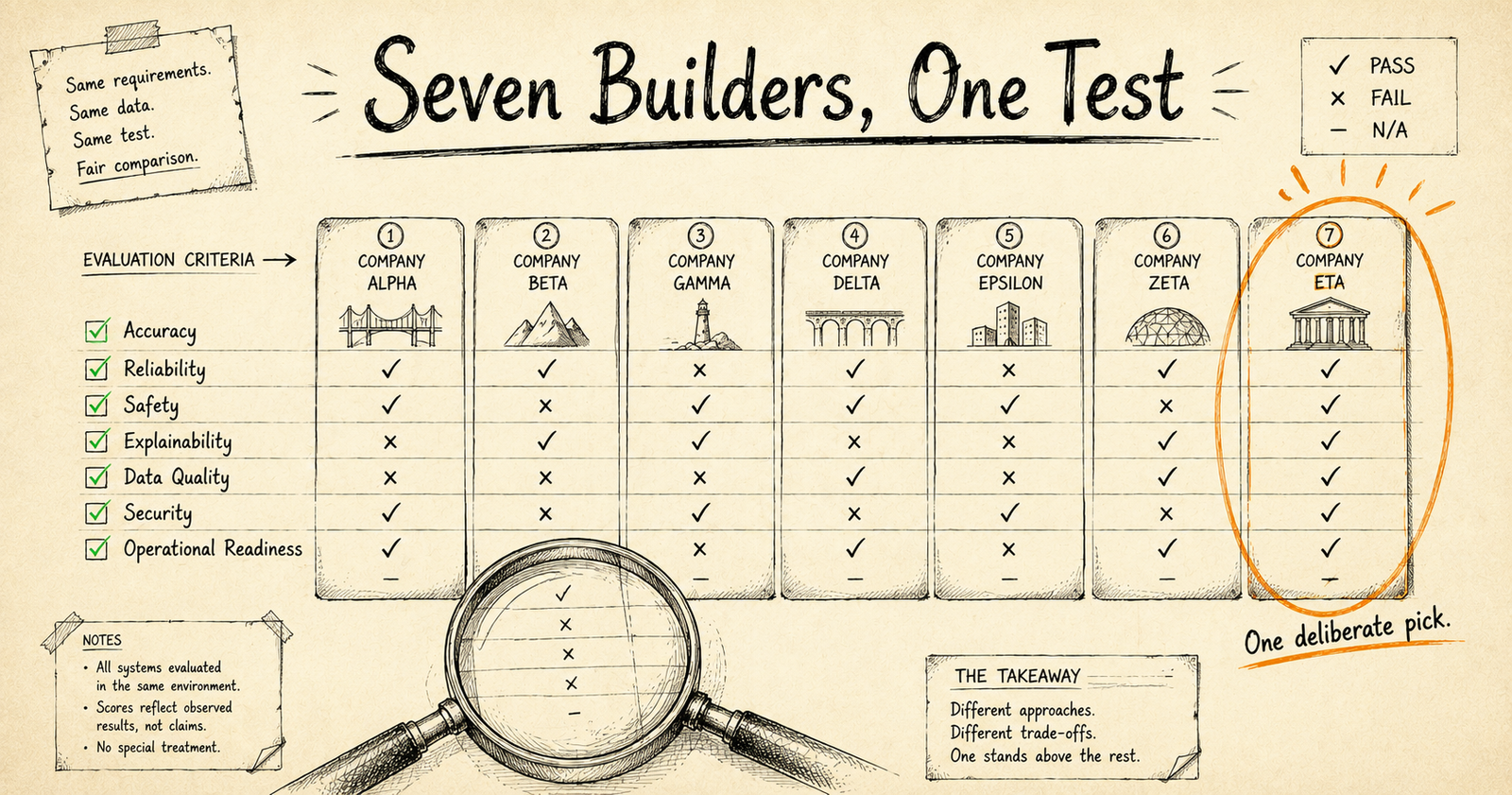
The best AI agent development companies in 2026 are best for different buyers, not best overall. The strongest options are Master of Code Global (conversational agents), NP Group and LeewayHertz (full-stack AI products), Centric Consulting (process-first builds), Neurons Lab (agentic AI for regulated enterprises), Relevance AI (no-code self-serve), Markovate (fast productized pilots), SoluLab (AI plus blockchain at scale), Azumo (nearshore, US-aligned capacity), and KORIX (governed agents inside your stack for UK SMBs). There is no universal number one — pick on fit, ownership, and budget.
New to agents? Start with what an AI agent is, then read on.
We are an AI agent development company. Writing a guide that recommends our direct competitors is either very honest or commercially reckless — we think it's the former, and we put ourselves last on purpose. I'm Shishir Mishra, founder of KORIX; I've spent 19 years building and, more often, rebuilding software systems other people shipped without controls. That second job — inheriting the wreckage — is where you learn which kind of AI agent vendor actually leaves you with something you can run, audit, and own.
This is the comparison the vendor pages won't write. Most "AI agent development companies" lists are pay-to-rank directories or thinly disguised ads. This one names real firms, states who each is genuinely good for, says plainly who they are not for, publishes our own price when most of the field hides theirs, and gives you a five-question test you can run on any vendor — including us — before you sign anything.
The five questions we scored every company on
A "Best AI Agent Development Companies" list is useless if it ranks by marketing spend. We score on the five things that actually determine whether your agent reaches production and survives there. We define a production-grade AI agent as one that runs inside your real systems, owns its decisions with logging and human escalation, and can be paused or rolled back when it's wrong — not a demo that impresses in a sandbox and stalls on contact with reality.
The stakes are not theoretical. Gartner predicts that by 2028, 33% of enterprise software applications will include agentic AI, up from less than 1% in 2024. Separately, Gartner forecasts that over 40% of agentic AI projects will be canceled by the end of 2027 — driven by escalating costs, unclear business value, and inadequate risk controls. The gap between those two numbers is the whole game: agents are arriving fast, and most attempts will fail. The MIT NANDA "State of AI in Business 2025" study reinforces it — roughly 95% of enterprise generative-AI pilots deliver no measurable return, with only about 5% capturing real value.
Andrew Ng, founder of DeepLearning.AI, has argued for years that the teams capturing the most AI value are the ones who ship narrow, working systems quickly and iterate on real production data — not the ones with the largest strategy decks. Cassie Kozyrkov, Google's former Chief Decision Scientist, makes the complementary point that the hard part of AI is rarely the model — it's choosing the right problem and wiring in the judgment around it. Both point to the same vendor-selection truth: the best company is the one that ships the right bounded use case into production fastest, with the controls to keep it honest.
- Where does the agent run? — inside your existing systems, or on the vendor's platform you then rent forever.
- Who owns the code? — you, the vendor, or a shared platform with exit costs.
- What ships, and when? — a working production agent by a defined date, or a strategy deck and a roadmap.
- What happens when it's wrong? — confidence thresholds, logging, and human escalation, or a black box.
- What does it actually cost? — a published range, or "let's discuss after discovery."
The 10 AI agent development companies — honest reviews
No company paid to be on this list. They are not ranked one to ten; each leads in a different lane. We've grouped them by the delivery model they're best at — and we're last, for a reason we explain at the end. We looked at the firms that repeatedly rank for this term plus specialists we've worked alongside, scored each on the same five questions, and where a company doesn't publish a fact — price, team size — we say so rather than guess.
1. Master of Code Global — conversational agents at scale
What they do: A conversational-AI firm building chatbots, voice assistants, and increasingly autonomous agents for enterprise clients across web, WhatsApp, and voice channels.
Best for: Customer-facing conversational agents that handle support, order processing, or lead qualification across multiple channels with one agent architecture.
Not ideal for: Silent back-office process automation or agents that operate entirely inside your CRM/ERP with no conversational layer. Their strength is conversation-first.
Pricing tier: $$$ — enterprise; mid-five-figure to six-figure engagements depending on channels and complexity.
2. NP Group (Net Solutions) — full-stack AI product builds
What they do: A product-development and AI solutions company building intelligent agents, ML models, and AI-integrated applications — the whole product around the agent, not just the agent.
Best for: Mid-to-large organisations building a new product with agents at the core, needing UI, backend, infrastructure, and agent logic under one roof from a single vendor.
Not ideal for: Small, focused single-agent builds — you'd be paying for full-team capacity you don't need. Clarify the IP arrangement upfront, as ownership terms vary by contract.
Pricing tier: $$–$$$ — competitive blended rates; mid-five-figure to six-figure depending on scope.
3. Centric Consulting — process-first agent builds
What they do: A management-and-technology consultancy that pairs business-process expertise with AI implementation — understanding the workflow before automating it. Strong in document processing, compliance monitoring, and operational decision agents.
Best for: Organisations where the process itself needs redesigning before an agent can automate it, especially in regulated industries where change management matters as much as the technology.
Not ideal for: Teams that already know exactly what to build and want fast, focused implementation. The consulting-discovery layer adds time and cost. Ask for agent-specific case studies, as the AI practice is newer than the core consulting business.
Pricing tier: $$$–$$$$ — consulting rates; six-figure engagements including the discovery phase.
4. LeewayHertz — enterprise AI products and platforms
What they do: A long-standing AI development company (now part of The Hackett Group) building custom generative-AI and agentic solutions for startups, SMBs, and enterprises — frequently cited in this category, with its own ZBrain AI platform alongside bespoke builds.
Best for: Enterprises wanting a custom, full-stack agentic product built and integrated end-to-end, with a broad bench across LLMs, data engineering, and app development.
Not ideal for: Small teams needing one bounded agent shipped in weeks on a fixed budget — the engagement model is built for larger, custom programmes. Confirm code ownership and ongoing maintenance terms before signing.
Pricing tier: $$$ — custom enterprise; typically six-figure for a full build.
5. Neurons Lab — agentic AI for regulated enterprises
What they do: A London-based AI consultancy (with a Singapore office) specialising in agentic and generative AI for enterprises, with deep focus on financial services and other regulated sectors and an emphasis on production deployment over experiments. They hold an AWS Agentic AI Competency.
Best for: Larger, regulated UK and European enterprises that need agentic AI built with sector-specific rigour and a credible compliance posture — and want a partner inside the same time zone.
Not ideal for: A 20–150-person SMB needing a single low-cost workflow shipped fast; the consultancy model is oriented to bigger, more complex programmes.
Pricing tier: $$$ — enterprise consultancy; engagement-based, typically six-figure for full programmes.
6. Relevance AI — no-code agent platform
What they do: A no-code/low-code platform for building and orchestrating AI agents and "AI workforces" yourself, without a development partner.
Best for: Teams that want to self-serve — building contained agents for sales, research, or operations quickly, and maintaining them in-house without writing code.
Not ideal for: Deep integration into a regulated system of record, custom data pipelines, or use cases where you must own and audit the underlying code. You're building on (and dependent on) their platform.
Pricing tier: $–$$ — SaaS subscription; a free tier plus paid plans from roughly $19/month up to about $599/month (Business), with custom enterprise pricing above that.
7. Markovate — fast, productized generative-AI pilots
What they do: A San Francisco generative-AI product studio (founded 2015) shipping agentic AI for approvals, scheduling, and operations across manufacturing, construction, healthcare, insurance, and real estate. ISO 9001 and ISO/IEC 27001 certified, with a productized "focused pilot in 4–6 weeks" delivery model and named work for firms like MPP Innovation and Standard Textile.
Best for: Enterprises that want a fast, structured generative-AI pilot from a studio that has packaged its delivery rather than reinventing it each time.
Not ideal for: Buyers who need a fixed, transparent price before starting — they don't publish one — or anyone wanting a no-code tool they run themselves rather than a built engagement.
Pricing tier: $$–$$$ — custom, not published; engagement-based, typically starting with a 4–6 week pilot.
8. SoluLab — a large AI-and-blockchain shop with enterprise logos
What they do: A 250+ person firm in Los Angeles (founded 2014) building AI agents alongside blockchain and Web3, with enterprise-grade certifications (SOC 2, ISO 9001, CMMI Level 3) and named work for the likes of Mercedes-Benz and Goldman Sachs.
Best for: Teams that want scale and a broad multidisciplinary bench under one roof — AI plus blockchain, IoT, and app development.
Not ideal for: Buyers who want a focused AI-only specialist — their centre of gravity is as much blockchain as AI — or who prefer a small senior team over a large shop.
Pricing tier: $$–$$$ — custom; an entry "senior engineer" subscription is advertised from around $99/month, with project pricing on request.
9. Azumo — nearshore AI engineering capacity, US-aligned
What they do: A San Francisco company (founded 2016) supplying US-timezone-aligned nearshore teams that build autonomous agents, RAG systems, and fine-tuned models, with production AI experience since 2016 and named work for the likes of Meta and UnitedHealth. SOC 2 certified; their CTO is a Certified Claude Architect.
Best for: US teams that want timezone-aligned nearshore engineering capacity — via a dedicated team, staff augmentation, or a full build.
Not ideal for: Buyers who want a fixed-scope productized agent rather than a staffing-model relationship, or who require an on-shore-only team.
Pricing tier: $$ — custom; staffing and engagement-based, not publicly listed.
10. KORIX — governed agents inside your stack (that's us, and we're last on purpose)
What we do: We build a single governed AI agent or workflow inside your existing systems — observable, auditable, human-supervised, rollback-ready — and we transfer full code ownership under our Bring Your Own Software (BYOS) model. One bounded use case, shipped in a 21-day pilot.
Best for: UK SMBs and professional-services firms (legal, accountancy, financial planning, agencies) of roughly 20–150 staff that want one governed agent live in their current stack, owned outright, without a six-figure transformation.
Not ideal for: Fortune-500-scale, multi-region transformation programmes (hire an enterprise SI or a specialist like Neurons Lab), or teams that just want a cheap self-serve bot (use Relevance AI). If your use case isn't yet bounded, we'll tell you so before taking your money.
Pricing tier: $$ — published and fixed: $15,000–$40,000 for a 21-day governed pilot with code ownership transferred. We list our price and our weaknesses because most of this list does neither. Judge accordingly.
AI agent development companies compared at a glance
The table below maps each company to its strongest delivery model, whether you typically own the code, and the buyer it fits. It's the fastest way to rule companies in or out before you spend a single discovery call.
| Company | Best at | You own the code? | Pricing | Best for |
|---|---|---|---|---|
| Master of Code | Conversational agents | Varies | $$$ | Multi-channel customer agents |
| NP Group | Full-stack AI products | By contract | $$–$$$ | New AI-core products |
| Centric Consulting | Process-first builds | By contract | $$$–$$$$ | Workflow redesign + AI |
| LeewayHertz | Enterprise AI platforms | Confirm upfront | $$$ | Custom full-stack programmes |
| Neurons Lab | Agentic AI, regulated | By contract | $$$ | Regulated UK/EU enterprises |
| Relevance AI | No-code self-serve | No (platform) | $–$$ | DIY contained agents |
| Markovate | Fast generative-AI pilots | By contract | $$–$$$ | Productized enterprise pilots |
| SoluLab | AI + blockchain at scale | By contract | $$–$$$ | Large multidisciplinary builds |
| Azumo | Nearshore AI capacity | Staffing model | $$ | US-aligned engineering capacity |
| KORIX | Governed agents in your stack | Yes — transferred | $$ ($15K–$40K) | UK SMB / professional services |
Company focus and pricing tiers as of June 2026; team sizes, headquarters, and exact pricing change — verify on each vendor's own site before committing.
What AI agent development costs in 2026
Pricing in this market splits by delivery model, not by quality. No-code platforms like Relevance AI run from roughly $19–$599/month. Custom builds are where the real range lives: a single, tightly-scoped agent typically starts around $15,000, while enterprise multi-agent programmes from the larger consultancies reach $150,000–$300,000+. The price driver is rarely the model — it's the integration into your existing systems and the governance around them. Most firms on this list don't publish a number; we do — a KORIX engagement is a fixed $15,000–$40,000 with full code ownership transferred. For the full breakdown of what moves the price, see our AI implementation cost guide.
The 5-question buyer test (run it on every vendor — including us)
Marketing pages won't tell you who a company is wrong for. These five questions will. Ask every shortlisted vendor the same five, in writing, and compare the answers side by side. Vague answers are themselves an answer.
- Where does the agent run? — In your existing systems (you keep control) or on their platform (you rent indefinitely). No-code platforms are honest about this; some custom shops are not.
- Do I own the code on the final day? — Get "yes, in full" in writing, or treat it as lock-in. This is the question that separates owning from renting.
- What ships in production, by when? — A dated, working agent — not a discovery deck. If Day 22 produces a strategy document, you bought consulting.
- What happens when the agent is wrong? — Confidence thresholds, audit logging, and human escalation, or a silent black box. With over 40% of agentic projects forecast by Gartner to fail by 2027, this is non-negotiable.
- What's the price range, before discovery? — A published or quotable range, or "let's discuss." Refusal to name any number is the market's single biggest red flag.
Want a Realistic Plan for Your Project?
No sales pitch. We will give you an honest read on what your situation actually needs, what it should cost, and whether AI is even the right tool here.
Book a Discovery Call →Where KORIX fits — and where it doesn't
Start with who we're not for, because that's where most vendor pages lie. If you need a Fortune-500-scale, multi-region transformation, hire an enterprise system integrator or a specialist like Neurons Lab. If you want a cheap self-serve bot you maintain yourself, Relevance AI will serve you better. We're not those things and won't pretend to be.
KORIX is for the buyer the big firms overcharge and the platforms underserve: a UK SMB or professional-services firm of roughly 20–150 staff that needs one governed AI agent or workflow, live inside its existing stack, owned outright — not a quarter-long programme. We build it observable, auditable, human-supervised, and rollback-ready, ship it in a 21-day pilot for a published $15,000–$40,000, and transfer the code under BYOS. The reason that threshold is real, not a pitch, is where AI value actually comes from: BCG finds that AI success is only about 10% algorithms and 70% people and process — which is exactly why one bounded, well-integrated use case beats a sweeping rollout that never lands.
We don't ask you to take that on faith. On the Proteinverse build, shipment time fell from 15–20 minutes to under 90 seconds — a 90%+ reduction — 221 products went live across 40+ brands, and 24 security issues were found and fixed before go-live. Lucky Valecha, the client, put the real test of a governed build plainly in his verified 5★ Clutch review: "Everything that was promised was delivered." On the Numerology Matrix pilot, Anna Mazurowska went from brief to a live product in under three weeks, also a verified 5★ Clutch review. Both are named, public, and checkable — which is exactly the standard this article asks you to hold every company on the list to.
Three ways buyers pick the wrong AI agent company
Pattern recognition from 19 years of inheriting other people's builds: the wrong vendor is almost always chosen for a predictable reason.
1. Buying the logo instead of the delivery model
A six-figure consultancy is hired for a job a boutique ships in three weeks — because the brand felt safe to a CFO. The deck is beautiful; the production agent is months away. Match the delivery model to the actual use case in front of you, not the most reassuring logo to the boardroom.
2. Ignoring the ownership question until it's too late
The agent works, then renewal arrives and the buyer learns the logic lives on the vendor's platform and leaving means rebuilding. Ask question two — "do I own the code?" — before signing, never after.
3. Skipping governance because the demo looked great
A sandbox demo dazzles; the live agent has no confidence threshold, no logging, no human escalation — and the first wrong answer in production is expensive and untraceable. This is precisely the failure pattern behind Gartner's 40% projection. Governance isn't bureaucracy; it's what keeps the agent out of that statistic.
The honest recommendation
If you need conversation at scale, start with Master of Code. If you're building a new AI-core product, look at NP Group or LeewayHertz. If your process needs redesigning first, Centric. If you're a regulated enterprise, Neurons Lab. If you want to self-serve, Relevance AI. If you want a fast productized pilot, Markovate; a large AI-and-blockchain shop, SoluLab; or nearshore, US-aligned engineering capacity, Azumo. And if you're a UK SMB or professional-services firm that wants one governed agent in your own stack, owned outright and live in 21 days — that's the buyer we built KORIX for.
Whatever you choose, run the five-question test first. For the deeper decision work, see our guides on how to evaluate an AI partner, what AI implementation actually costs, and why AI projects fail — and the governance pieces on what governed AI means and governance vs governed AI. The fastest way to compare us directly is the 21-day pilot page.
KORIX defines the best AI agent development company for you as the one whose delivery model — where the agent runs, who owns the code, what ships and when — matches your actual use case, not the one with the biggest logo or the loudest list.
The best AI agent development company isn't the one with the biggest logo — it's the one whose delivery model matches your use case, budget, and whether you need to own the code.
There is no universal #1. Conversational-first work (Master of Code), full-stack product builds (NP Group, LeewayHertz), process-first consulting (Centric), agentic AI for regulated enterprises (Neurons Lab), no-code self-serve (Relevance AI), and governed builds inside your existing stack for UK SMBs and professional-services firms (KORIX) are each 'best' for a different buyer. The expensive mistake is hiring a six-figure consultancy for a job a boutique ships in three weeks — or hiring a boutique for a multi-region transformation that needs an enterprise's compliance scaffolding. Pick on fit, not on ranking.
Choosing an AI partner: the full series
This article is part of our Choosing an AI partner series. The pillar guide covers the whole topic; the others each go deeper on one part.
- Pillar guideHow to evaluate an AI implementation partnerStart here: the proof to ask for, the red flags, and the questions that separate operators from sales decks.
- Best AI implementation partners in the UKPartners working in the UK side by side, and the criteria that actually separate them.
- AI agency vs in-house vs consultancyCost, speed, ownership and risk compared, and when each route is the wrong fit.
- AI consultancy vs AI deploymentTwo different products, and a four-question test for which one you need.
- How to write an AI project RFPThe requirements, questions and scope to include so you can compare vendors fairly.
- Buyer's guide to custom softwareHow to scope the work, brief a partner, and control cost and risk.
- Build vs buy AI agentsBuy the commodity; build only what touches your data or regulated actions.
- Build vs buy softwareA framework for when to build, when to buy, and the real total cost of each.
- Custom AI vs off-the-shelf toolsWhen a packaged product is enough and when you need something built.
Continue learning —
go deeper.
Who are the best AI agent development companies in 2026?
There is no single best company — it depends on your use case and delivery model. For conversational and customer-facing agents, Master of Code Global is strong. For full-stack AI products, NP Group and LeewayHertz can build the whole application around the agent. For process-first consulting, Centric Consulting redesigns the workflow before automating it. For agentic AI in regulated enterprises, Neurons Lab specialises in financial services. For no-code self-serve, Relevance AI lets teams build their own agents. For UK SMBs and professional-services firms that need a governed agent inside their existing stack with full code ownership, KORIX ships a single bounded use case in 21 days. Match the company to the job, not to a ranking.
How much does it cost to hire an AI agent development company?
Pricing varies widely by delivery model. Enterprise consultancies and full-stack product firms typically run six-figure engagements, often starting around $50,000 and exceeding $250,000 for multi-agent or multi-region builds. No-code platforms like Relevance AI charge SaaS subscriptions, often from around $19 up to a few hundred dollars a month, with custom enterprise tiers above that. Boutique implementation partners such as KORIX publish fixed-scope pricing — $15,000 to $40,000 for a single governed agent or workflow shipped in 21 days with full code ownership transferred. The biggest red flag in the whole market is a vendor who refuses to give any price range before a discovery call.
Should I use a no-code platform or hire an AI agent development company?
Use a no-code platform (like Relevance AI) when the agent runs a contained task, your team can maintain it, and you don't need deep integration into a regulated system of record. Hire a development company when the agent must live inside your existing CRM/ERP, handle sensitive data with audit trails, or make decisions where a wrong answer has real cost. The dividing line is governance and integration: no-code is fast and cheap until you hit compliance, custom data, or the need to own and audit the code — then a development partner is cheaper than rebuilding.
Do I own the code when an AI agent company builds an agent for me?
Not always — and this is the single most important question to ask before signing. Some firms build on their own platform and licence it back to you, so you are renting, not owning. Others transfer full code ownership at the end of the engagement. Ask directly: 'On the final day, do I own the source code and can I run it without you?' KORIX, for example, transfers full ownership as standard under its 'Bring Your Own Software' model. If a vendor is vague about IP, treat it as a lock-in risk and get the answer in writing.
What questions should I ask before hiring an AI agent development company?
Five non-negotiables: (1) Does the agent run inside my existing systems, or on your platform? (2) Do I own the code at the end? (3) What ships in production by a defined date — and what happens if it doesn't? (4) When the agent is wrong, is there a confidence threshold, logging, and human escalation? (5) Show me a comparable agent you've shipped to production, with the architecture and the outcome. Vague answers to any of these usually mean you are buying consulting hours or a rented platform, not a governed, owned system.
Which AI agent development company is best for a UK SMB or professional-services firm?
UK SMBs and professional-services firms (legal, accountancy, financial planning, agencies) usually need a governed agent inside their existing stack, with clear data handling and full ownership — not a six-figure enterprise transformation. That points to a boutique implementation partner. KORIX targets exactly this buyer: a single governed AI agent or workflow built inside your current systems, shipped in a 21-day pilot at $15,000–$40,000, with code ownership transferred. Neurons Lab (London-based) is a credible alternative for larger, more regulated enterprise needs. The right pick depends on scale: boutique for one bounded use case fast, enterprise specialist for multi-system regulated programmes.
Which AI agent development companies handle consulting and strategy, not just building?
Some firms lead with consulting — they redesign the workflow or strategy before any agent is built. Centric Consulting is process-first in exactly this way, and the large consultancies (Accenture, IBM, Cognizant) wrap agent work inside broader transformation programmes. Others are build- and deployment-led: they ship a working agent inside your existing systems with less upfront advisory. KORIX sits on the deployment-led end — it scopes one bounded use case and ships it in 21 days rather than running a long discovery phase, though it still advises on which workflow to automate first. The trade-off is real: consulting-led partners add strategic depth but cost more and take longer; deployment-led partners get a governed agent live faster. If you already know which workflow you want automated, a consulting-heavy engagement often means paying for delay.