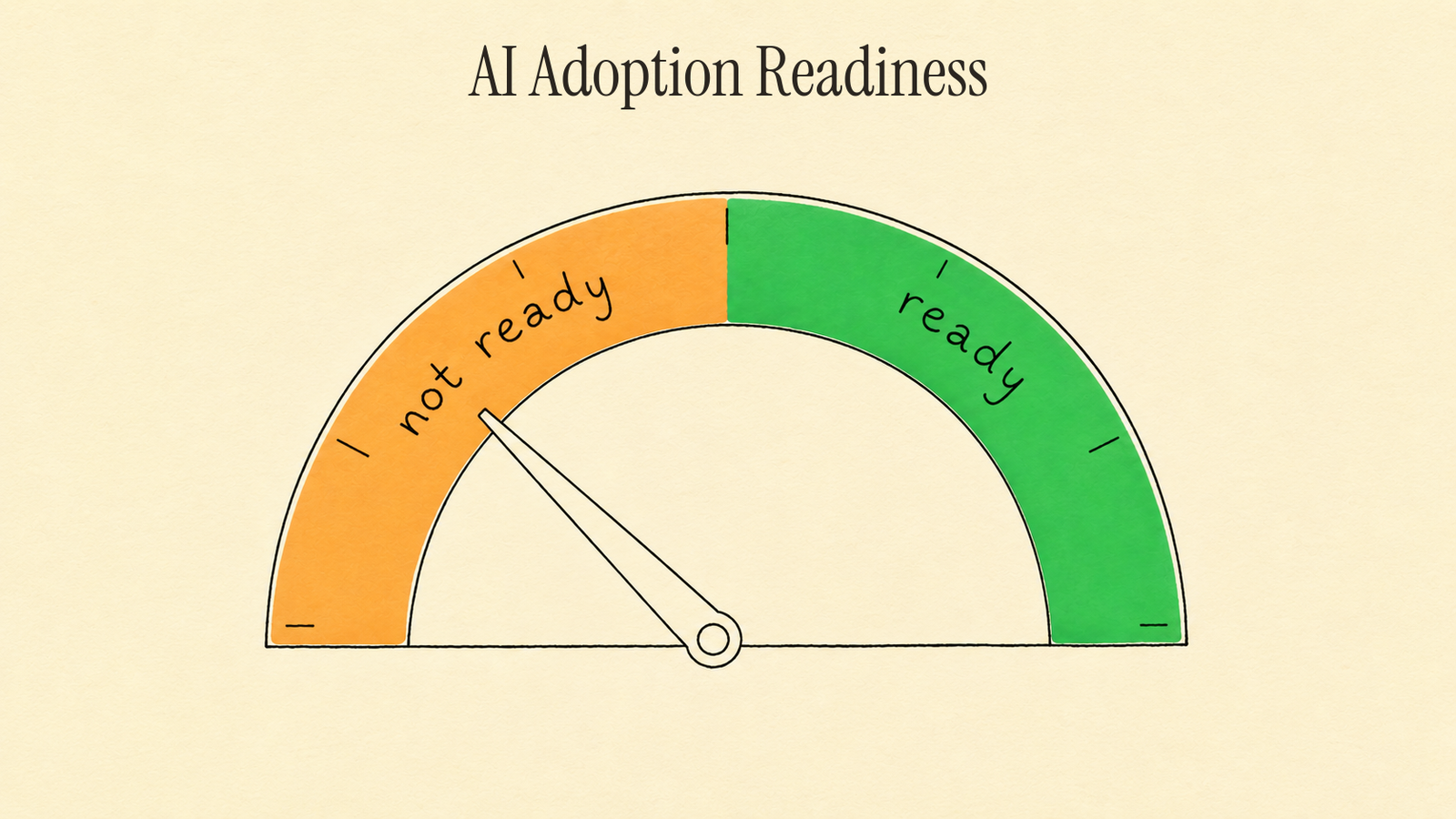
Don't adopt AI if you can't name one measurable problem it would solve, the process you'd automate is broken or undefined, your data is fragmented or ungoverned, you have no real software stack to build on, or you're only doing it because the board asked. In those cases AI amplifies the mess instead of fixing it. Adopting too early wastes more budget than waiting ever will — the smartest move is sometimes "not yet."
Almost everything written about enterprise AI is written to make you adopt it faster. This is the opposite. KORIX founder Shishir Mishra has spent nineteen years building and inheriting software, and the most expensive failures he sees aren't bad models — they're good tools adopted by organizations that weren't ready for them. A pilot greenlit because a competitor announced one. A "data project" with no defined question. An automation built on top of a process nobody had actually mapped. None of those fail because the AI is weak. They fail because the timing was wrong.
So this guide does the unfashionable thing: it tells you when to not buy — including from us. By the end you'll have seven concrete signals that mean "wait," a clear picture of who governed AI genuinely isn't for, and an honest test for whether your own organization is ready. If the answer is "not yet," that's not a failure — it's the cheapest, smartest decision you can make this quarter.
Why "too early" is the real AI failure mode
The headline numbers look like an adoption triumph and a deployment disaster at the same time. Stanford's 2025 AI Index found that 78% of organizations used AI in 2024. Yet MIT's NANDA initiative found only about 5% of custom enterprise AI pilots reach production with meaningful value — a figure corroborated in independent analysis of the 2025 data. And Gartner's estimate of generative-AI projects abandoned after proof-of-concept rose from at least 30% to at least 50% by the end of 2025.
Read those three numbers together and a pattern appears: a huge wave of organizations adopting AI, and the overwhelming majority getting nothing to production. The gap isn't a model-quality problem — the named causes are poor data, weak governance, escalating cost, and unclear value. Every one of those is a readiness problem, not a technology problem. They are what "adopted too early" looks like on a balance sheet. We unpack the mechanics in why AI projects fail and the broader picture in our state of AI adoption data — but the short version is this: the failure usually happened at the decision to start, not during the build.
KORIX defines AI readiness as four preconditions — a defined use case, a stable process, governable data, and clear ownership. When all four are present, AI tends to ship. When two or more are missing, adopting AI doesn't fix the gap — it spends money discovering it. The rest of this article is the honest list of signals that you're missing them.
Seven signals you should NOT adopt AI (yet)
If any two of these describe you, the responsible move is to pause and fix the foundation before you spend a pound or a dollar on a build.
1. You can't name one measurable outcome. "We want to use AI" is not a project; "we want to cut order-to-shipment time from 20 minutes to under 2" is. If you can't state the single, measurable thing AI is supposed to change, there's nothing to scope, nothing to test against, and nothing to know whether it worked. Vague mandates are the most common reason a pilot drifts until a CFO quietly kills it.
2. The process you'd automate is broken or undefined. AI is a force multiplier — it multiplies whatever you point it at, including chaos. Automating a process nobody has actually mapped just makes the breakage faster and harder to spot. If your team can't draw the current process on a whiteboard and agree it's right, automate nothing yet. Map it, fix it manually until it's stable, then — and only then — consider automating the stable version.
3. Your data is fragmented, stale, or ungoverned. The model is rarely the problem; the data feeding it usually is. If your information is scattered across systems that don't talk to each other, or you can't answer "where does this data live and who can see it?", an AI build will stall the moment it meets a real security or compliance review. Data residency and access control are not afterthoughts — if they're unresolved, you're not ready.
4. You don't have a software stack worth building on. The fastest, most durable AI lives inside the tools a team already uses — the principle behind our Bring Your Own Software (BYOS) approach. If you're pre-systems — running the business on spreadsheets and inboxes with no real platform underneath — you need foundations first, not agents. Building AI on top of nothing means building the nothing first, which is a different (and earlier) project.
5. You're adopting for the board, not for a pain. "Everyone else is doing AI" is FOMO, not strategy. Adoption driven by an announcement, a competitor's press release, or a slide that needs an "AI" bullet tends to produce demos that impress in the room and die in production, because no real operational pain was ever anchoring the work. If the honest driver is optics rather than a problem, the honest answer is to wait until there's a problem.
6. You need it live next week. A demo is cheap and fast; production-grade reliability, monitoring, governance, and integration are neither. If your timeline is "by Friday," you're scoping a toy, not a system — and a toy in production is a liability. Real AI work runs in weeks, not a weekend. If the deadline can't move and the scope can't shrink to something genuinely small, don't start.
7. You want a $50 subscription, not a build. Sometimes the honest answer is a cheap off-the-shelf tool, and there's no shame in that. If your need is generic and a SaaS product already solves it well, buying a seat license is smarter than commissioning custom work. Custom, governed AI is worth it when the use case is specific to your business and the data has to stay in your systems — not when an existing tool would do.
When AI IS the right call
This isn't an argument against AI — it's an argument against adopting it blind. The flip side of the seven signals is a clear green light. AI is the right call when you can name one specific, measurable outcome; when the process behind it is defined and stable enough to automate; when your data lives in systems you can govern; and when you're willing to own the result rather than rent it forever. When those four line up, the same research that looks grim in aggregate flips in your favour — the organizations that ship are the ones that started ready. The discipline of governed AI implementation exists precisely to keep those four conditions intact from day one.
How to get ready — the path from "not yet" to "go"
"Not yet" is a plan, not a dead end. If the signals above describe you, here is the sequence that turns a no into a yes — and notably, none of the first three steps require buying any AI at all.
Step one: pick one measurable outcome. Not "adopt AI" — one number you want to move, owned by one person, with a baseline you can measure today. The narrower the better. A single shipped use case teaches you more than a sprawling strategy, and it gives every later decision something concrete to be judged against.
Step two: map and stabilise the process by hand. Before any automation, draw the current process end to end and fix it manually until it's boring and repeatable. This is unglamorous and it is where most of the real value hides — McKinsey's State of AI research repeatedly finds that the organizations capturing value from AI are the ones that redesigned the underlying workflow, not the ones that bolted a model onto an old one. A stable manual process is the thing AI then makes fast; an unstable one is the thing AI makes fast and wrong.
Step three: consolidate and govern the data. Get the relevant data into systems that talk to each other, and answer the two governance questions up front — where does it live, and who can see it. If you can't answer those, you're not ready to point a model at it. This step alone often surfaces problems worth fixing regardless of whether AI ever enters the picture.
Step four: decide ownership. Will you own the result — the code, the models, the documentation — or rent it forever from a vendor? Deciding this before you build keeps you out of the lock-in trap and shapes which delivery route makes sense. Once those four are in place, you've moved from the bottom of the decision matrix to the top, and the odds that you become part of the 5% that ships rise sharply.
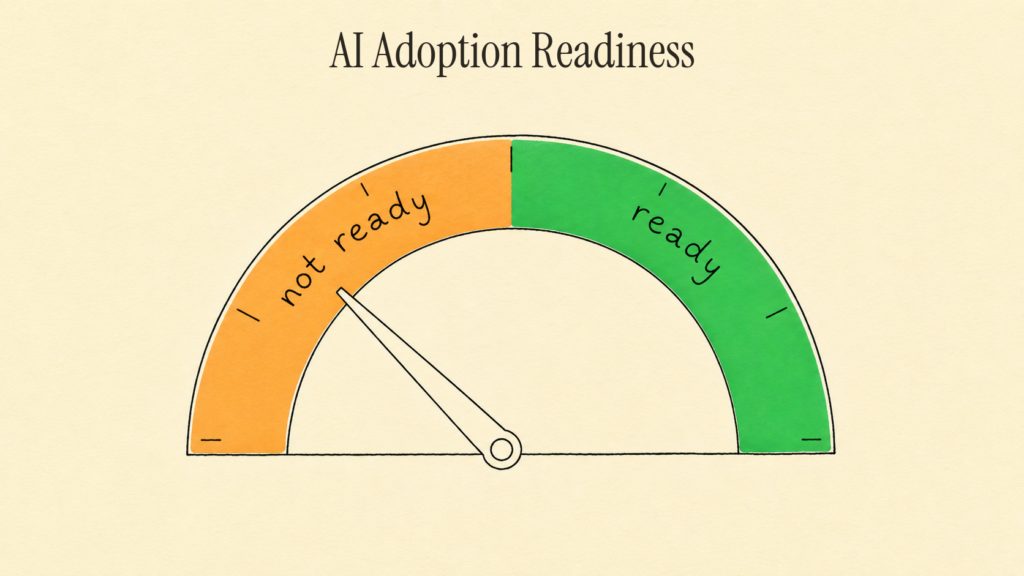
Adopt now, fix first, or don't: a decision matrix
Map your honest answers against this. Most organizations are in the middle column — and the middle column's correct action is "fix the foundation," not "buy AI."
| Your situation | Verdict | The honest next step |
|---|---|---|
| Clear use case · stable process · governable data · willing to own it | Adopt now | Scope one use case to a fixed, short production timeline |
| Real pain, but messy process or scattered data | Fix first, then adopt | Map and stabilise the process + consolidate data before any build |
| No defined use case · adopting for the board | Don't adopt yet | Find one measurable problem worth solving first |
| Pre-systems (no real software stack) | Don't adopt yet | Build the foundational systems before any agent |
| Generic need a SaaS tool already solves | Don't build | Buy the off-the-shelf subscription — it's the cheaper, honest answer |
Want a Realistic Plan for Your Project?
No sales pitch. We will give you an honest read on what your situation actually needs, what it should cost, and whether AI is even the right tool here.
Book a Discovery Call →Who governed AI specifically isn't for
Even among companies that are technically "ready," governed, custom AI — the kind KORIX builds — isn't always the right shape. It isn't for teams who want a permanent in-house capability more than a shipped system; if AI is your core product for years, you should hire and own the team, a trade-off we lay out in AI agency vs in-house vs consultancy. It isn't for buyers who need a big-brand consultancy's process and cover for a board or regulator. And it isn't for anyone who wants AI without governing the data that feeds it — that's the one precondition we won't compromise on, because ungoverned AI is how the failures in this article happen. Naming who we're not for is not modesty; it's how you can trust what we say about who we are for. The same honesty runs through our production AI agents and the 21-day pilot.
The real cost of adopting too early
Waiting feels like falling behind. Adopting into chaos is far more expensive. When you start before you're ready, you pay to discover what you could have known for free: that the data wasn't clean, the process wasn't defined, or no one owned the outcome. The pilot stalls, the budget burns, and the organization draws the worst possible conclusion — "AI doesn't work for us" — when the real issue was timing. That false conclusion is the most expensive part, because it poisons the next, better-timed attempt and makes it harder to fund. A KORIX engagement runs $15,000–$40,000 when the conditions are right; spent before they're right, that same money buys a stalled pilot and a demoralised team. The cheapest project is the one you correctly chose not to start.
Picture the common version of this. A mid-market firm sees a competitor announce an "AI assistant," so the leadership team greenlights one of their own with a quarter's budget and a vague brief to "use AI in operations." There's no single metric, the order data lives in three disconnected systems, and the process it's meant to support has never been written down. Four months later there's an impressive demo that works in a sandbox and falls over the moment it touches real, messy data and a security review. The budget is gone, the team is deflated, and the lesson the board takes away is "AI isn't ready for us." Every expensive part of that story was avoidable — not by buying a better model, but by waiting until there was a defined outcome, clean data, and a mapped process. The technology was never the bottleneck.
Waiting is not the same as falling behind
The fear that powers premature adoption is that waiting means losing. It doesn't. The companies winning with AI aren't the ones who adopted earliest — they're the ones who adopted readiest. A competitor who shipped a flashy pilot that quietly died is not ahead of you; they're behind, with a burned budget and an organization newly sceptical of AI. Meanwhile the months you spend getting ready — defining the use case, fixing the process, governing the data — are not idle. They produce value on their own: a cleaner process and consolidated, governed data are assets whether or not AI ever arrives. So "wait" is rarely "do nothing." It's "do the foundational work that makes the eventual build succeed, and that pays off even if it doesn't." The genuinely behind companies are the ones who skip that work twice — once by adopting too early and failing, and again by having to rebuild trust before they can try properly. Patience, here, is a competitive advantage disguised as caution.
How we apply this — including turning work away
We hold ourselves to this on the first call. When a prospect fails the readiness test, we say so — even when they're ready to pay — because a stalled build costs them money and costs us a reference we'd never get. The projects that did ship were the ones that started ready: Proteinverse, a 5-star Clutch engagement with Lucky Valecha, began with a sharp, measurable goal (cut order-to-shipment time, which dropped from 15–20 minutes to under 90 seconds) and a real stack to build on. Numerology Matrix, a 5-star Clutch project for Anna Mazurowska, had one clear use case and shipped to production by day 18. In both cases the readiness came first and the AI came second — which is the whole point. If you want a candid read on whether you're in the 5% or the 95%, that's a conversation we'll have honestly.
So before you greenlight anything, run the four-question readiness test on your own situation, and be honest about the answers. If they're clean, you're a strong candidate and the next step is scoping one use case to a real production timeline. If two or more are shaky, the smartest, cheapest decision you can make this quarter is to fix the foundation first — or to decide, with full confidence, that the answer for now is simply "not yet." Either way you'll have made the call on evidence instead of FOMO, which is more than most of the 95% can say. Talk to us if you'd like a second opinion on which it is.
The smartest AI decision is sometimes not yet
AI fails far more often from being adopted too early than from being adopted too late. If you don't have a real use case, a clean stack to build on, a process worth automating, and the will to govern the data, the honest move is to fix those first — or not adopt at all. Waiting costs you nothing; adopting into chaos costs you the budget and the credibility.
Getting started with AI: the full series
This article is part of our Getting started with AI series. The pillar guide covers the whole topic; the others each go deeper on one part.
- Pillar guideThe 21-day AI pilot explainedStart here: one governed AI use case in production in three weeks, week by week.
- 7 signs your business is ready for AIThe signs you are set up to adopt AI, and the red flags that mean wait.
- AI readiness assessmentScore your data, processes, team and goals, and see the gaps to close first.
- Preparing your data for AIWhat your business data needs before any AI project can use it.
- Why AI projects failUnclear goals, poor data, no ownership and weak governance, and how to avoid each.
- Why most AI pilots never reach productionThe industry numbers on stalled pilots, and the decisions that change the outcome.
- AI workflow automation for service businessesWhich workflows to automate first, with real tool comparisons.
Continue learning —
go deeper.
When should a company NOT adopt AI?
Don't adopt AI if you can't name one measurable problem it would solve, if the process you'd automate is broken or undefined, if your data is fragmented or ungoverned, if you lack a software stack worth building on, or if you're doing it for the board rather than a real pain. In those cases AI amplifies the underlying mess instead of fixing it. The honest sequence is: fix the foundation first, then automate — or don't automate at all.
Is it ever too early to adopt AI?
Yes, and too-early is the more common failure. MIT's NANDA initiative found only about 5% of enterprise AI pilots reach production with real value, and Gartner expects up to half of generative-AI projects to be abandoned after proof-of-concept. The named causes — poor data, weak governance, unclear value — are signs of adopting before the organization was ready. Waiting until you have a clear use case and a clean foundation dramatically improves your odds.
Who is governed, custom AI NOT for?
It isn't for pre-systems teams who don't yet run a real software stack — they need foundations first, not agents. It isn't for companies that only want a cheap off-the-shelf subscription rather than a custom build. It isn't for anyone who needs something live next week, since production-grade AI takes weeks. And it isn't for organizations unwilling to govern their data properly. For those situations, a SaaS tool, more time, or no AI at all is the honest answer.
What happens if you adopt AI too early?
You spend real money proving what you could have known for free: that the data wasn't ready, the process wasn't defined, or no one owned the outcome. The pilot stalls in the gap between a working demo and a governed, deployed system, the budget runs out, and the organization concludes 'AI doesn't work for us' — when the real problem was timing and foundations. Early failure also burns internal credibility, making the next, better-timed attempt harder to fund.
Should I automate a process before fixing it?
No. Automating a broken or undefined process just makes the breakage faster and harder to see. AI is a force multiplier — it multiplies whatever it's pointed at, including chaos. Map and fix the process manually until it's stable and measurable, then automate the stable version. KORIX often tells prospects to do exactly this before any build, even when it means a smaller or later engagement.
How do I know if my company IS ready for AI?
You're likely ready when you can answer four questions cleanly: there's one specific, measurable outcome you want; the process behind it is defined and stable; your data lives in systems you can govern; and you own — or are willing to own — the result rather than rent it forever. Four clear answers and you're a strong candidate. Two or more shaky answers and the honest move is to fix the foundation before you build.