
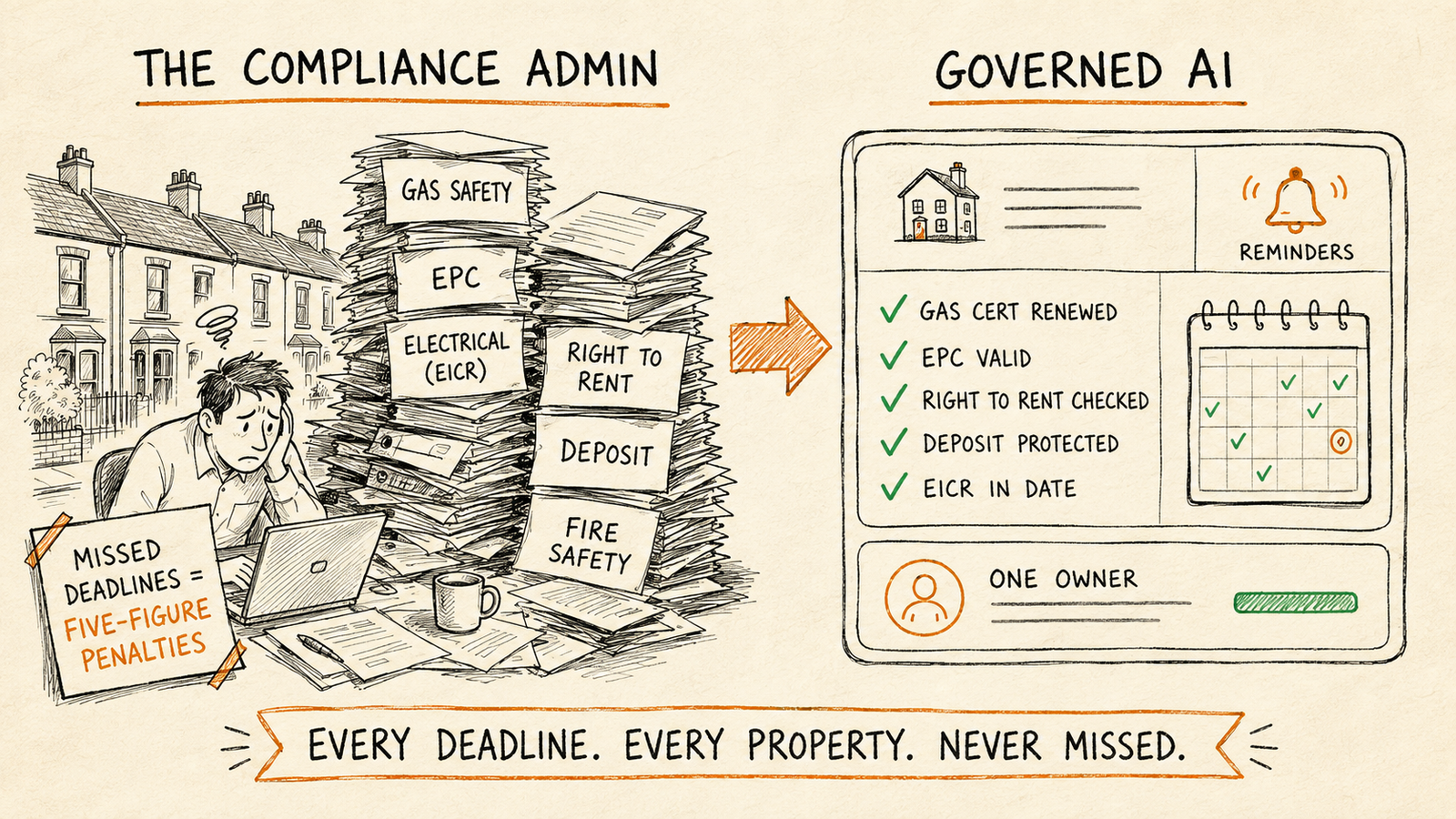
A letting agent isn't in the property business. They're in the deadline business. Every tenancy carries a stack of legal safety checks, each with its own clock and its own five-figure penalty: gas safety (up to £6,000), electrical checks (up to £40,000), deposit protection within 30 days (one to three times the deposit), and Right to Rent (up to £10,000 per occupier). Miss one and it's not admin anymore. It's a fine.
I'm Shishir Mishra, and I meet a lot of agents who are quietly drowning, and it's almost never the lettings that's hard, it's the compliance. Professional agents manage a huge share of England's 4.7-million-household private rented sector, plus millions of leasehold flats, and every one of those homes carries the same non-negotiable calendar of certificates and deadlines. When a portfolio grows faster than the admin behind it, something slips. And in this sector, "something slips" has a statutory price tag.
This article puts the real load on paper, the official deadlines and penalties, where the time and money actually leak, and the three ways agents run the compliance-and-chasing job. Only one of them is safe in a sector whose entire value is evidencing that you did the right thing on time.
The deadline maze every agent has to track
This is the part outsiders underestimate. For each tenancy and block, an agent is on the hook for a rolling set of legal requirements, each with an official penalty for missing it:
| Requirement | Clock | Penalty for missing (official maximum) |
|---|---|---|
| Gas safety check + CP12 to tenant | Annual; cert within 28 days | Up to £6,000 per breach (HSE); unlimited fine on conviction |
| Electrical safety (EICR) | At least every 5 years | Up to £40,000 (raised from £30,000, Nov 2025) |
| Deposit protection + prescribed info | Within 30 days | 1–3× the deposit, by court order |
| Right to Rent checks | Per occupier | Up to £10,000 (£20,000 repeat) |
| Fire risk assessment (block communal areas) | Ongoing, recorded | Fire-safety enforcement action |
None of these are optional, and none forgive a busy week. The HSE sets the gas-safety maximum at up to £6,000 per breach, with an unlimited fine and up to six months' imprisonment on conviction; electrical (EICR) breaches now carry up to £40,000 under gov.uk regulations, raised from £30,000 in November 2025. This is exactly why, in one industry survey, 29% of landlords now name compliance as the main reason they use an agent at all, the value you sell is not missing these.
And the rules just got heavier
The Renters' Rights Act 2025 adds a new layer: landlords and every property must register on a new Private Rented Sector Database (regional rollout from late 2026), a Decent Homes Standard applies to the private rented sector for the first time, and a mandatory PRS Landlord Ombudsman is coming. Every one of those is more to track, evidence and keep current, on top of the calendar above.
The professional bodies see the same pressure. Timothy Douglas, Head of Policy and Campaigns at Propertymark, puts the sector's case plainly: "Our members work hard every day to provide safe, well-managed homes. We need mandatory regulation to ensure everyone in the sector meets the same high standards." Higher standards mean more evidence, and evidence is exactly what a stretched back office struggles to produce on demand.
Enforcement is sharpening at the same time. Local authorities can keep the civil penalties they levy for compliance breaches, which gives councils a direct incentive to check, and, with the electrical maximum now at £40,000, a single missed report is worth pursuing. So the risk isn't just theoretical exposure on a spreadsheet; it's a better-resourced enforcement side actively looking for the certificate you didn't get to. For a growing agency, the question stops being "will anyone notice?" and becomes "can we prove, on demand, that every deadline was met?"
Where the time and money actually leak
Two places, on top of compliance itself:
- Arrears. In industry data, 17% of tenancies ended with more than five weeks' rent unpaid, and the average arrears claim rose 27% year on year to £1,816. Chasing arrears reliably is the difference between a phone call and a court claim.
- Maintenance. When repairs drag, tenants notice, in the official English Housing Survey, 35% of renters who were unhappy with repairs blamed the landlord being slow to act. Slow maintenance triage is a retention and reputation cost, not just an admin one.
And the admin itself is spilling into people's lives. In one 2026 industry survey, 46% of agents said they regularly do admin in the evenings and 25% at weekends, roughly eight hours a week lost to tasks that could be automated. Another survey found 55% of property professionals never use PropTech at all, and half feel the available tools don't fix their real daily problems. The sector is under-digitised precisely where the risk is highest. (These are survey figures, not official statistics, but the direction of travel is hard to miss.)
The pattern will feel familiar if you've read our companion piece on insurance broker renewal leakage: in both trades, the money doesn't leak on the deal. It leaks on the follow-up nobody had time for.
Want an honest read on your compliance and admin load? No pitch, we'll tell you where the real risk and lost hours sit. Book a discovery call.
Three ways to run the compliance-and-chasing load
Most agencies are doing one of these three things. They cost very differently, not in software price, but in fines risked and hours lost.
| Cost line | Manual (spreadsheets + reminders) | Generic AI tool | Governed AI agent |
|---|---|---|---|
| Deadline coverage | Relies on memory, things slip | Partial, unsupervised | Complete, every certificate + deadline |
| Handler time | High | Medium | Low |
| Judgement on exceptions | Human, but stretched | Automated, opaque | Human-in-the-loop by design |
| Audit trail (evidence you complied) | Patchy | Weak / black-box | Full, timestamped, defensible |
| Risk when something's missed | Five-figure fine | Missed and no clear record | Flagged early, logged either way |
| Time to live | , | Weeks to months | ~2 weeks |
Want a Realistic Plan for Your Project?
No sales pitch. We will give you an honest read on what your situation actually needs, what it should cost, and whether AI is even the right tool here.
Book a Discovery Call →Why a governed agent, not a generic tool

That audit trail matters more in lettings than in most sectors. When a tenant, a council, or a redress scheme asks who checked what and when, a governed agent shows the timestamped record instead of a scramble through inboxes. A generic reminder tool logs that it pinged you; it cannot prove the obligation was actually met, by whom, and against which property.
In a sector where the whole job is evidencing that you did the right thing on time, an opaque tool that quietly acts on your book is the wrong answer. KORIX defines a governed compliance agent as one that runs the deadline calendar and the chasing inside the systems you already use, escalates every judgement call to a person, and logs each action so the evidence exists before anyone asks for it. In practice that means a governed agent that plugs into your existing stack (Reapit, Fixflo, Arthur), watches the compliance calendar and the maintenance and arrears chasing, and escalates the exceptions, so when a landlord, tenant or regulator asks "was this done?", the answer is one timestamped record away.
That's the difference between automation that optimises for "did it send" and governance that optimises for "can you prove it, and did a human decide the close calls." The full build-versus-buy reasoning is in our build vs buy AI agents guide, and the money view is in what an AI agent costs; the deployment model itself is our agent deployment as a service.
Who this isn't for: if your compliance admin is already tight, every certificate tracked, every deadline hit, every action recorded. You don't have a leakage problem and you don't need an agent. Buy nothing. This is for agencies whose portfolio has outgrown the back office, where a missed EICR or gas cert is a matter of when, not if, and nobody can currently say how exposed they are.
Not sure where your agency sits? Take the 2-minute AI readiness assessment.
How to size your own exposure
- Count the recurring deadlines per unit, gas, electrical, EPC, deposit, Right to Rent, and per-block fire risk assessments, then multiply by your portfolio. That's your monthly deadline volume, and it's usually bigger than anyone guesses.
- Ask who owns each one, and what happens when they're off sick. Key-person risk is the quiet danger, the calendar that lives in one person's head.
- Add the arrears and maintenance chases you don't get to. Those are lost money and lost tenants, not just lost hours.
- Cost the fix against the exposure, not the software. One missed EICR or gas cert can dwarf a year of getting the chase right. If reliable tracking prevents even one five-figure penalty, the comparison isn't close, and if your admin is already watertight, the honest answer is to leave it alone.
Run those four lines and you'll have a defensible figure for what your compliance load is really costing you, in fines risked and hours lost, and a clear read on whether governing the calendar is worth it. Either way, you'll be deciding on numbers instead of a feeling. The penalty figures above are official maximums; the arrears, admin-hours and PropTech-adoption numbers are industry surveys, flagged as such; and any per-portfolio £ arithmetic you build from them is illustrative, re-run it with your agency's real deadline volume before acting.
Agents don't get fined for bad lettings. They get fined for missed deadlines. Fix the calendar, not the software.
Gas, electrical, deposit, Right to Rent and fire-safety checks each carry their own clock and their own five-figure penalty, and the Renters' Rights Act adds more to track and evidence. The reliable fix isn't another portal or a six-month project. It's a governed agent that runs the compliance calendar and the chasing, keeps a human on the judgement calls, and logs everything so you can always prove you complied. Size your exposure from real deadline volume, then fix the chase, not the software.
Continue learning —
go deeper.
What compliance does a UK letting agent have to track for each property?
At minimum: an annual gas safety check (CP12), an electrical safety report (EICR) at least every five years, an EPC, deposit protection with prescribed information inside 30 days, Right to Rent checks, and, for blocks, a recorded fire risk assessment. Each has its own deadline and its own penalty for missing it.
What are the penalties for missing property compliance deadlines?
They're serious and official: up to £6,000 per breach for gas safety, up to £40,000 for electrical safety breaches (raised from £30,000 in November 2025), one to three times the deposit for deposit-protection failures, and up to £10,000 per occupier (£20,000 for repeat breaches) for Right to Rent. These are official maximums, and local authorities increasingly keep the fines they levy.
What does the Renters' Rights Act change for letting agents?
It adds a mandatory Private Rented Sector Database registration for landlords and properties (regional rollout from late 2026), applies a Decent Homes Standard to the private rented sector, and introduces a mandatory PRS Landlord Ombudsman, all more to track, evidence and keep current on top of the existing safety calendar.
Can AI handle property compliance without creating risk?
Yes, if it's governed. A governed agent tracks the deadlines and does the chasing, but keeps a human on judgement calls and logs every action, so you always have a timestamped record that you complied, unlike an opaque tool that acts unsupervised.
Does it work inside Reapit, Fixflo or Arthur?
Yes, a governed agent runs inside the property software you already use rather than asking you to move your process onto another platform.