
AI governance is the rulebook. Governed AI is the system that enforces the rulebook at runtime. Governance is the policies, standards, roles, and oversight that decide how AI should be built and used in your organisation. Governed AI is an AI system engineered so those rules are actually applied on every request — observable, auditable, human-supervised, rollback-ready, and owned by your team. Most enterprises have written the first. Far fewer have built the second. That gap is where AI projects quietly go wrong.
These two terms get used interchangeably, and that confusion is expensive — because they solve different problems, are owned by different people, and fail in different ways. This guide draws the line clearly, shows where each one lives, and explains why you need both.
What is AI governance?
AI governance is the system of policies, standards, and oversight that ensures AI is developed and deployed safely, ethically, and in line with the law. It answers the question: "What are our rules for AI?"
It lives in documents, committees, and frameworks. The most referenced are:
- The NIST AI Risk Management Framework (AI RMF) — a voluntary framework from the U.S. National Institute of Standards and Technology for identifying and managing AI risk across its lifecycle.
- ISO/IEC 42001 — the international standard for an AI management system, the AI equivalent of ISO 27001 for information security.
- The EU AI Act — binding European regulation that classifies AI systems by risk level and sets obligations accordingly.
"A governance policy tells you what the AI is supposed to do. Governed AI is the part that makes sure it actually does it — on every request, in production, where it counts. Most teams have the first and assume it covers the second. It doesn't."
— Shishir Mishra, Founder & Systems Architect (AI), KORIX
AI governance is essential. But notice what it is: a set of intentions and rules. A framework does not run in production. A policy does not check a model's output at 2am. That enforcement is a separate job.
What is governed AI?
Governed AI systems are AI systems that are observable, auditable, human-supervised, rollback-ready, and owned by your team. It answers a different question: "Is the AI actually following the rules — right now, on this request?"
Where governance is a rulebook, governed AI is the operating layer that enforces the rulebook at runtime. Before a governed AI system acts, it checks organisational rules, roles, and permissions. As it acts, it logs what it did so the action is traceable. On sensitive steps, it keeps a human in the loop. And if something goes wrong, it can be paused or rolled back. The model is the same; the controls wrapped around it are what make it governed. (For the full breakdown, see what governed AI actually means.)
The core difference, in one table
| Dimension | AI Governance | Governed AI |
|---|---|---|
| What it is | Policies, standards, oversight — the rulebook | AI systems that enforce the rules at runtime — the operating layer |
| When it acts | Design-time: review, audit, approval cycles | Runtime: on every request and response |
| Form | Documents, committees, frameworks (NIST AI RMF, ISO 42001, EU AI Act) | Software: guardrails, logging, access control, human-in-the-loop, rollback |
| Owned by | Risk, legal, compliance, leadership | Your engineering team (built into the system) |
| Answers | "What are our rules for AI?" | "Is the AI obeying the rules, right now?" |
| Failure mode | Policy exists, nothing enforces it in production | Enforcement exists but isn't aligned to real policy |
| Output | Approvals, audit trails, risk registers | Observable, auditable, reversible AI behaviour in production |
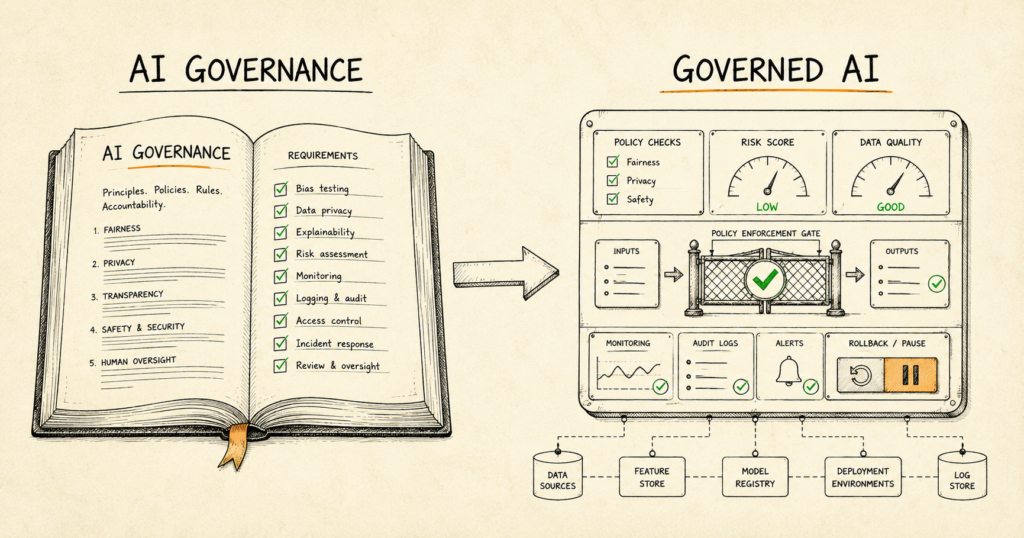
Why the distinction matters
Here is the failure that this confusion causes: an organisation invests in AI governance — a steering committee, a policy, an alignment to the NIST AI RMF — and then ships an AI feature to production that none of those rules touch. The policy says "AI must be auditable and human-supervised." The live system logs nothing, asks no one, and can't be rolled back. On paper, the company is governed. In production, the AI is doing whatever it wants.
In practice, a great deal of enterprise AI never reaches dependable production: the model works in a demo, then stalls because nothing makes it accountable at runtime. KORIX's answer is to make delivery accountable by default. On the Proteinverse build, shipment time fell from 15–20 minutes to under 90 seconds — a 90%+ reduction — 221 products went live across 40+ brands, the launch scored 91/100 on mobile Lighthouse, and 24 security issues were found and fixed before go-live. Every one of those outcomes is traceable. That is what "governed" looks like in practice: not a promise in a policy, but a result you can audit.
"Everything that was promised was delivered."
— Lucky Valecha, Proteinverse (verified 5★ Clutch review) — the operator's real test of a governed, accountable build: it does exactly what was specified, in production.
Governance without governed AI is a document nobody can enforce. Governed AI without governance is enforcement pointed at the wrong rules. The two only work as a pair: governance defines what "good" means, and governed AI makes the software actually behave that way, every time.
Want a Realistic Plan for Your Project?
No sales pitch. We will give you an honest read on what your situation actually needs, what it should cost, and whether AI is even the right tool here.
Book a Discovery Call →The 5 pillars of a governed AI system
KORIX builds governed AI on five enforceable properties — the runtime counterpart to a governance policy:
- Observable — you can see what the AI did, when, and why.
- Auditable — every action leaves a traceable record a reviewer can follow.
- Human-supervised — a person stays in the loop on the decisions that matter.
- Rollback-ready — if the AI gets it wrong, you can pause or reverse it.
- Owned by your team — the controls live in your stack, not a black box you rent.
A governance framework will tell you these properties matter. A governed AI system is what makes them true in production. This is the philosophy behind Bring Your Own Software (BYOS) — building governed AI inside the stack you already own.
How they work together
Think of it like financial controls. AI governance is the accounting policy — the rules for how money should be handled. Governed AI is the accounting system — the software that enforces those rules on every transaction, logs them, and flags exceptions. No serious company would write an accounting policy and then run the business with no ledger. Yet that is exactly what "governance-only" AI adoption does.
The sequence that works: governance sets the rules and risk thresholds → governed AI enforces them at runtime → the audit trail from production feeds back into governance, so the rules improve from real evidence. That loop is how AI adoption becomes durable instead of a one-off pilot that stalls.
Where to start
If you already have an AI governance policy, the missing half is almost always governed AI in production. If you have neither, start with the governance rules that matter most for your risk profile, then build the enforcement in. Either way, the goal is the same: AI you can see, check, supervise, and reverse — owned by your team. The fastest route is a focused, time-boxed build — which is exactly what the 21-day AI pilot and governed AI implementation are designed for.
KORIX defines governed AI as AI systems that are observable, auditable, human-supervised, rollback-ready, and owned by your team — the operating layer that turns an AI governance policy from a document into something your software actually obeys.
Wondering whether all this needs a dedicated executive? See our honest take on whether you actually need to hire a Head of AI Governance — or whether governed deployment gets you there without the six-figure role.
AI governance is the rulebook. Governed AI is how you actually live by it in production.
Most enterprises write an AI governance policy and still ship AI that nothing enforces at runtime. Governance defines the rules; governed AI is the operating layer that observes, checks, and can reverse what the AI does on every request. You need both — and the second is the one most teams are missing.
Continue learning —
go deeper.
Is governed AI the same as AI governance?
No. AI governance is the set of policies, standards, and oversight that define how AI should be built and used — the rulebook. Governed AI is an AI system engineered so those rules are enforced at runtime: it's observable, auditable, human-supervised, rollback-ready, and owned by your team. Governance is the rules; governed AI is the system that follows them on every request.
What is governed AI?
Governed AI systems are AI systems that are observable, auditable, human-supervised, rollback-ready, and owned by your team. Rather than producing answers purely on probability, a governed AI system checks organisational rules, roles, and access before it acts, logs what it did, and can be paused or rolled back — so AI behaviour in production stays safe, accountable, and traceable.
Is AI governance enough on its own?
No. A governance policy doesn't enforce itself. You can have a thorough AI governance framework on paper and still run AI in production that nothing checks, logs, or constrains at runtime. The policy describes the rules; governed AI is what makes the rules real on every live interaction. Governance without governed AI is a document; governed AI without governance is unguided.
Do I need both AI governance and governed AI?
Yes. They are two halves of one system. AI governance (often guided by frameworks like the NIST AI Risk Management Framework, ISO/IEC 42001, or the EU AI Act) sets the rules, roles, and risk thresholds. Governed AI is the engineering that enforces those rules at runtime. One without the other leaves a gap: rules nobody enforces, or enforcement that isn't aligned to your actual policy.
What standards and frameworks cover AI governance?
The most referenced are the NIST AI Risk Management Framework (a voluntary U.S. framework for managing AI risk), ISO/IEC 42001 (the international standard for an AI management system), and the EU AI Act (binding EU regulation that classifies AI by risk). These define the governance layer — the rules and oversight. They do not, on their own, make your live AI systems enforce those rules; that is what governed AI adds.
How is governed AI different from a normal AI chatbot or enterprise search?
A standard chatbot or enterprise search tool answers based on probability and whatever it can retrieve. A governed AI system enforces your organisation's rules, roles, and permissions before it generates a response, records what it did for audit, keeps a human in the loop on sensitive actions, and can be rolled back. The difference isn't the model — it's the controls wrapped around it in production.
Who owns governed AI inside a company?
Governance is usually owned by risk, legal, compliance, and leadership — they set the rules. Governed AI is built and owned by your engineering team, because enforcement lives in the system itself: the logging, guardrails, access checks, human-in-the-loop steps, and rollback. The two groups work together — one writes the rules, the other makes the software obey them.