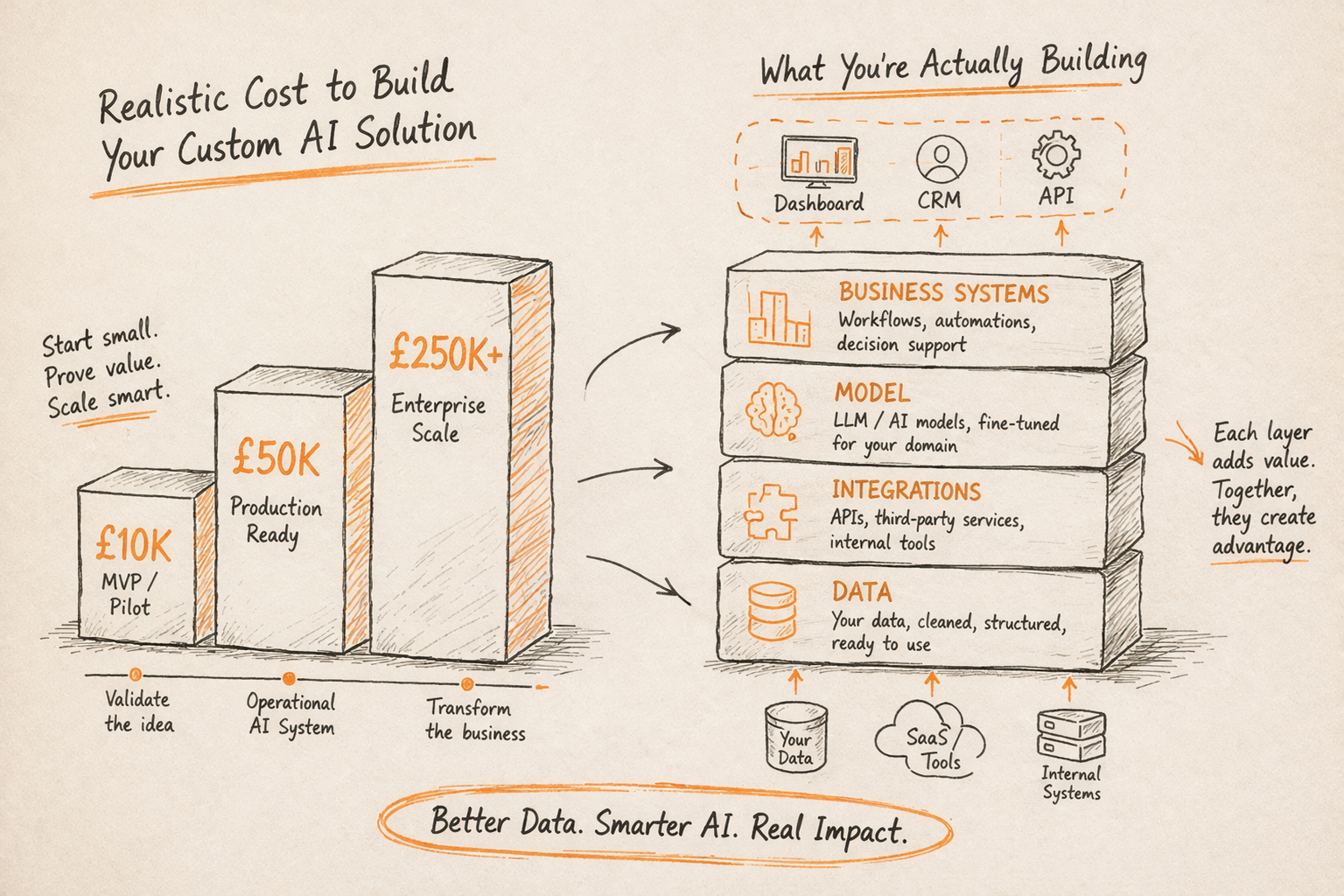
How much does AI implementation cost? AI implementation typically costs between $12K–$300K+ (USD) in 2026: roughly $12K–$40K for a simple automation, $40K–$100K for a mid-complexity system, and $100K–$300K+ for a full enterprise platform — plus 15–25% of the build cost per year to keep it running.
Simple automations like document classification or a basic chatbot sit at the low end; full platforms with governance, compliance layers, and multi-system orchestration sit at the top. These figures cover development only. Prices are shown in USD and localise automatically to GBP, EUR, INR, AED and AUD based on your location.
Those ranges are wide for a reason. The honest answer is that no two AI projects cost the same, because no two businesses have the same data, the same systems, or the same definition of “good enough.” Below, I’ll break down exactly what drives the price up or down so you can budget with confidence—whether you work with us or someone else entirely.
The run cost is the real cost. Budget 15–25% of the build, every year, to keep the system governed, monitored and current. It is the line clients most often leave out, and the one that decides whether the AI is still trustworthy in year two.
Trust, not the model, is why pilots die. The most common reason a mid-market pilot never reaches production is not the technology. It is that the business will not put an unaudited, unsupervised AI into a real workflow. Build governance and human oversight in from day one, or the cheapest pilot still costs 100%, because it never ships.
Why Custom AI Costs $12K–$300K, Not One Number
When someone asks “how much does AI cost?” it’s a bit like asking “how much does a house cost?” A studio apartment and a five-bedroom family home are both “houses,” but they’re not in the same universe financially.
AI projects work the same way. A straightforward document processing tool that extracts data from invoices is a fundamentally different build from a real-time fraud detection system that processes millions of transactions across multiple data sources. The technology stack, data engineering, testing rigour, compliance requirements, and integration complexity are all different.
The ranges I’ve shared above come from 19 years of building software and AI systems across multiple industries—finance, healthcare, logistics, real estate. They reflect what projects actually cost to build properly, not what sounds good in a sales pitch.
The 7 Factors That Determine Your Cost
Every AI project’s price is driven by the same core variables. Understanding these gives you the vocabulary to evaluate any quote you receive—from any vendor. It also helps you weigh the per-seat, per-use, and outcome-based pricing models a quote is built on.
1. Data Complexity
This is the single biggest cost driver, and the one most buyers underestimate. If your data is already clean, structured, and accessible through modern APIs, your project will cost significantly less. If your data lives in PDFs, scanned images, legacy databases, or spreadsheets emailed between departments—expect data preparation to consume 40–60% of the total project budget.
That’s not a mark-up. Data engineering is genuinely difficult work. A model trained on messy data produces messy results, so this step cannot be shortcut without undermining everything that follows. Independent surveys echo what we see on every project: in Anaconda’s annual State of Data Science survey, data professionals consistently report spending roughly 38–45% of their working time just on data preparation and cleaning—before any modelling begins.
2. Integration Requirements
A standalone AI tool that takes input and returns output is relatively straightforward. The moment you need it to connect with your CRM, ERP, email system, document management platform, and accounting software, complexity multiplies. Each integration adds $2.5K–$12K+ depending on the quality of the target system’s API documentation and whether it even has an API at all.
Legacy system integrations—think SAP, older Oracle deployments, or custom-built internal tools—are typically 3–5x more expensive than connecting to modern cloud platforms like Salesforce or HubSpot.
3. Model Complexity
Not all AI is created equal. Using a pre-trained foundation model (like GPT-4 or Claude) through an API with some prompt engineering is the cheapest approach—often adequate for summarisation, classification, and basic extraction tasks. Fine-tuning a model on your specific data costs more but delivers better accuracy for domain-specific tasks. Training a fully custom model from scratch is the most expensive option and is only justified when off-the-shelf models genuinely cannot handle your use case.
The gap is widening in the buyer’s favour. Stanford HAI’s 2025 AI Index found the inference cost of GPT-3.5-level performance fell from roughly $20 to $0.07 per million tokens between late 2022 and late 2024—close to a 280-fold drop in two years. For the large majority of business use cases, a well-engineered system on a foundation-model API is now both the cheapest and the fastest route. Paying to train a bespoke model rarely earns its keep unless you have data and a use case that genuinely demand it.
Many businesses assume they need a custom-trained model when a well-engineered system using existing foundation models would deliver better results at a fraction of the cost. A good AI partner will tell you when the simpler approach is the right one.
4. Compliance and Governance Needs
If you operate in a regulated industry—healthcare (HIPAA), financial services (FCA), or any sector handling sensitive personal data (GDPR)—your AI system needs audit trails, explainability features, data residency controls, and often human-in-the-loop approval workflows. This adds 20–40% to the total build cost. It’s not optional, and any vendor who quotes you a regulated AI system without factoring in compliance is either inexperienced or cutting corners you’ll pay for later.
At KORIX, governed AI is our focus area precisely because this is where the stakes are highest and the margin for error is smallest.
5. Human-in-the-Loop Requirements
Fully autonomous AI systems that make decisions without any human oversight are cheaper to build but carry higher risk. Systems that route certain decisions to human reviewers—based on confidence thresholds, edge cases, or regulatory requirements—require more sophisticated workflow design. This is especially important in finance and healthcare where an incorrect automated decision can have serious consequences.
6. Performance and Scale Requirements
Processing 100 documents per day requires very different infrastructure than processing 100,000. Real-time systems that need sub-second response times cost more than batch-processing systems that can run overnight. Be honest about your actual scale requirements—overbuilding for scale you don’t need is one of the most common ways AI budgets get inflated.
7. Timeline Urgency
A standard 12–16 week timeline allows for sequential development, thorough testing, and iteration. Compressing that to 6–8 weeks requires parallel workstreams, which means higher coordination overhead. Rush timelines (under 6 weeks) typically carry a 50–100% premium and come with higher risk of quality issues. My honest advice: unless there’s a genuine business reason for urgency, take the standard timeline.
Typical AI Project Cost Ranges
These ranges assume a US/UK-based or comparable-quality development partner, clean-ish data, and standard compliance requirements. Figures are in USD and localise to your region automatically. Your actual cost may be higher or lower depending on the factors above.
Where the 21-day pilot sits
The 21-Day AI Adoption Pilot is a fixed $15,000–$40,000 engagement covering one workflow, in production, owned by you at handover. The $12K–$300K+ range above describes full production systems spanning multiple workflows and integrations. The pilot is not a discounted version of that. It is a smaller, fixed scope, designed so you can see the result before committing to the larger one.
To see how these play out in practice, take a look at our Document AI case study and Financial Planning AI project—both include scope context that maps to these ranges.
When Custom AI Is NOT Worth the Investment
Full transparency: I’m Shishir Mishra, and I run a company that builds custom AI systems. So take what follows as my honest assessment, knowing that bias exists. That said, one of the fastest ways to waste money is to build custom when off-the-shelf would do.
Use an existing SaaS tool instead of custom AI if:
- Your use case is well-served by tools like Jasper, Copy.ai, Otter.ai, or other established products. A $250/month subscription that solves 80% of your problem is almost always better than a $40K custom build that solves 95%.
- Your process doesn’t generate or require proprietary data. If you’re using generic data and standard workflows, the SaaS tools have already optimised for your use case at scale.
- You need a solution this week. Custom AI takes weeks to months. If you need results tomorrow, SaaS is your answer.
Our no-code platforms review covers what's available.
Hold off on custom AI entirely if:
- Your data isn’t ready. If your core business data lives in unstructured spreadsheets, email threads, and paper files, invest in data infrastructure first. AI built on a shaky data foundation will disappoint.
- Your team isn’t ready to adopt AI workflows. If leadership isn’t committed to changing how the team works, the system will be ignored after launch. I’ve seen this happen repeatedly.
- You can’t articulate the business outcome you want. “We want to use AI” is not a brief. “We want to reduce invoice processing time from 4 hours to 20 minutes” is. If you can’t define the target, you can’t measure success.
This isn’t pessimism—it’s the industry pattern. Gartner forecasts that at least 30% of generative AI projects are abandoned after the proof-of-concept stage, most often because of poor data quality, weak governance, or unclear business value. And scaled, bottom-line impact is rarer than the headlines suggest: McKinsey’s 2025 State of AI report found only about 6% of organisations attribute more than 5% of company-wide earnings to AI. The technology rarely fails on its own—readiness and adoption are where the money leaks out, which is exactly why a small, scoped first step beats a big bet.
If you’re unsure whether your organisation is ready, an AI Pilot is the lowest-risk way to find out. It’s a 21-day focused engagement designed to validate whether AI can solve your specific problem before you commit to a full build.
How to Budget Realistically
Based on what I’ve seen work across 150+ projects, here’s how to approach AI budgeting without either overspending or being caught off guard:
- Start with a pilot, not a platform. A $12K–$25K pilot validates your assumptions with real data in 3–4 weeks. It’s the single best investment you can make before committing to a full build. Our 21-Day AI Pilot is structured specifically for this purpose.
- Budget for 1.5x the quoted amount. Not because vendors are dishonest, but because scope changes, edge cases, and iteration are inevitable. If your vendor quotes $40K, make sure you have $60K available. If you only spend $40K, great. If you need $55K, you’re not in crisis.
- Factor in ongoing costs from day one. Don’t treat maintenance and hosting as surprises. Add 15–25% of build cost per year to your financial model before you greenlight the project.
- Get multiple quotes and compare what’s included. A $40K quote that includes data engineering, testing, deployment, and 3 months of support is not the same as a $30K quote that covers development only. Read the scope documents carefully.
- Define success metrics before you start. “Processing time reduced by 80%” or “manual review eliminated for 90% of cases”—concrete targets keep the project focused and give you a clear framework for evaluating ROI.
For a complete evaluation framework, read our Buyer's Guide.
How KORIX Approaches Pricing
I’ll be straightforward about how we work, including the limitations:
- Fixed-price pilots. Our 21-Day AI Pilot has a defined scope and fixed price. You know exactly what you’re paying and what you’ll get. No surprises.
- Time-and-materials for complex builds. For larger projects, we work on a time-and-materials basis with weekly progress reports and budget tracking. This is more honest than a fixed price that either pads the estimate or leaves critical work undone.
- Full ownership transfer. You own the code, the models, the data pipelines—everything. No vendor lock-in, no recurring licence fees for your own system. If you want to take it in-house or switch vendors later, you can.
- Honest about capacity. KORIX is a focused practice, not a 200-person agency. That means personalised attention and direct access to the person building your system. It also means we take on a limited number of projects at any given time. If we’re not the right fit, I’ll tell you.
Our sweet spot is governed AI systems for mid-market businesses in regulated industries—the projects where getting it right matters more than getting it fast. If that matches your needs, let’s talk. If it doesn’t, the guidance in this article will still help you evaluate other vendors. If you want to compare us with other firms, our honest review of UK AI partners includes our own limitations.
Custom AI in 2026 costs $12K – $300K+ to build, plus 15–25% annually to maintain.
The biggest cost drivers are data complexity, integration requirements, and compliance needs. Start with a pilot to validate your assumptions. Budget 1.5× the quoted amount. And be honest about whether your organisation is actually ready to adopt AI — the technology is the easy part; the change management is where most projects succeed or fail.
AI cost and pricing: the full series
This guide is the starting point for AI cost and pricing. Each article below goes deeper on one part of it.
- How much does an AI agent cost?The build, run and maintain breakdown for an AI agent, and how to budget it.
- AI pricing models comparedPer-seat, per-use and outcome pricing compared on real three-year cost.
- What drives software development pricingScope, complexity, integrations and risk: the factors behind every quote.
- Hidden costs of the wrong partnerRework, lock-in, lost time and no ownership, and how to spot them upfront.
- How to measure AI ROIThe metrics that matter, how to set a baseline, and how to prove value to your board.
Recommended Reading
How much does AI implementation cost in 2026?
A custom AI system typically costs between $12K–$300K+ (USD) to build in 2026. Simple automations run $12K–$40K, mid-complexity systems that integrate with your tools run $40K–$100K, and full enterprise platforms with governance and compliance range from $100K–$300K+. Budget an additional 15–25% of the build cost per year for ongoing maintenance. Figures are USD and localise to your region automatically.
What’s the most underestimated cost in an AI project?
The ongoing run cost. Across the 150+ projects in Shishir Mishra’s career, the line clients most often leave out is the 15–25% of build cost per year needed to keep the system governed, monitored, and current. The build is a one-time number; staying trustworthy is the recurring one.
Why do most AI pilots never reach production?
In KORIX’s experience it is rarely the model, it is trust. A mid-market business will not run an unaudited, unsupervised AI in a real workflow. Pilots that build governance and human oversight in from day one convert; pilots that bolt it on later stall. It is the thinking behind our 21-Day AI Pilot.
What’s the cheapest way to start with AI?
A focused AI pilot using pre-trained models (GPT-4, Claude) with prompt engineering. This typically costs $12K–$25K and validates whether AI can solve your specific problem before committing to a full build. Our 21-Day AI Pilot is structured for exactly this.
Why is there such a big price difference between vendors?
Three reasons: scope (what’s included in the quote), quality (testing, documentation, governance), and location (US/UK rates vs offshore). A $30K quote that covers only development is not cheaper than a $40K quote that includes data engineering, testing, deployment, and 3 months of support. Compare what’s included, not just the number.
Should I go with a freelancer or an agency?
Depends on complexity. A skilled freelancer can handle straightforward projects well. For projects needing multiple specialities (data engineering + ML + DevOps + governance), an agency or focused practice brings the coordination. Read our Build vs Buy guide for a decision framework.
How do I know if I’m being overcharged?
Get 3 quotes for the same scope. If one is significantly cheaper, ask what’s missing. If one is significantly more expensive, ask what extra you’re getting. Honest vendors will walk you through their pricing. Our Buyer’s Guide has 20 specific questions to ask.
What ongoing costs should I expect after launch?
Budget 15–25% of the original build cost per year. This covers model monitoring, security patches, API changes, bug fixes, and incremental improvements. Plus hosting/infrastructure costs of $250–$2.5K+/month depending on scale.