
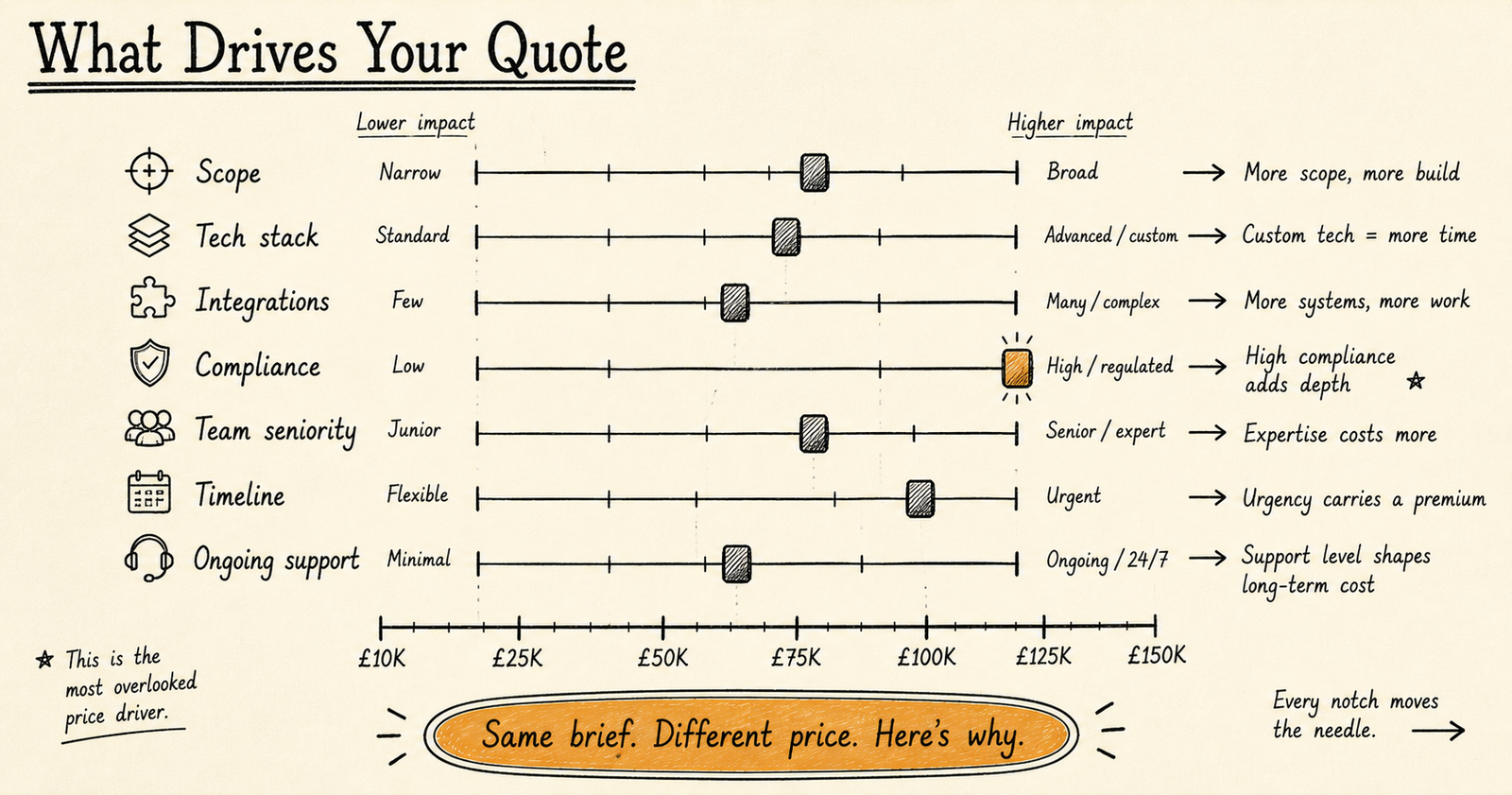
What factors affect software development pricing? Seven factors determine what custom software costs to build: technical complexity, number of integrations, design and UX requirements, compliance and security needs, team location and structure, timeline urgency, and post-launch support scope. A simple web application might cost £15K–£40K. A complex, compliance-heavy enterprise platform can exceed £200K. The difference comes down to how these seven variables combine in your specific project.
Understanding these factors gives you two advantages: you can evaluate vendor quotes intelligently, and you can make deliberate trade-offs to control your budget. Below, I’ll walk through each factor with the actual numbers so you know what to expect—regardless of who you hire.
Factor 1: Technical Complexity
This is the foundation. A straightforward CRUD application—where users create, read, update, and delete records through a web interface—is fundamentally different from a system that processes natural language, runs predictive models, or orchestrates real-time data streams across multiple services.
Here’s how complexity tiers typically map to cost:
- Low complexity (content sites, basic dashboards, simple workflows): £15K–£40K. Standard web technologies, minimal custom logic, well-understood patterns.
- Medium complexity (multi-role platforms, API-driven applications, reporting systems): £40K–£100K. Custom business logic, role-based access, data processing pipelines.
- High complexity (AI/ML systems, real-time processing, multi-tenant SaaS platforms): £100K–£300K+. Specialised engineering, complex infrastructure, extensive testing requirements.
The key question to ask yourself: how much custom logic does this system need to contain? The more unique your business rules, the higher the complexity. If 80% of what you need exists in off-the-shelf software, the cost of that last 20% of customisation may not justify a full custom build.
Factor 2: Number of Integrations
Every system your new software needs to talk to adds cost. But the range is enormous depending on what you’re connecting to.
Modern cloud APIs (Stripe, Salesforce, HubSpot, Slack, Google Workspace) typically cost £2K–£5K per integration. These platforms have well-documented APIs, robust SDKs, and large developer communities. The work is mostly configuration and mapping.
Legacy system integrations (older ERP systems, on-premise databases, proprietary internal tools) cost £5K–£15K+ each. Documentation is often incomplete or outdated. Data formats may be non-standard. Authentication can be complex. In some cases, the only way to connect is through screen scraping or file-based transfers—both fragile and expensive to maintain.
Integrations are the most commonly underestimated line item in software projects. A project with 8 integrations doesn’t just cost 8x a single integration—it creates exponentially more testing scenarios, failure modes, and maintenance burden. Every additional connection is a point where things can break.
When planning your project, list every system the software needs to connect with. Then honestly assess each one: is the API modern and documented, or will your development team need to reverse-engineer the connection? This single exercise can dramatically improve the accuracy of your budget. See how integration complexity played out in our Lead Intelligence case study.
Factor 3: Design and UX Requirements
The visual and interaction design of your software has a direct impact on cost. There’s nothing wrong with choosing any tier—it depends on who’s using the system and how critical the user experience is to adoption.
- Template-based design: £3K–£8K. Uses pre-built UI component libraries (like Material UI or Tailwind components) with your branding applied. Functional, professional, fast to implement. Ideal for internal tools where your team just needs it to work.
- Custom UI/UX design: £8K–£25K. Original interface design based on user research and wireframing. Custom components, branded experience, thoughtful interaction patterns. Appropriate for customer-facing products where experience drives adoption.
- Complex interactive interfaces: £15K–£40K. Data visualisation dashboards, drag-and-drop builders, real-time collaborative interfaces. Significant front-end engineering effort. Only justified when the interface IS the product.
A common mistake is over-investing in design for internal tools. If your operations team is the primary user, they care about speed and reliability, not animations. Conversely, under-investing in design for customer-facing products is equally wasteful—users will abandon a confusing interface regardless of how good the backend is.
Factor 4: Compliance and Security
Every software project should include standard security practices—encrypted data at rest and in transit, secure authentication, input validation, regular dependency updates. This should be included in any reputable vendor’s base price.
Regulated industries are a different matter entirely. If you’re building for healthcare, finance, or any sector handling sensitive personal data, additional requirements include:
- Audit logging — every data access and modification tracked and immutable
- Data residency controls — ensuring data stays in specific geographic regions
- Access control documentation — formal role definitions and permission matrices
- Penetration testing — third-party security assessment before launch
- Compliance documentation — evidence packages for HIPAA, FCA, SOC 2, or GDPR audits
Expect compliance requirements to add 20–40% to total project cost. This premium reflects genuine additional engineering work, not a mark-up. A system that passes a regulatory audit requires fundamentally different architecture decisions than one that doesn’t.
If a vendor quotes you a regulated-industry project without a compliance line item, either they don’t understand the regulatory landscape or they’re planning to deal with it later. Both are red flags. The cost of retrofitting compliance after the fact is typically 2–3x what it would have cost to build it in from the start. Learn more about our governance-first approach.
Factor 5: Team Location and Structure
Where your development team is based has a significant impact on cost. Here’s an honest comparison:
The cheapest hourly rate does not always produce the cheapest project. A team charging £30/hour that takes 3x as long and requires more project management overhead can easily cost more than a team charging £100/hour that delivers in half the time with fewer revisions.
What actually matters is: does this team have direct experience building the type of system you need? Have they worked in your industry? Can they communicate complex trade-offs clearly? Those questions matter more than geography.
See Where Your Project Lands
Use these factors to get a realistic estimate for your specific requirements. No commitment, no sales call required.
Get a Custom Estimate →Factor 6: Timeline and Urgency
Software development has a natural pace. Compressing that pace costs money—here’s why and how much:
- Standard timeline (no premium): Sequential phases—discovery, design, development, testing, deployment. Each phase informs the next. This is the most cost-efficient approach and produces the best outcomes. For most projects, this means 10–16 weeks.
- Accelerated timeline (20–40% premium): Overlapping phases, parallel workstreams, faster decision cycles. Requires more coordination and more experienced developers who can handle ambiguity. Suitable when there’s a genuine business deadline—a regulatory change, a market window, a contractual obligation.
- Rush timeline (50–100% premium): Everything runs in parallel. Higher risk of rework. Requires the most senior available talent working at full capacity. I generally advise against this unless the business case is overwhelming. The quality trade-offs are real.
If a vendor is pressuring you to commit quickly or offering discounts that expire next week, that’s a sales tactic, not a timeline consideration. Your project timeline should be driven by your business needs, not a vendor’s quarterly targets.
Factor 7: Post-Launch Support Scope
This is the factor most buyers forget to negotiate upfront—and the one that causes the most friction after launch.
- Bug fixes only: 5–10% of build cost per year. The vendor fixes defects in the original functionality. No new features, no changes to existing behaviour. The minimum viable support tier.
- Maintenance and minor enhancements: 15–25% of build cost per year. Bug fixes plus security updates, dependency upgrades, minor feature additions, and performance optimisation. This is the tier most businesses actually need.
- Managed service / ongoing development: 25–40% of build cost per year. Continuous feature development, A/B testing, scaling optimisation, dedicated support. Essentially an ongoing development relationship. Appropriate for products that are central to your business and need constant evolution.
“Build and forget” is the most expensive approach long-term. Software that isn’t maintained accumulates security vulnerabilities, breaks when third-party APIs change, and becomes progressively harder to modify. By year three, a neglected system often costs more to update than it would have cost to maintain continuously.
Whatever your support scope, get it in writing before the project starts. Clarify response times, what’s included versus billed separately, and how the relationship can be ended if needed. This prevents the most common post-launch disputes. For more on evaluating these terms, see our Buyer’s Guide.
A Real-World Example: Healthcare Document Processing
Let’s put all seven factors together with a hypothetical project—a document processing system for a healthcare provider that needs to extract patient data from referral letters and route it into their clinical management system.
| Factor | This Project | Impact on Cost |
|---|---|---|
| Technical complexity | AI document extraction with NLP—high complexity | High (+) |
| Integrations | Clinical management system (legacy) + NHS Spine—2 complex integrations | High (+) |
| Design/UX | Internal review dashboard—template-based is sufficient | Low |
| Compliance | HIPAA-equivalent (NHS DSPT), patient data handling—full compliance needed | High (+) |
| Team location | UK-based required for NHS data handling | Medium (+) |
| Timeline | Standard 14-week timeline—no rush | Neutral |
| Support scope | Maintenance + enhancements (ongoing model retraining) | Medium (+) |
Estimated total: £65K–£95K for the initial build, plus £12K–£20K per year in maintenance and model retraining. The high complexity, legacy integrations, and compliance requirements push this toward the upper end. The standard timeline and simple UI keep it from going higher.
If this same project were in a non-regulated industry, with modern API integrations and a medium-complexity algorithm instead of AI—the estimate drops to £30K–£50K. That’s how much these factors matter. For a closer look at what a project like this involves, see our Document AI case study.
Use this to quickly assess where your project sits.
| Factor | Low Impact | Medium Impact | High Impact |
|---|---|---|---|
| Complexity | CRUD / standard workflows | Custom logic, multi-role | AI/ML, real-time, SaaS |
| Integrations | 0–2 modern APIs | 3–5 mixed APIs | 6+ or legacy systems |
| Design/UX | Template-based | Custom UI/UX | Complex interactive |
| Compliance | Standard security | GDPR, basic audit | HIPAA, FCA, SOC 2 |
| Team location | Offshore | Nearshore / hybrid | UK/US onshore |
| Timeline | Standard | Accelerated (+20–40%) | Rush (+50–100%) |
| Support | Bug fixes only | Maintenance + minor enhancements | Managed service |
Software pricing is driven by 7 measurable factors — not arbitrary mark-ups.
Complexity, integrations, design, compliance, team location, timeline, and support scope. Understanding these gives you the vocabulary to evaluate any quote from any vendor. Budget 1.5× the quoted amount, factor in 15–25% annually for maintenance, and make deliberate trade-offs rather than hoping for the best.
Recommended Reading
What is the biggest factor in software development cost?
Technical complexity is the single biggest factor. A simple CRUD application costs £15K–£40K, while a complex AI/ML system with real-time processing can exceed £200K. The amount of custom business logic your system requires determines the baseline cost.
How much do integrations add to software cost?
Modern cloud API integrations (Stripe, Salesforce, HubSpot) typically cost £2K–£5K each. Legacy system integrations (older ERP, on-premise databases) cost £5K–£15K+ each due to poor documentation and non-standard data formats.
Does team location affect software pricing?
Significantly. Offshore teams (India/SE Asia) charge £20–£50/hr, Eastern Europe £40–£80/hr, and UK/US teams £80–£175/hr. However, the cheapest hourly rate doesn’t always produce the cheapest project — experience and communication quality matter more than geography.
How much does compliance add to project cost?
Expect compliance requirements (HIPAA, FCA, SOC 2, GDPR) to add 20–40% to total project cost. This covers audit logging, data residency controls, access control documentation, penetration testing, and compliance evidence packages. It’s genuine engineering work, not a mark-up.
What should I budget for post-launch maintenance?
Budget 15–25% of the original build cost per year for maintenance and minor enhancements. Bug fixes only cost 5–10% annually, while a full managed service runs 25–40% per year. Get support terms in writing before the project starts. Read our Buyer’s Guide for the full checklist.