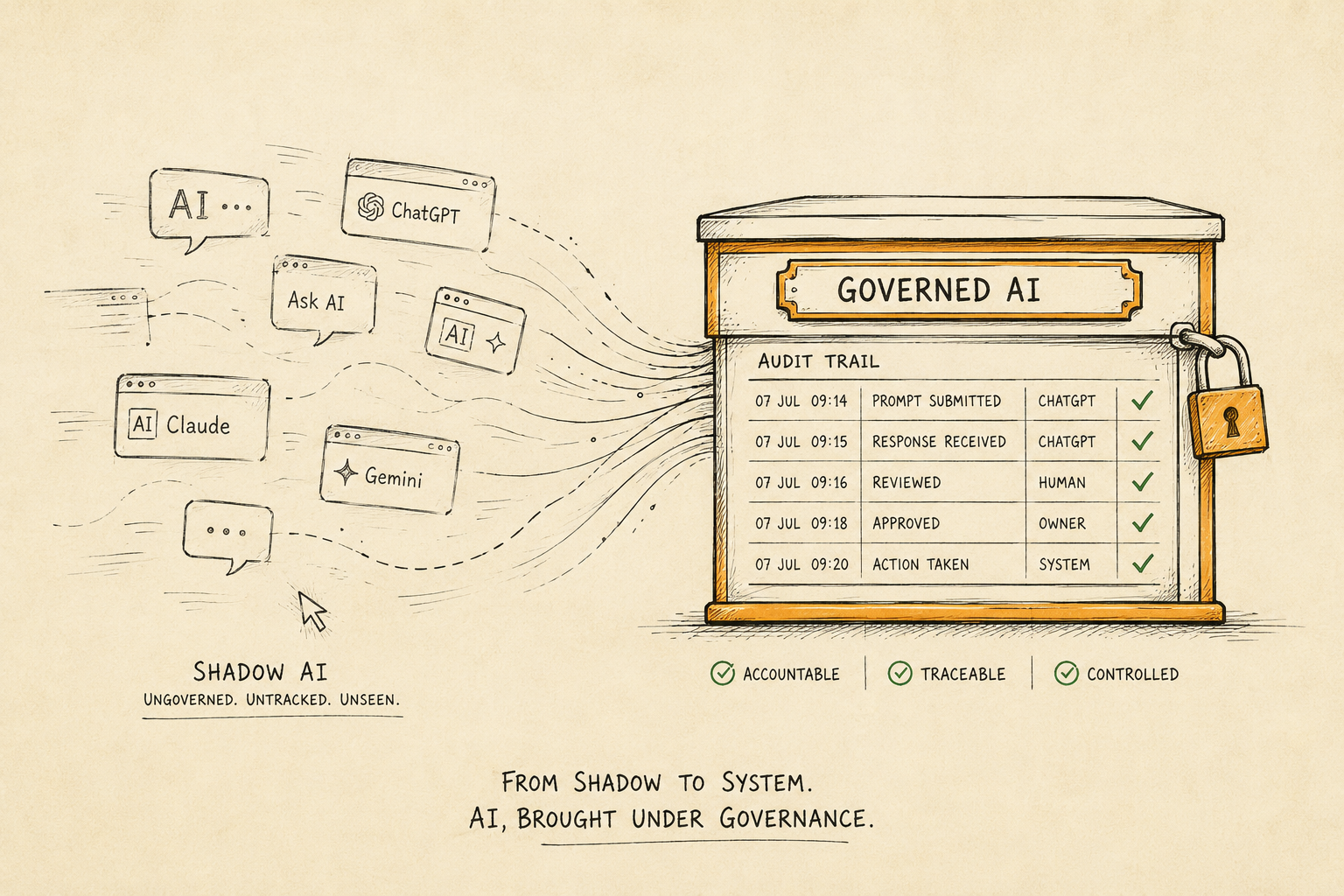
They already are. Microsoft's 2025 UK research found that 71% of UK employees have used unapproved consumer AI tools at work, and 51% do so every week. The risk is not the AI itself; it is that it is ungoverned: no audit trail, no accountable owner, and client data leaving your control. Governance is what turns shadow AI into auditable AI you can stand behind.
You do not need a survey to know it is happening in your business, but the numbers make it concrete. Alongside that 71%, only about a third (32%) of employees say they are even concerned about the privacy of the company or customer data they put into these tools. And what goes in is not trivial: Cyberhaven's analysis of 1.6 million workers found that 11% of everything employees paste into ChatGPT is sensitive data. And the trend is accelerating: Zendesk's 2026 CX Trends Report found shadow AI use in some industries has grown by as much as 250% year over year. The question is not whether shadow AI is happening in your firm. It is whether you can see it, and whether you could defend it if a regulator asked.
What "shadow AI" actually is
Shadow AI is your staff using consumer AI tools on real work, off the radar. Someone pastes a client email into ChatGPT to draft a reply. Someone runs a spreadsheet of customer data through a free summariser. Someone uses Copilot to write a policy document, or asks a chatbot to interpret a rule. None of it is logged, none of it is overseen, and often nobody senior knows it is happening. It is not malicious. It is people trying to get their work done faster with tools that are one browser tab away, and Microsoft's research shows the most common reason is simply that they already use these tools in their personal lives.
It is the AI-era version of shadow IT, the familiar problem of staff using unsanctioned software. The difference is that shadow AI does not just route data through an unapproved tool; it makes decisions and produces output that reach your customers, which raises the stakes. And it is not hypothetical: in 2023, Samsung engineers pasted proprietary source code and internal meeting notes into ChatGPT, and the company banned the tool within weeks.
The reason it matters is that these are not sandboxes. They are production: real client data, real decisions, and real output going to real customers, produced by a system nobody in your business can see into. The moment AI touches a customer outcome, it stops being a personal productivity trick and becomes part of how your firm operates, whether or not anyone decided it should.
Why it is a risk in a regulated business
For an insurance broker, a financial adviser, or anyone giving regulated advice, ungoverned AI creates four specific exposures. Take a broker whose account handler uses ChatGPT to speed up renewal summaries:
- Data leakage. The client's details have been pasted into a consumer tool and left your control. You cannot say where that data went, who can see it, or whether it was used to train a model. Given that 11% of what employees paste into these tools is already sensitive, this is not a hypothetical.
- No audit trail. Under the FCA's Consumer Duty you have to be able to evidence good customer outcomes. If AI shaped the summary, the recommendation, or the wording, and you cannot show what it did or why, you cannot demonstrate the outcome was good. Absence of evidence is the exposure.
- Decisions no one can explain or reverse. A figure or a recommendation that came out of a black box, off the record, is one you cannot defend to a client, a complaint handler, or the regulator, and cannot cleanly undo.
- Inconsistent output. Ten people using ten different tools their own way is not a process. It is ten different risk profiles, and no way to know which files are affected.
The common thread is the same one behind most failed AI projects: it is not the model, it is the absence of governance around it. For the wider version of this risk once agents are involved, see AI agent risks.
Worth 15 minutes to see your shadow AI made auditable?
No pitch. We show you the one workflow we would bring in-house first, logged and owned, and what it would take.
Book a 15-minute callShadow AI vs governed AI, at a glance
The same underlying tools sit behind both. The difference is entirely in the wrapper around them.
| Shadow AI | Governed AI | |
|---|---|---|
| Where it runs | Consumer tools, personal accounts | Inside systems you control |
| Logging | None | Every action, full audit trail |
| Owner | Nobody | One accountable human, with a kill switch |
| Reversible | No | Yes |
| Client data | Leaves your control | Stays in your systems |
| Consumer Duty | Cannot evidence outcomes | Evidenced and defensible |
The wrong fix: banning it
The instinct is to ban the tools. It does not work. A ban does not remove the pressure that made people reach for AI in the first place, the deadline and the workload are still there, so the usage just moves further underground, onto personal phones and personal accounts where you have even less visibility. You end up with exactly the same risk, minus the ability to see it, plus a team that has learned not to tell you what they are doing. PagerDuty's 2026 research found that a third of employees (33%) who use AI at work would hide it from their managers to avoid scrutiny; a ban only sharpens that instinct. The 71% figure is what usage looks like without a serious ban; drive it underground and you simply lose the 51% who currently do it in the open.
Enforcement makes it worse, not better. You cannot audit what you have pushed into the dark. The goal is not to forbid AI. It is to govern it: take the workflows your team already finds useful and bring them in-house on terms you can stand behind. That is the difference between renting a black box and owning an auditable system, which we cover in governed AI vs AI consultancy and AI governance vs governed AI.
The governed pattern
Governing shadow AI means giving people the capability they were reaching for, inside a system you control:
- An audit trail on every action, so you can show a regulator what happened and why.
- One accountable human owner, with a clear kill switch, not a tool that belongs to nobody.
- Reversibility, so any decision the AI influenced can be traced and undone.
- Data that stays in systems you control, not a consumer tool's servers.
- A human checkpoint wherever the consequence is high, and automation only where the work is routine.
This is what we build. On one document workflow we run, every action is logged for a 100% audit trail across 2,847 documents, and a human reviews only the cases the agent is unsure about. For a UK-regulated financial-planning workflow, every automated decision is fully audited, which is exactly what a Consumer-Duty environment requires. Across 50-plus governed builds the pattern holds: the useful work still happens, faster than before, and you can prove exactly how. Our 21-Day AI Pilot puts one bounded workflow live in about 21 days, fixed scope and fixed price from around $15,000, and you own the code at the end.
Your AI policy is probably theatre. Here is how to tell.
Most businesses that discover shadow AI respond by writing a policy. It goes in the handbook, people acknowledge it, and the box is ticked. Six months later the same tools are still in use and nothing has changed, because a policy is a statement of intent and intent does not run in production.
There is a simple test. Pick the rule you are most confident about, something like "no client data goes into a public AI tool." Now ask who would know if it were broken this morning. Not who is responsible, who would know. If the answer is nobody, or it is "we would find out at the next audit," you do not have a control. You have a wish.
A real control produces evidence without anyone remembering to produce it. It logs the action at the moment it happens, it names an accountable owner, and it fails closed when something is outside the boundary. That is the whole difference between AI governance and governed AI: the first is the rulebook, the second is the thing that enforces the rulebook at runtime, on every request, whether or not anyone is watching.
This matters more in a regulated business than most people assume. When a regulator asks what happened, "we had a policy" is not an answer. The answer they want is a record: what the system did, on whose authority, and what a human checked. If you cannot produce that record, the policy was never the control.
The three places shadow AI actually leaks
In practice the exposure is narrower and more specific than the general anxiety suggests. It concentrates in three places, and they need different fixes.
1. Data going in. This is the one everyone worries about, and it is real: client names, contract terms, medical or financial detail pasted into a consumer tool to save twenty minutes. The fix is not a warning poster. It is giving people a sanctioned route to the same outcome, inside systems you already own, so the shortcut stops being the only fast option available.
2. Output going out unverified. This one gets far less attention and causes more damage. A confident, plausible, wrong paragraph goes into a client email, a report, or advice. Nobody pasted any sensitive data anywhere, so no data rule was broken, and the business still gave a client something it cannot stand behind. The fix here is a human checkpoint wherever the consequence is high, not a restriction on the tool.
3. Access that nobody scoped. The quiet one. Somebody connects an AI tool to a mailbox, a drive, or a CRM to make it more useful, and grants it far more reach than the task requires. Now an ungoverned tool has standing access to everything that account can see, and it persists long after the person who set it up has moved on. Least privilege is unglamorous and it is the control that matters most here.
Notice that only the first of these is a data-protection problem. The second is a quality and accountability problem, and the third is an access-management problem. A single policy document written to address the first will not touch the other two, which is why so many businesses feel exposed even after they have "dealt with" shadow AI.
Want a Realistic Plan for Your Project?
No sales pitch. We will give you an honest read on what your situation actually needs, what it should cost, and whether AI is even the right tool here.
Book a Discovery Call →Where this will not help you
We should be straight about the limits, because the governed approach is not a fit for everyone and the trade-offs are real.
If your business genuinely has no client data, no regulatory exposure and no client-facing output produced with AI, this is not urgent for you. Buy the tools your team likes and get on with the work. Governance is a cost, and paying it when the risk is not there is waste.
If you want a fast answer, this is also not the right fit. Bringing two workflows in-house, logged and owned, takes weeks rather than days. Anyone offering to solve shadow AI across your whole business in a fortnight is selling you a policy document with better branding.
And if the honest answer is that leadership does not want visibility, no system fixes that. Every control described here produces evidence. Evidence is only useful to an organisation that intends to look at it and act on what it finds. If a ban is being considered mainly so that responsibility sits with the employee who broke it, governance is not what is being asked for.
Sanctioned tools need the same discipline, and the newest ones raise the bar. GPT-6 Astra ships switched off in Business and Enterprise workspaces precisely because someone has to decide, and its reasoning is harder to inspect than the model it replaces. If that decision is on your desk, see what to settle before you enable it.
What governing it properly costs
People expect a licence fee and a switch to flip. That is not the shape of it. The tooling is rarely the expensive part; the governance around it is, because that is where the audit trail, the ownership and the access boundaries get built and tested.
For a reference point rather than a quote, our own governed pilot runs 15K to 40K, scoped per use case, and lands in 21 days. That covers taking one or two real workflows, the ones with genuine client data or client-facing output, and making them auditable inside the software you already run. It deliberately does not cover the whole estate, because doing two workflows properly removes more real risk than doing twelve badly.
The number worth comparing it against is not another vendor's quote. It is what an unlogged AI decision costs you the first time a client, an auditor or an insurer asks you to explain it and you cannot.
The conversation that actually works
Visibility is the first move, and it is the one most businesses get wrong on delivery rather than intent. If a third of people would hide their AI use from a manager to avoid scrutiny, then the way you ask decides what you find out. An email announcing an audit of unapproved tool usage will return a very clean and very inaccurate picture.
What works is asking about the work, not the tool. "Where in your week are you doing something repetitive that you wish you did not have to?" tells you where the pressure is. "What have you tried that helped?" tells you what they reached for. Neither question sounds like an investigation, and both produce the map you actually need: which workflows carry real client data, and which shortcuts have quietly become load-bearing.
Two rules make this work. Say up front that nobody is in trouble, and mean it, because you only get one attempt at this. And close the loop within a fortnight by sanctioning at least one thing people told you about. If the first visible outcome of honesty is a new restriction, you have taught the organisation not to answer the question next time, and you will be back to guessing.
What to do this week
You do not have to solve all of it at once, and you should not try to. The first move is visibility, not a policy document. Find out, without blame, what AI your team is actually using and for what. People will tell you if the question is "how are you using this" rather than "who broke the rules." Then pick the one or two workflows that show up most, the ones with real client data or real client-facing output, and govern those first. Everything else can wait. Bringing two workflows in-house, logged and owned, removes more real risk than a ban ever will.
A five-question shadow-AI check
Ask these about your own business today:
- Do you know what AI tools your team already uses?
- Is any of that usage logged?
- Is there one accountable owner for it?
- Can you reverse a decision the AI influenced?
- Does client data leave the building when your team uses these tools?
If the answers are no, you do not have governed AI. You have shadow AI. The good news is that the fix is not a ban or a big platform migration. It is bringing the handful of workflows that matter in-house, governed, in weeks.
Turn the tools they already use into ones you can stand behind.
We bring the workflow in-house inside your existing systems, fully logged, with one accountable owner, and you own the code.
Scope your first workflowShadow AI is not a discipline problem. It is a governance gap.
Your team reached for AI because it helps. Banning it just hides it. The safe move is to bring the workflows that matter in-house, logged, owned, and reversible, with client data in systems you control. Governed, the same tools stop being a liability and become something you can evidence and stand behind.
Governed AI: the full series
This article is part of our Governed AI series. The pillar guide covers the whole topic; the others each go deeper on one part.
- Pillar guideWhat is governed AI?Start here: AI that is observable, auditable, human-supervised, rollback-ready and owned by your team.
- AI governance vs governed AIAI governance is the rulebook; governed AI is the system that enforces it at runtime.
- Governed AI implementation for service businessesPutting governed AI into a service firm without a six-month delay.
- AI compliance checklist (SOC 2, HIPAA, GDPR)The nine controls to have in place before AI touches regulated work.
- AI agent risks and how to govern themThe real risk: an agent acting with more access than it should, with no one watching.
- Do you need a head of AI governance?Who should own AI decisions in your firm, and what to do instead of a new hire.
Continue learning —
go deeper.
Is it a problem if my staff use ChatGPT?
Not if it is governed. The problem is ungoverned use: no audit trail, no accountable owner, and client data leaving your control. Cyberhaven found 11% of what employees paste into ChatGPT is sensitive data. Bring the useful workflows in-house, logged and owned, and the same tools stop being a liability.
What counts as shadow AI?
Any use of an AI tool on real work that your business has not sanctioned, logged, or overseen: a consumer chatbot, a browser extension, a personal Copilot account. If nobody owns it and nothing is logged, it is shadow AI, even if the person using it means well.
Should we ban AI tools at work?
Bans push usage underground onto personal devices where you have even less visibility. Microsoft found 71% of UK employees already use unapproved AI at work; forbidding it mostly costs you the visibility you have. Governing the useful workflows, so they are auditable, owned, and reversible, is safer and more effective.
How does shadow AI affect Consumer Duty?
If AI touches customer outcomes and you cannot evidence what it did or why, you cannot demonstrate good outcomes under the FCA Consumer Duty. An audit trail on every action, tied to an accountable human, is what makes it defensible.
How quickly can we bring our AI use under governance?
One bounded workflow can be live, governed, and owned inside your systems in about 21 days through the KORIX 21-Day AI Pilot, fixed scope and fixed price. You do not have to govern everything at once; start with the one or two workflows that touch real client data.
How does KORIX handle this?
We bring the workflows in-house inside your existing systems, fully logged, with one accountable owner and a kill switch, and you own the code. One bounded workflow live in about 21 days, from around 15,000 US dollars, fixed scope.