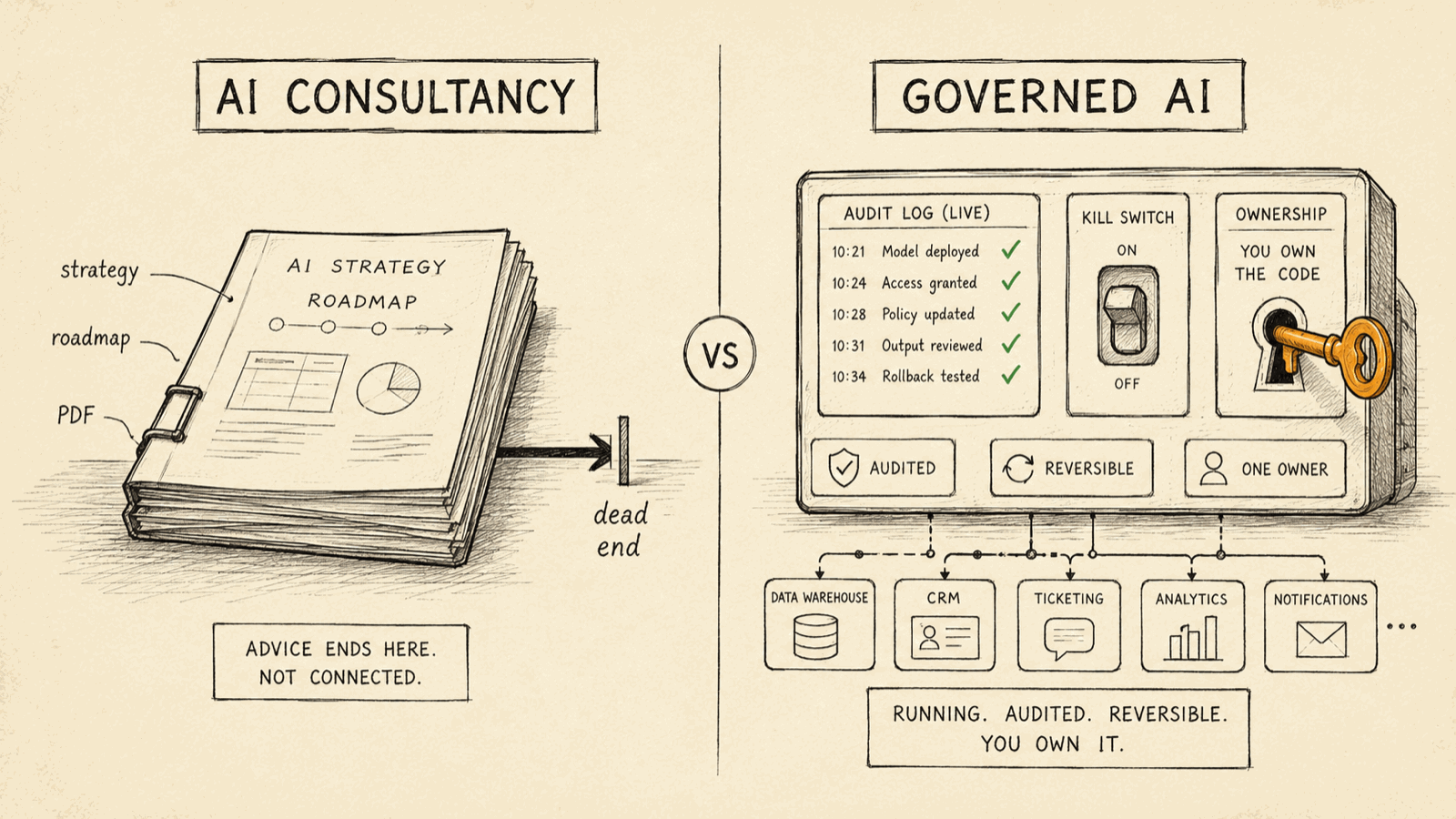
Most AI consultancies sell you a strategy: a readiness report, a roadmap, a slide deck. You are left to build, run, and answer for the system yourself. Governed AI is the opposite. It is a working system in production, auditable and reversible, with one accountable owner, delivered in 21 days, and the code is yours.
Book a 15-minute call. No pitch. We will show you the one workflow we would build first.
The difference in one line
A consultancy tells you what to do. A governed build does it, hands you the keys, and leaves you able to prove it works. The distinction matters most on the questions a board actually asks: who owns this, who is accountable, and can we show what it did? This page is the ownership and accountability side of the decision. For the broader route comparison, see our consultancy vs deployment buyer's guide.
| Typical AI consultancy | Governed AI (KORIX) | |
|---|---|---|
| What you get | Strategy, roadmap, recommendations | A working system in production |
| Who builds it | You, or a vendor you then manage | We build it inside your existing tools |
| Who owns the code | Usually the vendor; you rent access | You. No lock-in |
| Auditability | Not their remit | Every action logged; you can evidence it |
| Accountability | Diffuse | One human owner, plus a kill switch |
| Time to value | Months of discovery | One workflow live in 21 days |
| When it ends | The deck lands | You own a running asset |
Why most enterprise AI never ships
The uncomfortable number: MIT's 2025 study of enterprise AI found that 95% of generative-AI pilots deliver no measurable return, and only about 5% achieve meaningful ROI. The usual explanation is "the model was not good enough." In practice it is almost never the model. It is governance and ownership: no audit trail, no accountable human, no clean handoff from a clever demo to a system the business can actually run and stand behind. It is the same gap we describe in governed AI.
Consultancy deepens that gap. A roadmap that recommends AI does not put AI into production, and a proof-of-concept that nobody owns quietly dies. The projects that ship are the ones built for production from day one, with ownership settled before a line of code is written.
UK businesses are estimated to write off around £67bn a year on failed transformation and AI initiatives (Emergn, 2026), an average of 2.5% of revenue. Emergn's own diagnosis is weak governance and oversight, not spend, which is the same root cause behind the failed pilots above.
What "governed AI" actually means
Governed is not a feature you add later. It is how the system is built. It is also distinct from writing an AI policy: for that difference, see AI governance vs governed AI.
- Auditable. Every action the AI takes is logged, so you can show what happened and why. That is what makes it fit for a regulated, Consumer-Duty world.
- A human owner. One accountable person, with a clear off switch. Not a black box bolted onto your operations.
- Reversible. Nothing the system does cannot be undone.
- Bounded. The agent is scoped to a defined task, not handed the run of your business.
What "you own the code" means
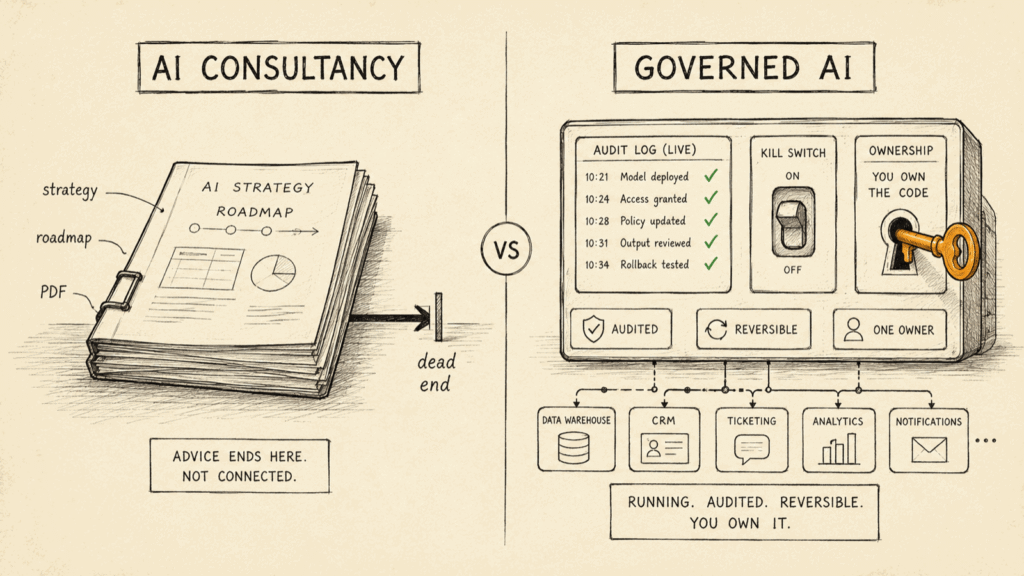
It means exactly what it says. When the build is done, the code is yours: hosted where you choose, changeable by whoever you like, with no dependency on us to keep running. You are buying an asset, not renting a seat. That is the opposite of the lock-in that makes most AI purchases risky, and it is the reason a governed build keeps paying off long after the invoice.
Want a Realistic Plan for Your Project?
No sales pitch. We will give you an honest read on what your situation actually needs, what it should cost, and whether AI is even the right tool here.
Book a Discovery Call →How KORIX does it
We treat AI as a connected system, not a model drop: governance, data readiness, workflow integration, and engineering, built inside the software your team already uses. Our flagship 21-Day AI Pilot puts one real workflow into production in 21 days, fixed scope, fixed price, and you own the code.
Track record: 5.0 on Clutch, OpenAI Select Partner, and an authorized Zapier Silver Solution Partner. A founder is on every project.
See the difference on one of your own workflows.
Book a 15-minute callDo you own your AI? A buyer's checklist
Ask any AI vendor these five questions before you sign. You can also run our AI Readiness Score first.
- Do I own the code, or am I renting access?
- Can I see why the system did what it did?
- Is there one accountable human owner and an off switch?
- Can every action be reversed?
- Will one real workflow be in production in weeks, not a roadmap in months?
If the answers are no, it is a consultancy engagement or a locked-in product, not governed AI. Ours answers yes to all five.
Worth 15 minutes to see the difference on your own workflow?
No pitch. We will show you the one workflow we would put into production first, what it would take, and how you would own it.
A consultancy advises; governed AI ships and hands you the keys
A consultancy ends with a roadmap you still have to build, run, and answer for. Governed AI ends with a working system in production: auditable, reversible, owned by one accountable person, live in 21 days, and the code is yours. If a vendor can't say yes to owning the code, showing why the AI acted, naming an accountable owner, reversing any action, and shipping one workflow in weeks, it isn't governed AI.
Continue learning —
go deeper.
Is governed AI just AI consulting with a different name?
No. Consulting ends with advice; governed AI ends with a working, auditable system in production that you own. The deliverable is different. A consultancy hands you a strategy, a readiness report, and a roadmap, then leaves you to build and run the system yourself. Governed AI is the running system, with one accountable owner and the code in your hands.
What does 'you own the code' mean in practice?
The code is handed over to you at the end of the build, hosted wherever you choose, changeable by whoever you like, with no ongoing dependency on KORIX to keep it running. You are buying an asset, not renting a seat. That is the opposite of the vendor lock-in that makes most AI purchases risky.
Why do most enterprise AI projects fail?
Independent research from MIT Project NANDA (2025) found that around 95% of enterprise generative-AI pilots show no measurable return, with only about 5% achieving meaningful ROI. The cause is usually governance and ownership, not model quality: no audit trail, no accountable owner, and no clean handoff from a demo to a system the business can actually run and stand behind.
How long does a governed AI build take?
One real workflow is live in production in 21 days through the KORIX 21-Day AI Pilot: fixed scope, fixed price, and the client owns the code. You get a running asset at the end, not a deck.
Is governed AI suitable for regulated industries like insurance?
Yes. Auditability, reversibility, and a named human owner are exactly what a Consumer Duty or regulated environment requires, which is why governed AI suits insurance, property, and recruitment. You can evidence what the system did and why.