
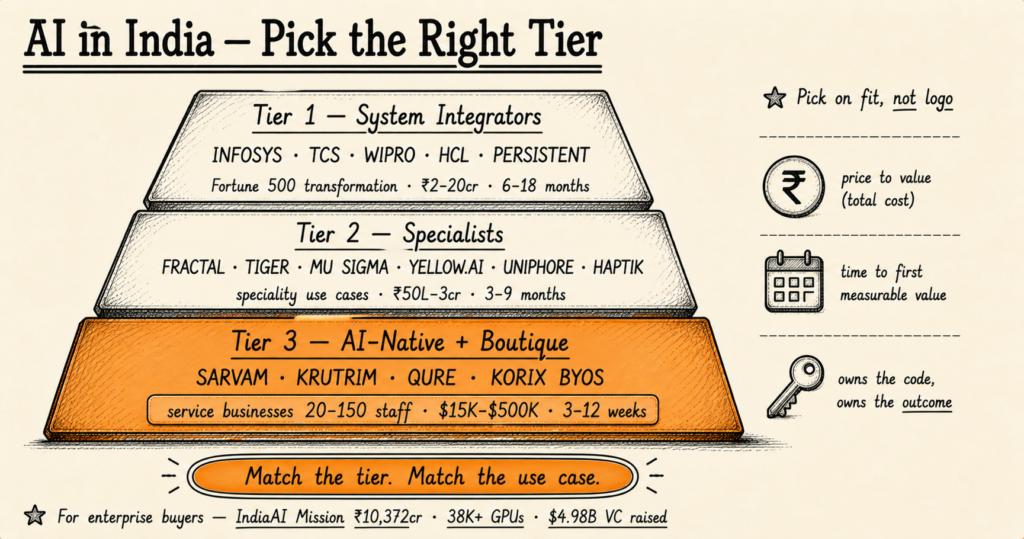
India's AI implementation market splits into three tiers in 2026 — global system integrators (Infosys, TCS, Wipro, HCL, Persistent), specialist analytics firms (Fractal, Tiger, Mu Sigma), and AI-native + boutique implementation partners (Sarvam, Krutrim, Yellow.ai, KORIX). Pick on fit, not logo. The wrong tier costs 5× more, ships 6× slower, and produces a worse outcome.
I've spent 19 years building software systems, the last several focused on AI implementation for service businesses with 20-150 staff. KORIX is itself based in India with global delivery — we sit in the boutique implementation tier this article describes. That position lets me write something a tier-1 SI cannot: an honest comparison of where each tier wins, where each tier overcharges, and the specific decision rules that send most enterprise AI projects to the wrong vendor on Day 1.
The Indian AI services market is also bigger and faster-growing than most enterprise buyers realise. The IndiaAI Mission has committed ₹10,372 crore (~$1.25B) of public investment between 2024 and 2026 with over 38,000 GPUs deployed across sovereign-cloud infrastructure. Indian AI firms raised approximately $4.98B in venture capital across the same period, per IndiaAI ecosystem reporting. That capital, combined with India's deep AI engineering talent pool, is the reason global consultancies are now subcontracting their AI delivery to Indian firms — not the other way around.
The Three Tiers (And Why You Need to Know Which One You're Buying From)
Every AI implementation vendor in India falls into one of three operational tiers. The tiers differ on size, pricing, time-to-value, and the type of buyer they serve well. Picking the wrong tier is the single most expensive mistake an enterprise buyer makes.
Tier 1 — Global System Integrators. Multi-billion-dollar firms with ten thousand or more AI engineers. Built for Fortune 500 transformation programmes — multi-vertical, multi-region, multi-year. Carry their own compliance scaffolding (SOC 2, ISO 27001, sector-specific certifications), their own delivery methodologies, and their own platform investments. Sell at premium prices because they're a low-risk choice for a CFO signing off on a multi-crore programme.
Tier 2 — Specialist Firms. 500-5,000 employee analytics or AI-native specialists. Deeper subject-matter expertise than Tier 1 in their niche (Fractal Analytics on decision modelling; Mu Sigma on optimisation; Yellow.ai on conversational AI). Better engagement economics than Tier 1 for projects scoped to their speciality. Worse engagement economics than Tier 1 if the project requires multi-discipline orchestration outside their niche.
Tier 3 — Boutique Implementation Partners + AI-Native Startups. 5-50 person teams or AI-native product firms (Sarvam AI, Krutrim, KORIX). Fastest time-to-value (21-day pilots, working production deployments by Day 22). Strongest at deploying inside an existing tech stack rather than on top of yet another platform. The right tier for service businesses with 20-150 staff and for any organisation where a single bounded use case needs to ship before broader rollout.
Andrew Ng, who has shipped more production AI than almost anyone alive, has been making a related point publicly for years: the firms that capture the most AI value are not the ones with the largest consulting teams — they are the ones who ship working systems quickly and iterate on real production data. Cassie Kozyrkov, former Chief Decision Scientist at Google, frames the vendor-selection problem in a complementary way: "The bottleneck is not the AI technology. The bottleneck is knowing which problem to give it." Translated to Indian AI vendor selection: the right tier is the one that understands the buyer's specific operational reality and ships fastest into production for that use case — not the one with the biggest delivery team or the most-decorated platform.
BCG's 2026 AI Value Capture research backs this with data: organisations that piloted AI on a specific bounded workflow before broader deployment had significantly higher rates of successful scaled adoption. The Deloitte 2026 State of Generative AI in the Enterprise survey separately reports that 72% of enterprise AI projects exceed their original budget by at least 30%, almost always due to scope expansion at the consulting-to-implementation handoff. The vendor that anchors against this problem from Day 1 — by contracting on production deployment rather than strategy deliverables — is the one most likely to ship within budget.
Tier 1 — Global System Integrators
For Fortune 500 transformation programmes — full operating-model rebuilds across multiple business units — Tier 1 SIs are the right choice. They carry compliance scaffolding, multi-region delivery capability, and the brand cover a CFO needs for a ₹10+ crore programme.
Infosys (Topaz)
Best for: Multi-business-unit AI transformation at Fortune 500 scale. What they built: Topaz — one of India's most comprehensive enterprise GenAI platforms with built-in governance, data foundations, and integration frameworks. The cliff: Pricing model assumes multi-month, multi-million-dollar engagements; smaller projects get under-prioritised. Pricing range: ₹2-20 crore per programme. When they're right: Fortune 500 with a CTO mandate to standardise AI across the business.
TCS (Tata Consultancy Services)
Best for: Banking, financial services, and telecom-vertical AI transformation. Largest Indian SI by headcount and revenue. What they built: Multiple AI accelerators tied to vertical-specific data models. The cliff: Engagement cycle (procurement → kickoff → first output) often runs 4-6 months — invisible until you're inside it. Pricing range: ₹2-15 crore. When they're right: Regulated industries where the SI's existing compliance certification and audit experience matters as much as the AI capability.
Wipro
Best for: Cross-region delivery (US/EU/India) for global enterprises. What they built: Wipro AI investments span infrastructure (HOLMES platform), services, and vertical solutions. The cliff: Quality varies sharply by delivery team — the right team is excellent, the wrong team produces work that requires rebuilding. Pricing range: ₹1.5-12 crore. When they're right: Multi-region enterprise with existing Wipro relationship and a strong programme management function on the buyer side.
HCL Technologies
Best for: Engineering-services-led AI projects (manufacturing, IoT, embedded systems). What they built: AI-augmented engineering services with strong R&D depth. The cliff: Less strong on pure-play data science vs. engineering integration. Pricing range: ₹1.5-10 crore. When they're right: AI use cases tied to physical operations — supply chain, manufacturing, product engineering.
Persistent Systems
Best for: Software product companies needing AI capability augmented into their own products. What they built: A "Re(AI)magining" approach embedding AI throughout software delivery, data management, and business workflows; rated as a leader in 2026 GenAI services rankings. The cliff: Pricing assumes you have an internal product team to collaborate with. Pricing range: ₹1-8 crore. When they're right: ISVs and software product companies adding AI features to existing products.
Tier 2 — Specialist Firms
For specific AI capabilities — advanced decision modelling, conversational AI, customer experience, vertical AI — specialists outperform tier-1 SIs in both cost and outcome quality. The risk is locking into a specialist when your use case requires orchestration across capabilities.
Fractal Analytics
Best for: Decision intelligence, advanced analytics, AI for Fortune 500 strategic decisions. What they built: Fractal turns complex data into simple actionable AI insights with design tools for anomaly detection, operational decision-making, and pricing strategy. NYSE-listed November 2025; valuation in the $1-2B range. Pricing range: ₹50 lakh to ₹3 crore per engagement. When they're right: Use cases that need human judgment augmented by data — pricing optimisation, supply-chain decision support, churn analytics.
Tiger Analytics
Best for: Insurance, retail, and CPG analytics with strong execution discipline. What they built: Mid-tier analytics specialist with strong vertical depth. Pricing range: ₹40 lakh to ₹2 crore. When they're right: Mid-market enterprises needing analytics depth without tier-1 SI overhead.
Mu Sigma
Best for: Decision sciences and structured problem-solving for Fortune 100. What they built: The original "decision sciences" pioneer in India; pre-dates the GenAI wave. The cliff: Talent rotation is high; engagement quality varies by team. Pricing range: ₹50 lakh to ₹3 crore. When they're right: Large enterprises with embedded decision-sciences functions needing capacity augmentation.
LatentView Analytics
Best for: Marketing analytics and customer-data-platform AI. What they built: Specialist marketing-analytics firm with strong AI augmentation. Pricing range: ₹40 lakh to ₹2 crore. When they're right: Customer-experience and marketing-led AI initiatives.
Tier 3 — AI-Native Startups + Boutique Implementation Partners
For service businesses with 20-150 staff, AI-native product firms, and any organisation that needs a single bounded use case to ship in weeks (not quarters), Tier 3 is the right tier. Faster time-to-value, lower total cost, code ownership transferred — but you have to scope tighter than a tier-1 SI engagement would.
Sarvam AI
Best for: Indic-language AI applications, sovereign deployment, multilingual conversational AI. What they built: Sarvam AI ships open-weight Indic LLMs and full-stack sovereign AI deployment. The cliff: Best fit when Indic-language depth or data-residency-in-India is a hard requirement. Pricing range: Project-based; typical engagements $50K-$500K. When they're right: BFSI, government, and consumer applications where Indic depth or sovereign infra is non-negotiable.
Krutrim
Best for: Sovereign AI infrastructure, full-stack model+cloud deployment. What they built: India's most ambitious full-stack AI infrastructure play — sovereign cloud, models, and deployment platform. Backed by Ola founders and significant capital. The cliff: Newer firm — execution patterns still being established. Pricing range: Custom enterprise. When they're right: Buyers who need an end-to-end Indian-sovereign AI stack rather than mixing global components.
Yellow.ai + Haptik + Uniphore
Best for: Conversational AI, customer-experience automation, voice-first agent deployments. What they built: Three of India's strongest conversational-AI specialists, each with deep enterprise customer bases. The cliff: Strong on conversation; less so on multi-system workflow orchestration outside the conversational surface. Pricing range: $20K-$200K/year SaaS plus deployment services. When they're right: Customer support, sales-CX, and voice-bot use cases at enterprise scale.
Qure.ai (vertical AI)
Best for: Healthcare AI — specifically medical imaging diagnostic support. What they built: AI diagnostic support deployed across 39 million+ patient screenings with regulatory clearance in multiple geographies. The cliff: Vertical-specific — not a general AI vendor. Pricing range: Custom per institution. When they're right: Healthcare providers needing regulated, peer-reviewed clinical AI.
KORIX (boutique implementation, service-business focus)
Best for: Service businesses with 20-150 staff that need a working AI deployment in three weeks, deployed inside their existing stack (HubSpot, Salesforce, Microsoft 365, Slack) with full code ownership transferred. What we built: The BYOS (Bring Your Own Stack) deployment model — bespoke AI agents and workflows wired directly into the buyer's existing software estate, no platform fees, no per-run costs after build. The cliff: Not built for Fortune 500 transformation programmes — explicitly. If your engagement is multi-business-unit and multi-year, hire Tier 1. Pricing range: $15K-$40K for a single deployed agent or workflow via the 21-Day AI Pilot. When we're right: Mid-market service businesses (legal, accounting, consulting, agencies, financial services boutiques) deploying their first 1-3 production AI use cases.
Decision Framework: Which Tier Fits You?
Match your situation to the right tier using these five questions. Answer them honestly and the tier falls out.
| Decision question | Tier 1 (Infosys, TCS) | Tier 2 (Fractal, Yellow.ai) | Tier 3 (KORIX, Sarvam) |
|---|---|---|---|
| Company size | Fortune 500 / large enterprise | Mid-large with embedded analytics | SME / service business 20-150 staff |
| Project scope | Multi-BU transformation | Speciality use case (analytics, conversational) | Single bounded use case in weeks |
| Budget | ₹2-20 crore | ₹40 lakh - ₹3 crore | $15K-$500K (₹12L - ₹4 crore) |
| Timeline | 6-18+ months | 3-9 months | 3-12 weeks (boutique) / SaaS |
| Code ownership | Often shared / SI platform | Specialist platform / shared | Buyer-owned / SaaS |
Pricing as of May 2026; verify with each firm before commitments.
Want a Realistic Plan for Your Project?
No sales pitch. We will give you an honest read on what your situation actually needs, what it should cost, and whether AI is even the right tool here.
Book a Discovery Call →The Five Questions Every Indian AI Vendor Should Be Able to Answer
Before signing any contract, walk every prospective vendor through these five questions. They were honed across 19 years of inheriting AI projects that failed at the consulting-to-implementation handoff. The vendors who can answer all five concretely are the ones worth hiring. The vendors who deflect on any one of them are selling you consulting hours, not implementation.
- Who owns the code at the end of the engagement? The right answer is "you". If the answer involves a "shared platform," "vendor-managed deployment," or "we retain the IP," you are renting access to your own automation indefinitely. The full cost of that decision compounds over 3-5 years.
- What ships in production by a defined date? Not a deck, not a roadmap, not a "phase 1 deliverable" that's a strategy document. Ship working software into a real workflow by a specific calendar date, with a contractual consequence if missed. KORIX's 21-Day Pilot has a Day 22 production guarantee — if no working system is in production by Day 22, the second invoice doesn't go out.
- How is the work governed? SOC 2 certification, audit trails for every AI decision, model version pinning, rollback semantics, role-based access control. Governed AI is a design choice from Day 1, not a feature added in phase 2. Vendors who treat it as phase 2 are accepting risk on your behalf.
- What's the all-in cost — not just engagement fee? Total cost includes data preparation (40-60% of project budget per Gartner-tracked benchmarks), integration, post-deployment support, optional retainer. The all-in number for a Tier 1 SI starting at ₹2 crore often lands at ₹4-5 crore after data prep and integration. Tier 3 boutique projects at $30K often land at $30K because the scope was bounded from Day 1. Our full breakdown of true AI implementation cost is here.
- Show me a similar deployment you've shipped. Not a case-study slide. Names redacted is fine, but show the actual architecture diagram, the metrics before and after deployment, and the failure modes you encountered. Vendors who can't show this for the specific use case you're hiring for are doing it for the first time on your budget.
According to Atlassian's 2026 State of Product survey, 46% of operations teams cite integration as the single biggest barrier to scaling AI automation. Translated to vendor selection: the vendors who can answer Question 5 with a concrete architecture diagram are the ones who have actually shipped — and integration is where most engagements break.
Three Implementation Failures I've Inherited (Lessons for Buyers)
Pattern recognition from 19 years of inheriting and rebuilding AI projects. The names are disguised; the lessons are exact.
Failure 1: The retail rebuild that never connected to inventory
A retail analytics rebuild I inherited a couple of years ago. The original vendor — a tier-1 SI — had spent eight months on prediction models that performed beautifully in demo environments. In production, the predictions were useless because the models had never been wired into the client's actual inventory system. The data pipeline didn't exist. The SI's contract had defined "models built and validated" as the deliverable, with integration listed in a "phase 2" that was never funded. The rebuild cost the client roughly three times what the original project should have cost if it had been designed as a deployment from Day 1.
Lesson: If your contract treats integration as phase 2, you bought consulting. Insist on production deployment as the contractual deliverable, not as a follow-on phase.
Failure 2: The CX automation that ignored compliance
A B2B financial services firm hired a tier-2 conversational AI specialist to deploy customer-support agents across email and chat. The vendor's platform was excellent at conversation but had no built-in audit trail for regulatory compliance. Six months in, the firm's regulator asked for the decision-trace for a specific customer complaint — and the platform couldn't produce it. The fix was rebuilding around a compliance-first stack with audit trails on every agent decision, model version pinning, and human approval checkpoints for any external action. The cost was roughly twice what designing the system with compliance from Day 1 would have cost.
Lesson: Specialist platforms optimise for their speciality. If your industry is regulated, the audit trail is not a "nice to have" — it's a Day-1 architecture decision the vendor must own contractually.
Failure 3: The boutique project that grew into an enterprise-shaped problem
A mid-market services firm hired a Tier 3 boutique to deploy AI-driven document extraction for thousands of monthly applications. The deployment shipped on time. Three months later, the firm's parent group decided to standardise the approach across five international subsidiaries, each with different compliance requirements, different existing tech stacks, and different volumes. The boutique didn't have the multi-region delivery capability or the compliance scaffolding to handle the rollout. The right move was to bring in a Tier 1 SI for the multi-region rollout while keeping the boutique's deployment as the working reference implementation. Both vendors were the right call — for different scopes.
Lesson: Tier doesn't fail you when scope grows beyond what the tier was right-sized for. Re-tender at the right tier when the scope changes; don't try to stretch a boutique into a multi-region SI engagement or a tier-1 SI into a single bounded pilot.
The Honest Recommendation
If you are a Fortune 500 enterprise running a multi-business-unit AI transformation, hire a Tier 1 SI. Infosys (Topaz), TCS, and Wipro are the obvious shortlist. Persistent Systems is the right call if you are a software product company adding AI to your own products.
If you are a mid-large enterprise with a specific advanced-analytics or conversational-AI use case, hire a Tier 2 specialist. Fractal Analytics, Tiger Analytics, Yellow.ai, Uniphore, and Haptik are each best-in-class for their niche.
If you are a service business with 20-150 staff that needs a single working AI deployment in three weeks, deployed inside your existing stack, with code you own — hire a Tier 3 boutique. KORIX BYOS exists specifically for this profile, and the 21-Day Pilot is the structured engagement we recommend as the lowest-risk way to validate the use case and the vendor at the same time.
For the question of "build vs buy" within these tiers, our breakdown of Build vs Buy covers the in-house vs agency vs hybrid frameworks. For the broader question of "is the vendor I'm evaluating actually good at this?", our 8-criteria evaluation framework walks through the specific contract terms and architecture questions to ask. For the underlying "do I need consulting or implementation?", see our AI Consultancy vs AI Deployment Buyer's Guide.
KORIX defines the right Indian AI vendor as the firm whose tier is sized correctly for your use case, whose contract specifies production deployment as the deliverable, and whose architecture survives the five questions in this article. Most enterprise buyers in 2026 are still hiring on logo and brand premium — and the firms doing that are spending three to five times more than their peers for outcomes that are measurably worse.
India has world-class AI implementation talent — at three different scales. Pick on fit, not on logo.
The Indian AI implementation market splits into three tiers: global SI giants (Infosys, TCS, Wipro, HCL, Persistent) for Fortune 500 transformation; specialist firms (Fractal, Tiger, Mu Sigma, Yellow.ai, Uniphore) for advanced analytics or conversational AI; and AI-native + boutique implementation partners (Sarvam, Krutrim, KORIX) for mid-market service businesses needing a single bounded use case to ship in weeks. The biggest mistake enterprise buyers make in 2026 is hiring a tier-1 SI for a use case a boutique would deliver in three weeks for ten percent of the cost — or hiring a boutique for a multi-region transformation that needs the SI's compliance scaffolding.
Continue learning —
go deeper.
Which Indian AI company is best for enterprise AI implementation in 2026?
There is no single best — it depends on company size and use case. For Fortune 500 transformation programmes, Infosys (Topaz platform), TCS, Wipro, HCL, and Persistent Systems offer the deepest enterprise SI capabilities with built-in governance and compliance scaffolding. For advanced analytics use cases (forecasting, optimisation, decision modelling), Fractal Analytics, Tiger Analytics, and Mu Sigma are specialised. For AI-native products (LLMs, conversational AI, agents), Sarvam AI, Krutrim, Yellow.ai, Uniphore, and Haptik lead. For service businesses with 20-150 staff that need a working AI deployment in weeks, boutique implementation partners like KORIX deliver bespoke systems inside your existing stack at a fraction of the SI cost.
How much do AI implementation companies in India charge in 2026?
Pricing varies dramatically by tier. Tier-1 system integrators (Infosys, TCS, Wipro) typically run multi-month engagements with budgets starting around ₹2 crore (~$240K) and frequently exceeding ₹10 crore (~$1.2M) for full transformation programmes. Specialist analytics firms (Fractal, Tiger) sit in the ₹50 lakh to ₹3 crore range per project. AI-native product firms charge SaaS pricing typically $5,000-$50,000/month for enterprise tiers. Boutique implementation partners like KORIX offer fixed-scope 21-day pilots at $15,000-$40,000 for a single deployed agent or workflow, with full code ownership transferred. Be wary of vendors who refuse to disclose price ranges — that is the single biggest red flag in the Indian AI services market.
What is the difference between an AI consulting company and an AI implementation company in India?
An AI consulting company sells you a strategy, roadmap, and deck. An AI implementation company ships you a working system in production. The distinction matters because most enterprise AI projects fail at the consulting-to-implementation handoff — you have a beautiful deck but no working software. Ask any prospective vendor: 'On Day 22 of the engagement, what do I have running in production?' If the answer is 'a strategy document' or 'roadmap,' you bought consulting. If the answer is 'a deployed agent or workflow inside your existing stack with code you own,' you bought implementation.
Are Indian AI companies competitive with global players like Accenture, Deloitte, and McKinsey?
Yes, particularly at the implementation tier. Indian SI giants (Infosys, TCS, Wipro, HCL) have shipped more enterprise AI deployments than most global consultancies, often at 30-50% lower delivery cost due to talent density. Indian AI-native firms (Sarvam AI, Krutrim) are building genuinely novel infrastructure — Sarvam's open-weight Indic models and Krutrim's full-stack sovereign AI cloud are competitive with global frontier work. The IndiaAI Mission has committed ₹10,372 crore (~$1.25B) and over 38,000 deployed GPUs to back this. The gap that remains is brand premium — global consultancies charge 2-3× more for the same deliverable, which can be worth it for board-level optics but rarely for outcome quality.
What questions should I ask an AI implementation company before signing in India?
Five non-negotiables: (1) Who owns the code at the end of the engagement — you, the vendor, or a shared platform? (2) What ships in production by a defined date — and what happens if it doesn't? (3) How is the work governed — SOC 2, audit trails, model version pinning? (4) What's the all-in cost including data preparation, integration, and post-deployment support? (5) Show me a similar deployment you've shipped — names redacted is fine, but show the architecture and the metrics. Vendors who can't answer all five concretely are selling you consulting hours, not implementation. Our full evaluation framework is at /learning-center/how-to-evaluate-ai-partner.