AI consultancy gives you a strategy. AI deployment gives you a system. Most UK service businesses pay for one when they desperately need the other, and the vendor rarely tells them the difference.
Related reading: how to write an AI project RFP.
That distinction sounds obvious. In practice, it is not. Consultancy and deployment are sold side by side, often by the same firms, using nearly identical language. "AI transformation." "AI enablement." "AI-powered outcomes." The brochures blur together. The invoices do not.
This guide exists to separate them cleanly. By the end, you will know exactly what you are buying with each engagement type, what each costs in 2026, and, using a framework called the Deliverable Test, which one your business actually needs right now.
If you want a faster diagnosis, the 2-minute AI readiness quiz will tell you before you finish reading.
What AI Consultancy Actually Delivers
AI consultancy is an advisory product. You are buying thinking time, structured analysis, and documented recommendations from people who have seen many AI projects across many organisations.
A well-run consultancy engagement typically delivers:
- An audit of your current processes, data landscape, and tooling
- A prioritised list of AI use cases by effort and impact
- A technology roadmap with vendor recommendations
- A governance framework covering risk, compliance, and model oversight
- Stakeholder presentations and change-management guidance
What it does not deliver: working software. A consultancy engagement ends with a document: a strategy deck, a roadmap PDF, a requirements specification. The document may be excellent. It may be exactly what a large enterprise needs before committing to a multi-year transformation programme.
The question that document rarely settles is ownership: do you own your AI, and who is accountable when it acts? That is the line between a consultancy engagement and governed AI.
For a 35-person professional services firm or a 60-person logistics company, that document often sits in a shared drive until someone decides to act on it, which costs more money.
If you are weighing providers before you commit, our honest review of AI agent development companies scores ten of them on the same five buyer questions.
This sequencing made sense for ERP implementations in 2005. For AI in 2026, it frequently means paying for a roadmap before a single hour of productive AI work happens inside your business. Many service businesses are better served by a short, scoped deployment that generates real data, and then informing the broader strategy from observed results rather than projected ones.
The McKinsey State of AI 2024 report found that organisations reporting the most value from AI were disproportionately those that had moved from pilots to scaled deployment, not those with more sophisticated AI strategies on paper. Strategy without deployment is a hypothesis.
What AI Deployment Actually Delivers
AI deployment is a production product. You are buying a system that is live inside your business: processing inputs, producing outputs, and changing how work actually gets done.
A scoped deployment engagement typically delivers:
- A configured or custom-built AI agent or workflow
- Integration with your existing software stack (CRM, inbox, document store, ERP)
- Testing, iteration, and a production handover
- Documentation and your team trained to use the live system
The output is not a PDF. It is software running in your environment on Day 22.
This distinction shapes everything: the vendor's incentives, the timeline, the risk profile, and what "done" actually means.
Andrew Ng has argued for years that AI is the new electricity: a general-purpose technology whose value shows up only once it is applied inside an industry, not while it is being admired in the abstract (Stanford Graduate School of Business). The same logic applies one level down: a strategy describes the wiring, a deployment installs it.
The KORIX 21-Day AI Pilot is structured around this principle. The deliverable is a production system or you do not pay the second invoice. That guarantee is only possible because deployment, not strategy, is the product.
For practical context on what deployment actually costs at different scopes, the AI implementation cost breakdown covers the full 2026 pricing landscape in the UK market.
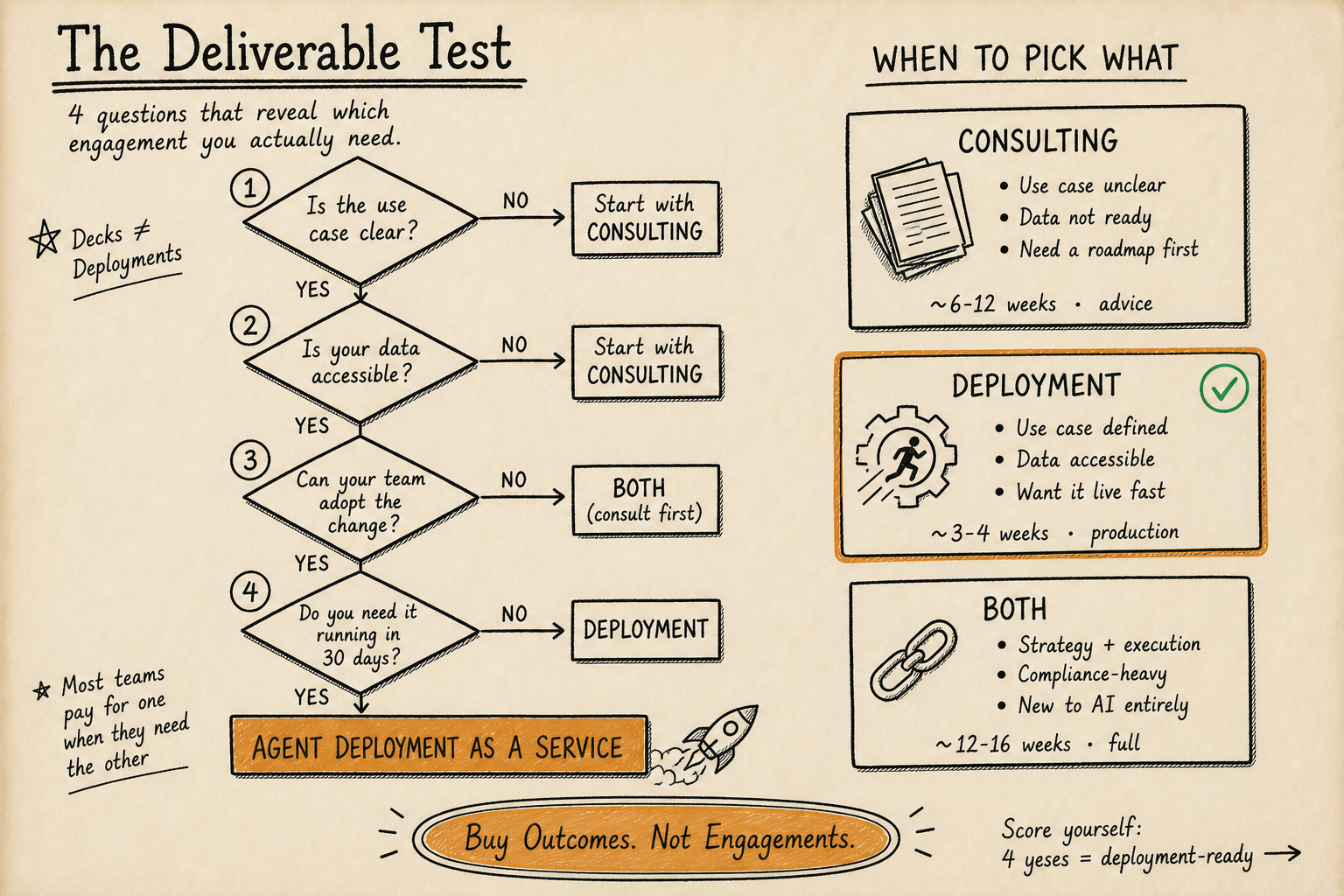
The Deliverable Test: 4 Questions That Reveal What You Need
Most buyers frame this choice incorrectly. They ask: "Are we ready for AI?" or "Do we need help planning our AI strategy?" These are consultancy-shaped questions. They pull you toward advisory engagements regardless of your actual situation.
The better frame is operational: what do you need to exist on the other side of this engagement?
The Deliverable Test is a four-question diagnostic. Answer each one honestly. The pattern of answers tells you exactly where to spend your money.
Question 1: Can you describe the repeatable process you want AI to handle?
If yes (you can name the process, describe the inputs and outputs, and point to where it happens in your current tools), you do not need a consultant to find your use case. You need someone to build it.
If no (you know AI should help somewhere but cannot yet name the specific workflow), then a scoped discovery engagement has real value. But that discovery should take weeks, not months, and should end with a deployment brief, not another strategy document.
Question 2: Does your answer to Question 1 exist in your current software stack?
Most service businesses already use HubSpot, Salesforce, Microsoft 365, Google Workspace, or a combination. If the process you want to automate lives inside tools you already own, you almost certainly do not need a new AI platform. You need an agent or workflow built inside what you have.
This is the core logic behind the KORIX Bring Your Own Stack philosophy. New platforms mean new training, new data migration, new seat licences, and new lock-in. The better question is always: what would happen if the software you already use could think?
Question 3: What does "success" look like at Day 30?
If your answer involves words like "clarity," "alignment," or "roadmap," you are describing a consultancy outcome. Those are real outcomes, sometimes the right outcomes.
If your answer involves words like "hours saved," "leads processed," "documents handled," or "clients served," you are describing a deployment outcome. That means a working system is the right investment.
Buying advice and buying a working system are two separate procurements. A roadmap does not build anything, so the second procurement still has to happen, at a cost that was never in the first budget. If you know what you want built, skip the strategy layer entirely. Go straight to a deployment partner who guarantees production.
Question 4: What is the cost of waiting three more months?
Consultancy engagements typically run 8–16 weeks before they produce their primary deliverable. If your business is losing 20 hours a week to a manual process that AI can handle, three months of strategy is 240 hours of productivity that never comes back.
The Stanford HAI AI Index 2024 reported that the performance gap between AI-augmented and non-augmented workflows in professional services continues to widen, compounding quarterly. The cost of waiting is not static. It grows.
Side-by-Side: Consultancy vs Deployment in 2026
| Dimension | AI Consultancy (Advisory) | AI Deployment (Production) | KORIX 21-Day Pilot | Large systems integrator |
|---|---|---|---|---|
| Primary deliverable | Strategy document / roadmap | Live software system | Production AI agent | Platform licence + roadmap |
| Typical timeline | 8–20 weeks | 3–12 weeks | 21 days | 6–18 months |
| How to compare price | Ask for day rate × days × named team | Ask for day rate × days × named team | Fixed from discovery | Ask for day rate × days × named team |
| Ongoing licence required | Rarely | No (if BYOS model) | No | Usually yes |
| Risk if it fails | Sunk advisory cost | Sunk build cost | Day 22 Guarantee | Very high sunk cost |
| Best fit | Large enterprises, complex governance, no internal clarity | SMEs with a defined process to automate | Service businesses 20–150 staff, defined process | Enterprise transformation programmes |
| You own the output? | Yes (documents) | Yes (if source code included) | Yes (full source code) | Rarely, platform-dependent |
Some vendors sell a combined consultancy + deployment package. In theory, this is efficient. In practice, watch the billing split. If 60–70% of the budget is in the consultancy phase, you are funding their thinking, not your system. A legitimate hybrid engagement front-loads discovery lightly (2–4 weeks maximum) and transitions quickly into build. If the discovery phase exceeds 25% of the total engagement budget, ask what exactly you are paying for.
Real Pricing: What the UK Market Looks Like in 2026
Pricing opacity is one of the main ways buyers end up in the wrong engagement type. Here is what the market actually looks like for UK service businesses.
AI Consultancy Fees
- Boutique AI consultancy (a handful of specialists): the lowest day rate of the three, and the most likely to quote you a fixed scope.
- Mid-market consultancy: higher day rates and a longer discovery phase, usually with a larger team on the engagement than the one you meet in the pitch.
- Big Four advisory practice: the highest day rates, enterprise-only, with minimum engagement sizes that rule out most service businesses.
We have deliberately not printed day-rate figures against those tiers. Rates move with firm, scope and region, and we have no public source we can point you to, so any number here would be a guess dressed up as research. Ask each firm three questions instead: what is the day rate, how many days, and who is actually on the team. Then you are comparing like with like.
The full cost breakdown covers deployment pricing in more detail, including what drives price upward (data quality, integration complexity, compliance requirements) and where unnecessary cost is most commonly added.
For Gartner's perspective, the Hype Cycle for AI 2024 noted that enterprise AI budgets are increasingly shifting toward deployment and MLOps rather than strategy and education, a structural shift that started in 2023 and has accelerated since.
Want a Realistic Plan for Your Project?
No sales pitch. We will give you an honest read on what your situation actually needs, what it should cost, and whether AI is even the right tool here.
Book a Discovery Call →When Consultancy Is the Right Answer
This article is not an argument against consultancy. For the right situation, it is exactly the right product. Here is when it genuinely earns its fee.
You have no internal AI capability and significant regulatory exposure. Financial services, healthcare, legal: businesses operating in regulated environments need governance design before deployment. Cutting the strategy phase here creates compliance risk. The governed AI explainer outlines what that governance layer actually requires.
You are choosing between fundamentally different AI architectures. If the decision is between building a proprietary model, fine-tuning an open-source model, or licensing an enterprise platform , and that decision carries large downstream consequences, paying for structured analysis is rational. The build vs buy decision framework covers this specific choice in detail.
Your stakeholder alignment problem is more expensive than your process problem. Some organisations have the technical clarity to deploy immediately but cannot get internal sign-off without a credible third-party strategic recommendation. In that context, a well-authored roadmap from a recognised consultancy is not waste. It is political infrastructure.
You genuinely do not know what to automate. If you passed on Question 1 of the Deliverable Test, a short discovery engagement, tightly scoped to 3–4 weeks and priced accordingly, is the honest starting point. The 7 signs your business is ready for AI can also help you self-assess before spending on external discovery.
The IBM Global AI Adoption Index 2024 found that lack of AI skills and unclear use cases remain the two most frequently cited barriers to AI adoption among mid-market firms. For those firms, targeted consultancy addresses a real gap. The failure mode is extending that advisory phase long after the use cases are clear.
When Deployment Is the Right Answer
You are ready for deployment, and should skip consultancy entirely, when these conditions are met.
The process is visible and repeatable. You can describe it in two sentences. It happens the same way every time. There are inputs (documents, emails, form submissions, data records) and outputs (summaries, classifications, responses, routed tasks). If that describes something in your business, a consultant cannot add value by studying it for eight weeks.
Your stack is already established. If your team lives in Microsoft 365, HubSpot, or a CRM your developers know well, the AI should live there too. The KORIX Agent library shows what can be deployed into existing software environments without platform migration.
Time is the actual constraint. Service businesses between 20 and 150 staff often cannot afford six months of strategy. They need relief from the operational pressure that is limiting growth right now. For Anna Mazurowska at Numerology-Matrix, the constraint was time-per-client. Each reading took 3–4 hours of manual research, synthesis, and formatting. After KORIX deployed an AI agent to handle the repeatable analysis, that same reading takes 8 minutes. That is a 95% time reduction and an 8x increase in client capacity, metrics verified via a published Clutch review. See the full case study here.
No consultancy phase preceded that outcome. The process was visible. The stack existed. The build started.
You have already done a pilot and you know it works. If your team has run a manual or low-fidelity test of an AI workflow and seen the result, you are past the strategy phase. You need production engineering. The how to evaluate an AI partner guide covers what to look for when selecting a deployment partner specifically.
The measuring AI ROI framework matters here too, because deployment without measurement is just cost. Define your baseline metrics before the build starts so you can prove the outcome on Day 30.
The Most Common Mistake: Buying Consultancy When You Need Deployment
The pattern repeats across industry. A business recognises it needs AI. It searches for AI help. It finds a firm that sells both consultancy and deployment. The firm's sales process naturally funnels toward a discovery engagement first, because that is lower risk for the vendor, easier to scope, and billable immediately.
The business buys the discovery. Eight weeks later, they have a roadmap. Now they need to fund the build. The total spend is now 40% higher than if they had started with a scoped deployment and let the real-world results guide the strategy.
BCG's AI report noted that companies spending the highest proportion of their AI budget on implementation, rather than strategy, were generating the fastest returns. This is not an argument against planning. It is an argument against over-planning at the expense of production.
The common AI failure modes article documents this pattern specifically: extended strategy phases that dissolve momentum before a line of production code is written.
The no-code AI platform landscape has also matured to the point where simple workflow automations can be deployed without any consultancy phase. If your use case is document classification, email triage, or basic data extraction, the document processing tools guide will tell you what is available off the shelf before you pay anyone to help you decide.
How to Use This Guide Before Your Next Vendor Call
Before you take a meeting with any AI firm, consultancy or deployment, run the Deliverable Test silently in your head. Then ask the vendor one direct question: "What exists at the end of this engagement that did not exist at the start?"
If the answer is primarily document-based (strategy, roadmap, assessment, report), you are looking at a consultancy product. Price it accordingly. Hold it to a tight timeline. Do not let it extend past 6 weeks without a defined handover point into build.
If the answer is system-based (an agent is live, a workflow is running, a process is automated), you are looking at a deployment product. Ask for the guarantee. Ask what "production" means specifically. Ask whether you own the source code when the engagement ends.
The best AI partners will answer that question without hesitation, and structure their entire commercial offer around it. Everything else is noise.
Related: weighing an off-the-shelf agent against a custom build? See build vs buy AI agents.
Ready to move from document to system? Explore KORIX's AI and software development services — end-to-end implementation, from agent deployment to web, mobile, and growth builds.
Related reading: not sure how AI governance and governed AI differ? See AI Governance vs Governed AI: The Real Difference — a side-by-side comparison of the rulebook vs. the system that enforces it, and why you need both.
Related: AI Agency vs In-House vs Consultancy: how the three delivery routes compare on cost, speed, ownership and risk, including when each is the wrong fit.
AI consultancy gives you a document; AI deployment gives you a system, and most service businesses with 20–150 staff need the system, not the strategy.
The Deliverable Test reduces this decision to four direct questions about your process clarity, your existing stack, your definition of success, and the cost of waiting. If you can name the process, point to it in your current tools, and define success in operational terms, you are ready for deployment rather than consultancy. Paying for a roadmap before a single hour of production AI work happens is one of the most common and most expensive mistakes service businesses make in 2026. The faster path is a scoped, guaranteed deployment that generates real data within 21 days, and lets the results inform any broader strategy that follows.
Choosing an AI partner: the full series
This article is part of our Choosing an AI partner series. The pillar guide covers the whole topic; the others each go deeper on one part.
- Pillar guideHow to evaluate an AI implementation partnerStart here: the proof to ask for, the red flags, and the questions that separate operators from sales decks.
- Best AI implementation partners in the UKPartners working in the UK side by side, and the criteria that actually separate them.
- AI agent development companies reviewedAn honest review on price, code ownership, governance and production record.
- AI agency vs in-house vs consultancyCost, speed, ownership and risk compared, and when each route is the wrong fit.
- How to write an AI project RFPThe requirements, questions and scope to include so you can compare vendors fairly.
- Buyer's guide to custom softwareHow to scope the work, brief a partner, and control cost and risk.
- Build vs buy AI agentsBuy the commodity; build only what touches your data or regulated actions.
- Build vs buy softwareA framework for when to build, when to buy, and the real total cost of each.
- Custom AI vs off-the-shelf toolsWhen a packaged product is enough and when you need something built.
Continue learning —
go deeper.
What is the core difference between AI consultancy and AI deployment?
AI consultancy delivers strategic output: audits, roadmaps, governance frameworks, and recommendations. AI deployment delivers operational output: a working AI system integrated into your existing software environment. Consultancy tells you what to do. Deployment does it. The confusion arises because many firms sell both under similar language. The clearest test: ask your vendor what exists at the end of the engagement that did not exist at the start. If the answer is a document, that is consultancy. If the answer is running software, that is deployment.
Can a service business with 30 staff afford AI deployment?
Yes, and often more easily than it affords consultancy. Scoped deployment engagements for a single defined workflow are sold as a fixed price, so ask for that price and what is included before you compare anything else. The constraint is not size; it is process clarity. If you can describe the repeatable process you want automated in two sentences, the build cost is predictable and the ROI is measurable within 30 days. The KORIX 21-Day AI Pilot is specifically structured for service businesses between 20 and 150 staff.
How long does AI consultancy typically take in 2026?
A boutique AI consultancy engagement runs 6–12 weeks for a small-to-mid market firm. Big Four engagements for enterprise clients typically run 12–20 weeks. The output is usually a strategy document and technology roadmap. For businesses that already have process clarity, this timeline represents significant opportunity cost, particularly if a manual process is consuming 15–30 hours per week while the strategy phase runs.
What does "production" mean in the context of AI deployment?
Production means the AI system is live, integrated into your real tools, processing real data, and delivering real outputs, not a demo, prototype, or sandbox environment. A production system has been tested against edge cases, connected to your actual data sources, and handed over to your team with documentation. The KORIX Day 22 Production Guarantee is specifically defined around this standard: a system running in your environment on real inputs, or you do not pay the second invoice.
Do I need to replace my existing software to deploy AI?
In most cases, no. The most efficient deployments build AI into tools your team already uses: HubSpot, Salesforce, Microsoft 365, Google Workspace, and industry-specific platforms. This approach eliminates data migration costs, retraining time, and platform lock-in. KORIX calls this the Bring Your Own Stack philosophy. The only time new infrastructure is justified is when your existing stack genuinely cannot support the required integration, which is rarer than vendors who sell new platforms would like you to believe.
When should a service business do consultancy before deployment?
Three situations justify a consultancy phase: you operate in a regulated industry (financial services, healthcare, legal) and need governance design before building; you are choosing between fundamentally different AI architectures with significant downstream cost implications; or you genuinely cannot identify which process to automate first. In all other cases, particularly when you have a visible, repeatable process and an established software stack, deployment is the faster and cheaper path to measurable ROI.
How do I measure whether an AI deployment was worth the cost?
Define your baseline metrics before the build starts. The most useful metrics for service businesses are: time per task (before and after), volume handled per week, error rate, and staff hours redirected. Anna Mazurowska at Numerology-Matrix measured this precisely: readings went from 3–4 hours per client to 8 minutes, a 95% time reduction that translated into an 8x increase in client capacity. The KORIX AI ROI metrics guide covers the full measurement framework for deployment engagements.