AI readiness for business is not about having the latest technology — it’s about whether your organisation has the foundations to make AI work. The models are mature. The tooling is accessible. The cost has come down dramatically. Yet the majority of AI projects still never reach production. The bottleneck is almost never the technology. It’s the business.
An e-commerce company approached us wanting AI demand forecasting across hundreds of SKUs. When we assessed their setup, we found product data spread across three disconnected systems with inconsistent naming conventions. Instead of building AI immediately, we first implemented a unified data structure and reporting layer so AI predictions would actually be usable. Three months later, the AI system we built on top of that foundation delivered real results — but only because we fixed the data first.
After 19 years of building systems across multiple industries, I’ve learned to assess AI readiness for business before a single line of code is written. It comes down to seven indicators — none of which involve technical sophistication. You don’t need a data science team. You don’t need a massive budget. You need readiness in ways most people don’t talk about.
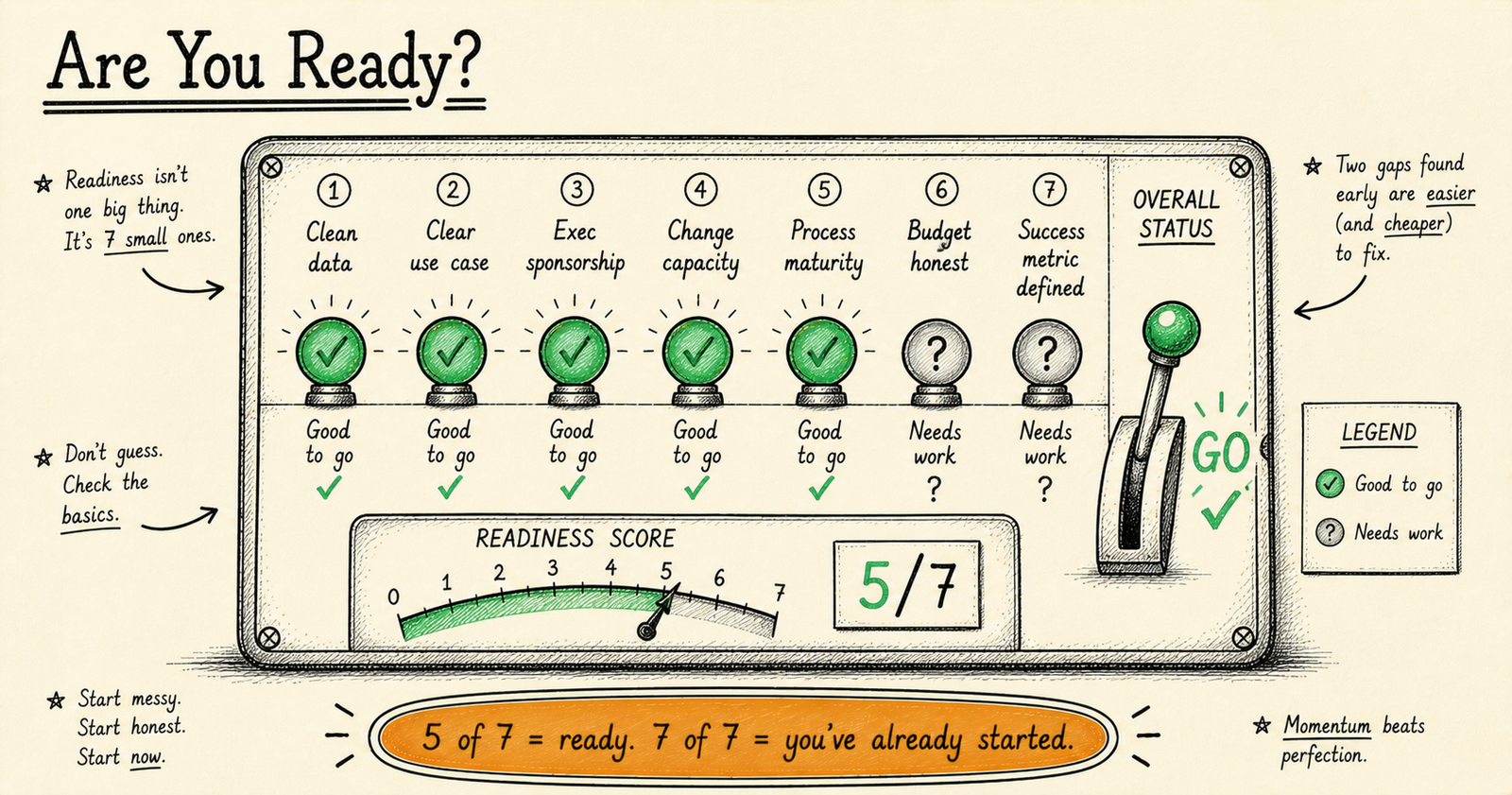
Here are the seven signs of AI readiness I look for. If you tick most of them, you’re in a strong position. If you don’t, that’s not a failure — it’s information you can act on.
Show as a table: 7 Signs Your Business Is Ready for AI Adoption
| Sign | What It Means | Why It Matters |
|---|---|---|
| 1. Specific problem, not vague ambition | You can name the exact process AI will improve | Unfocused AI projects rarely reach production |
| 2. Data exists and someone owns it | Your data is accessible with clear ownership | AI without quality data produces unreliable results |
| 3. Budget holder, not just a champion | Someone with spending authority backs the project | Champions without budgets cannot sustain a project |
| 4. Team willing to change workflows | Staff are prepared to adapt how they work | AI changes processes; resistance kills adoption |
| 5. Leadership accepts AI will make mistakes | Executives understand AI is probabilistic | Unrealistic expectations lead to premature cancellation |
| 6. Can commit 3 weeks of focused effort | The team has capacity for a focused pilot | Part-time attention produces part-time results |
| 7. Want to own it, not outsource it | Goal is internal capability, not permanent dependency | Outsourced AI creates vendor lock-in and ongoing costs |
And if the signs point the other way, read when not to adopt AI.
Sign 1 — You Have a Specific Problem, Not a Vague Ambition
The first sign of AI readiness for business is having a specific, measurable problem to solve — not a vague ambition to “use AI.”
There is a world of difference between “we want to use AI” and “we want to reduce document processing from 4 hours to 20 minutes.” The first is a sentiment. The second is a brief.
Organisations that succeed with AI start with a clearly defined problem that has measurable outcomes. They can articulate what success looks like in numbers: time saved, errors reduced, throughput increased, decisions accelerated. They know which process hurts, who it hurts, and roughly what fixing it would be worth.
If you’re still at the “we should probably be doing something with AI” stage, you’re not ready. That’s fine — but spending money at that stage means you’re funding exploration, not solving a problem. Those are different budgets with different expectations.
“If you can’t describe the problem without using the word ‘AI,’ you don’t have an AI problem yet.”
Knowing your regulatory obligations is a readiness signal in itself. The AI compliance checklist maps them out.
Sign 2 — Your Data Exists and Someone Owns It
Data ownership is the second pillar of AI readiness. You do not need perfect data — but it must exist, be findable, and have a responsible owner within your organisation.
AI runs on data. Not perfect data — the idea that you need immaculate datasets before starting is a myth that delays adoption unnecessarily. But the data does need to exist, it needs to be findable, and someone in your organisation needs to be responsible for it.
“Findable” means it lives in systems you can access, not in someone’s email inbox or on a USB drive in a drawer. “Owned” means there’s a person (or team) who can answer questions about it: where it comes from, how often it’s updated, what the fields mean, and who has access.
You don’t need a data warehouse. You don’t need a chief data officer. But you do need to be able to say: “Here’s our data, here’s where it lives, and here’s who knows about it.” If that statement makes you uncomfortable, the readiness assessment can help pinpoint exactly what’s missing.
Most businesses underestimate their data readiness. Data doesn’t need to be perfect — it needs to be accessible and consistently structured enough that a system can learn from it. A good AI partner will tell you what’s usable and what needs cleaning before you spend a penny on development.
Sign 3 — You Have a Budget Holder, Not Just a Champion
True AI readiness for business requires someone with budget authority — not just an enthusiast who champions the idea internally.
Every failed AI initiative I’ve seen had an enthusiast somewhere in the organisation. Someone who read the articles, attended the webinars, and built the internal case. What most of those projects lacked was a budget holder — someone with the authority to allocate funds and the accountability to justify the spend.
Champions are necessary but insufficient. They create awareness and internal momentum. But without someone who can sign off on a budget, approve a timeline, and commit resources, the project stalls at the proposal stage — or worse, it starts and runs out of funding mid-way through.
The best setup is when the champion and the budget holder are the same person. The second best is when they’re aligned. The worst is when the champion is selling the idea upward to a sceptical CFO who hasn’t been involved in any of the conversations.
If you’re the champion and you don’t control the budget, read our guide on what AI actually costs — it gives you the numbers to make a credible internal case.
Sign 4 — Your Team Is Willing to Change Workflows
Workflow flexibility is a critical marker of AI readiness. AI that maps onto broken processes amplifies the brokenness — ready organisations understand that adoption means genuine change.
We built an AI lead qualification system for a sales organisation, but the sales team kept ignoring the scoring and contacting leads the old way. The system technically worked, but adoption stalled because the workflow had not changed. The fix was redesigning the CRM process so the AI score directly determined lead routing and follow-ups. Once the workflow enforced the AI’s output, adoption went from near zero to full adoption within two weeks.
AI that maps onto broken processes amplifies the brokenness. This is the lesson that costs organisations the most money and the most time, because the technology works exactly as designed — it just accelerates the wrong thing.
Ready organisations understand that AI adoption means workflow change. Not theoretical change that lives in a slide deck — actual, daily, “I’m doing my job differently now” change. The team members who will use the system need to be open to that. Not excited about it, necessarily. Just open.
If your team’s response to “we’re implementing AI” is “as long as it doesn’t change anything I do,” you have a change management problem that no amount of technology will solve. Address that first. The governed AI approach helps because it keeps humans in control of the process, which reduces resistance.
Sign 5 — Leadership Accepts AI Will Make Mistakes
Leadership that expects AI to be perfect will kill every AI initiative. Mature AI readiness means understanding that AI systems make mistakes — and designing governance around that reality.
Zero-tolerance for AI errors equals zero chance of AI adoption. This is not negotiable.
Every AI system makes mistakes. Large language models hallucinate. Classification models produce false positives. Prediction models get things wrong. The question is not whether your system will make errors — it’s whether your organisation has a framework for handling them. Guardrails. Human review for high-stakes decisions. Confidence thresholds that route uncertain cases to people. Feedback loops that improve the system over time.
Organisations where leadership expects AI to be perfect from day one will either never launch (because no system meets that bar) or will launch and immediately lose confidence at the first mistake. Both outcomes waste the investment.
The right question from leadership is not “will it make mistakes?” but “what happens when it makes a mistake, and how do we minimise the impact?” That’s the mindset that leads to successful deployment. It’s also why we document common failure patterns — so you know what to expect before it happens.
Don’t compare AI accuracy to perfection. Compare it to your current process. If your team makes errors on 8% of cases and AI makes errors on 3%, that’s a significant improvement — even though 3% is not zero.
Sign 6 — You Can Commit 3 Weeks of Focused Effort
AI readiness for business demands focused time, not spare-time experimentation. If your key people cannot dedicate a few hours per week for three weeks, the project will stall.
AI adoption is not a background activity. It requires attention from the people who know your processes, your data, and your business logic. Our 21-Day AI Pilot is structured around this reality — three weeks of focused, collaborative effort that proves whether AI can solve your specific problem.
That means stakeholders need to be available for meetings. Subject-matter experts need to answer questions about edge cases. Decision-makers need to review outputs and give feedback within days, not weeks. If your key people are so consumed by daily operations that they can’t carve out a few hours per week for three weeks, the project will drag out, lose momentum, and deliver diluted results.
This doesn’t mean dropping everything. It means being able to prioritise the project enough that it doesn’t compete with 47 other initiatives for attention. If three weeks sounds impossible right now, you’re probably not ready — and that’s genuinely better to know now than after you’ve started.
Sign 7 — You Want to Own It, Not Outsource It
The final sign of AI readiness is the desire to build internal capability rather than permanently outsource. Organisations that own their AI systems gain compounding advantages over time.
There is a fundamental difference between building internal AI capability and renting it from a vendor. Both are valid strategies, but they lead to very different outcomes over time.
Organisations that are truly ready for AI want to understand what’s being built, how it works, and how to maintain it. They don’t want a black box that only the vendor can operate. They want their team to grow with the technology — not remain dependent on an external partner indefinitely.
This doesn’t mean you need to build everything in-house. It means you choose partners who transfer knowledge, who document their work, who hand over code and models, and who make themselves unnecessary over time. Vendor dependency is a strategic risk. The organisations that avoid it are the ones that ask: “What happens if we stop working with you?” before the engagement begins.
At KORIX, full ownership transfer is built into every engagement. You own the code, the models, the pipelines — everything. That’s not altruism; it’s how AI adoption actually sticks.
How Many Signs Do You Tick?
Take our free AI readiness assessment and get a personalised score with specific recommendations for your business.
Take the Assessment →Building AI Readiness for Business When You’re Not There Yet
Not being AI-ready today does not mean never ready. Every one of the seven readiness indicators is buildable — most organisations can develop genuine AI readiness in 4 to 12 weeks.
Not ready does not mean never ready. It means “not today.” And knowing that is genuinely valuable — far more valuable than starting a project that fails because the foundations weren’t there.
Every one of the seven signs above is something you can develop. None of them require hiring data scientists or buying expensive tools. They require clarity, alignment, and a willingness to prepare properly. Most organisations can build genuine AI readiness in 4 to 12 weeks.
We have seen this firsthand. A company came to us wanting AI for customer support automation, but their support requests were poorly categorised and answers were not documented consistently. We recommended standardising their knowledge base and ticket classification first. Six months later, when they came back with clean data and clear processes, the AI deployment was straightforward. The delay saved them from building a system that would have failed.
If you’re missing Signs 1–2 (no specific problem, no data ownership), start there. Define a concrete use case and audit your data. These two steps alone will tell you more about your AI readiness than any consultant report.
If you’re missing Signs 3–4 (no budget authority, resistance to workflow change), it’s an internal alignment problem. Build the business case with real cost data and involve the people who will be affected by the change early in the process.
If you’re missing Signs 5–7 (perfectionism, no time, outsource mindset), it’s a leadership mindset issue. These are the hardest to change but also the most impactful. Sometimes a small, low-risk pilot is the fastest way to shift these perspectives because people believe evidence more than arguments.
The Fastest Way to Assess Your AI Readiness for Business
You can assess your AI readiness for business in 30 minutes with a structured questionnaire or a direct conversation with someone who builds these systems.
A head of operations booked a discovery call assuming their company was not ready for AI yet. During the conversation we realised they already had structured CRM data, clear sales processes, and defined KPIs. The foundation was stronger than they thought. Because the data and processes were already in place, we were able to launch a pilot automation and prediction system within a few weeks — faster than most engagements where the data groundwork still needs doing.
You can spend weeks doing internal analysis, or you can get a definitive answer in 30 minutes.
- Take the AI Readiness Assessment — a structured questionnaire that scores your organisation across all seven dimensions and gives you specific, actionable recommendations.
- Book a free discovery call — 30 minutes with the person who builds the systems, not a sales rep. We will tell you honestly whether you’re ready, what you need to work on, and whether KORIX is the right fit. No commitment, no pressure.
- Start with the 21-Day AI Pilot — if you tick most of the seven signs, this is the lowest-risk way to validate that AI can solve your specific problem. Fixed scope. Fixed timeline. You keep everything we build.
The worst thing you can do is wait until you feel “completely ready.” Nobody ever does. The second worst thing is starting before you’ve addressed the basics. These seven signs help you find the right moment — not too early, not too late.
AI readiness is not about technical sophistication.
It’s about having a clear problem, accessible data, budget authority, willingness to change, tolerance for imperfection, available time, and the desire to own what you build. Most of these are decisions, not capabilities. You are probably closer to ready than you think.
Getting started with AI: the full series
This article is part of our Getting started with AI series. The pillar guide covers the whole topic; the others each go deeper on one part.
- Pillar guideThe 21-day AI pilot explainedStart here: one governed AI use case in production in three weeks, week by week.
- AI readiness assessmentScore your data, processes, team and goals, and see the gaps to close first.
- Preparing your data for AIWhat your business data needs before any AI project can use it.
- Why AI projects failUnclear goals, poor data, no ownership and weak governance, and how to avoid each.
- Why most AI pilots never reach productionThe industry numbers on stalled pilots, and the decisions that change the outcome.
- When not to adopt AIThe honest signals that you should wait, and why adopting too early costs more.
- AI workflow automation for service businessesWhich workflows to automate first, with real tool comparisons.
Recommended Reading
How do I know if my business is ready for AI?
Look for seven indicators: a specific problem to solve, accessible data with clear ownership, a budget holder with authority, a team willing to change workflows, leadership that accepts imperfection, capacity to commit 3 weeks of focused effort, and a desire to build internal capability. Our free readiness assessment scores you across all seven.
What should I do if my business is not ready for AI?
Not ready does not mean never ready. Start by defining a specific business problem AI could solve, then audit and centralise your data, identify a budget holder, and build internal alignment. Most organisations can build genuine readiness in 4 to 12 weeks with focused effort.
Do I need a data science team to be AI-ready?
No. None of the seven readiness signs require technical expertise. You need business clarity, data accessibility, budget authority, and organisational willingness. A good AI partner brings the technical capability — you bring the domain knowledge and commitment.
How long does it take to become AI-ready?
Most organisations can build AI readiness in 4 to 12 weeks by focusing on data accessibility, stakeholder alignment, and defining a clear first use case. The biggest variable is leadership buy-in — some teams align quickly, others need more time and evidence.
What is the lowest-risk way to test AI in my business?
A structured pilot with fixed scope and timeline. Our 21-Day AI Pilot is designed for exactly this — it validates whether AI can solve your specific problem before you commit to a full build. You keep everything we build, regardless of whether you continue.