
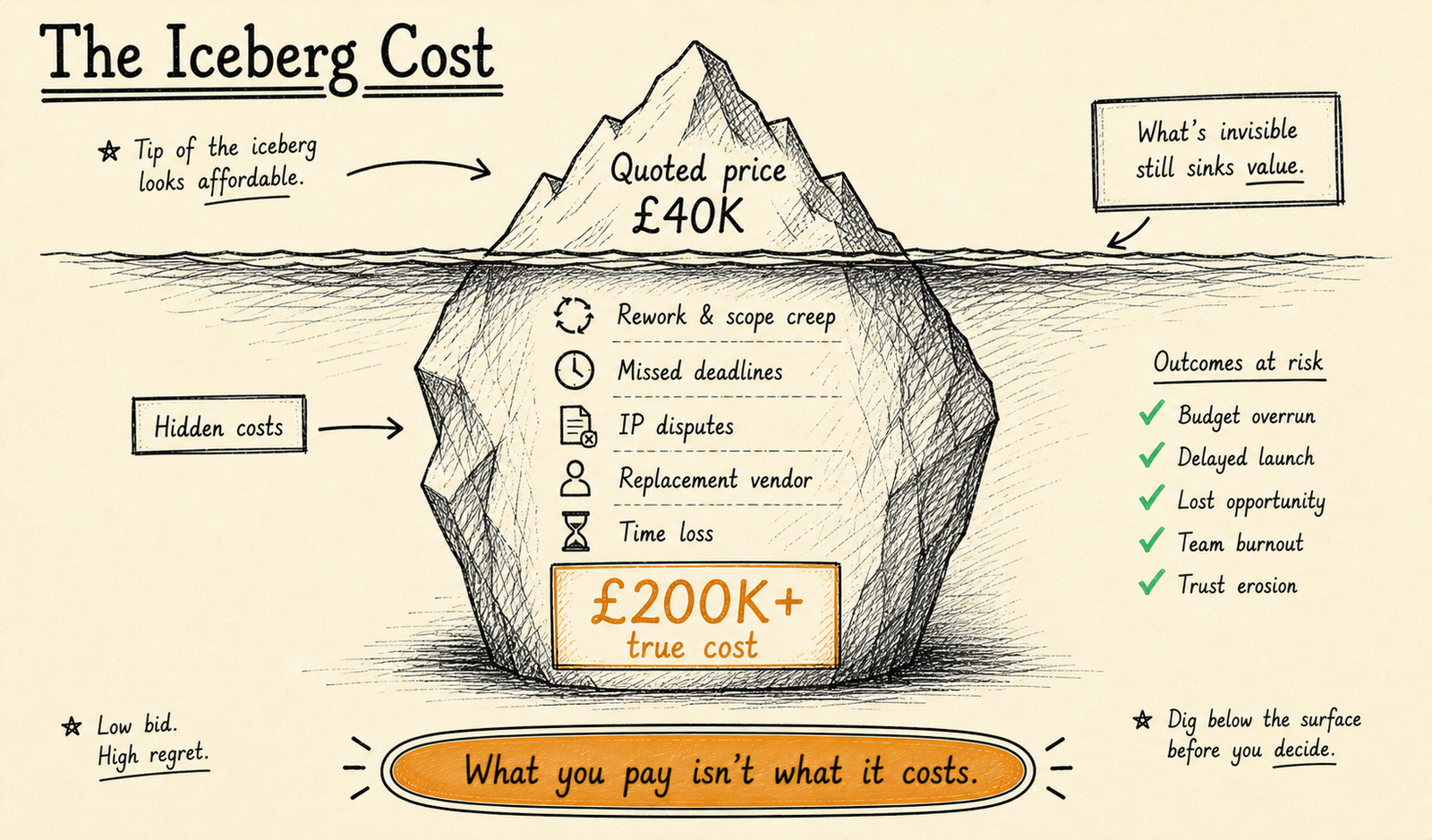
What are the hidden costs of choosing the wrong software partner? The upfront quote covers only 40–60% of the total cost of a software project. The rest hides in places most buyers don’t think to look until they’re already committed. The five most expensive hidden costs: rework from miscommunication (averaging 25% of budget), vendor lock-in (migration costs typically 2–3x the original build), scope creep from poor planning, knowledge transfer gaps when the agency disappears, and ongoing maintenance surprises that weren’t in the original quote.
I’ve been on both sides of this — as the person building the software and as someone brought in to rescue projects that went sideways with other partners. After 19 years and 150+ projects, I can tell you exactly where the money disappears and how to prevent it.
Hidden Cost 1 — Rework From Miscommunication
This is the most common hidden cost and the easiest to prevent. It follows a predictable pattern: vague requirements lead to wrong assumptions, which lead to expensive rework. Industry data puts the average cost of rework at 25% of total project budget. On a £60,000 project, that’s £15,000 spent building the wrong thing and then rebuilding it.
Here’s how it happens. You describe what you want in a meeting. The agency nods and writes something down. Four weeks later, they show you a build that matches what they heard — which isn’t what you meant. The gap between verbal descriptions and working software is enormous, and every gap costs time and money to close.
The worst version of this is when the agency doesn’t show you anything for 8–12 weeks. By then, the misunderstandings have compounded. You’re looking at weeks of rework, not days.
How to prevent it
- Insist on a paid discovery phase — 1–2 weeks of detailed specification before development starts. Any agency that skips this step is setting up the project for rework.
- Get detailed written specs with wireframes or mockups before signing off on development. “We’ll figure it out as we go” is a rework guarantee.
- Demand fortnightly demos of working software, not slide decks. Catching a misunderstanding at week 2 costs a fraction of catching it at week 10.
- Confirm in writing. After every call, the decisions and changes should be documented and agreed upon.
Hidden Cost 2 — Vendor Lock-In
This is the hidden cost that hurts the most in the long run. Your agency builds your system on their proprietary framework, hosts it on their infrastructure, and retains ownership of key components. Everything works fine — until you want to leave.
Then you discover that migrating away from a proprietary platform costs 2–3x the original build cost. You’re not just rebuilding the software — you’re reverse-engineering what it does, migrating data out of a custom schema, and rewriting integrations from scratch.
The warning signs:
- The agency hosts everything and won’t give you infrastructure access
- The contract says they own the code (or is vague about IP)
- They use a proprietary framework or CMS you can’t find other developers for
- There’s no documented API — everything is tightly coupled to their systems
- Leaving requires a “migration fee” that wasn’t mentioned upfront
A company I spoke with paid £45,000 for a custom platform built on an agency’s proprietary stack. When they wanted to switch providers two years later, they were quoted £110,000 for the migration — more than double the original build. They stayed with the original agency. That’s the lock-in working exactly as designed.
How to prevent it
- Demand full code ownership in the contract. You paid for it — you should own it.
- Require standard, open-source tech stacks where multiple developers can work on the codebase
- Insist on your own hosting (or hosting you control), with full deployment documentation
- Get the source code delivered to a repository you own, with commit history intact
Hidden Cost 3 — Scope Creep From Poor Planning
“While you’re at it, can you also...” is the most expensive sentence in software development. Individually, each addition seems small. Collectively, they can inflate a project budget by 30–50%.
But here’s the part most articles won’t tell you: scope creep is usually the agency’s fault, not the client’s. It happens because the planning phase was too shallow. If the agency had asked better questions upfront and mapped out the full workflow, most of those “additions” would have been in the original scope.
The honest version: clients don’t add features for fun. They add them because the original plan missed something they need. That’s a planning failure, not a client behaviour problem.
How to prevent it
- Fixed-scope phases with clear deliverables and milestones — not open-ended retainers
- A thorough discovery process that maps full user journeys, not just the happy path
- A change request process in writing — any addition gets a cost and timeline estimate before it’s approved
- A “Phase 2” backlog for features that are wanted but not essential for launch
Get the complete evaluation checklist
Our Buyer’s Guide includes 20+ questions to ask any software partner before signing, plus red flags to watch for in proposals and contracts.
Get a Custom Estimate →Hidden Cost 4 — Knowledge Transfer Gaps
The project launches. The agency sends a final invoice. Your team is now responsible for a system they didn’t build and don’t fully understand. Six weeks later, something breaks and nobody knows how to fix it.
Documentation is the first thing cut when budgets get tight. It’s invisible work — nobody sees it until they need it. And when they need it and it doesn’t exist, the cost is brutal: emergency calls to the original developer (if they’re available), expensive onboarding for a new developer who has to reverse-engineer the codebase, or worst case, features that simply stop working because nobody understands how they were built.
The typical cost of poor knowledge transfer: 3–6 months of reduced productivity as your team figures out a system they inherited without adequate documentation.
How to prevent it
- Include documentation as a line item in the SOW — not as a nice-to-have, but as a required deliverable
- Require a handover session with your internal team (or your next developer) as part of the final phase
- Demand a README, architecture overview, and deployment guide at minimum
- Withhold final payment until documentation is delivered and verified by someone other than the person who wrote the code
Hidden Cost 5 — Ongoing Maintenance Surprises
The quote covered “development.” It did not cover what happens after launch. Security patches, dependency updates, server maintenance, bug fixes, performance monitoring, SSL renewals, database backups — all of these cost money, and most proposals don’t mention them.
A reasonable rule of thumb: budget 15–25% of the original build cost per year for ongoing maintenance. On a £80,000 project, that’s £12,000–£20,000 annually. It’s not optional — unmaintained software accumulates technical debt that eventually becomes a security risk or a reliability crisis. For a deeper look at these numbers, see our article on software pricing factors.
| Maintenance Item | Typical Annual Cost | Risk If Ignored |
|---|---|---|
| Security patches | 2–5% of build cost | Data breaches, compliance violations |
| Dependency updates | 3–5% of build cost | Breaking changes, deprecated libraries |
| Bug fixes | 3–8% of build cost | User frustration, lost revenue |
| Infrastructure & hosting | £1,200–£6,000/year | Downtime, slow performance |
| Monitoring & backups | £600–£2,400/year | Data loss, undetected failures |
How to prevent it
- Ask for a maintenance estimate as part of the original proposal
- Agree on a support retainer or at least an hourly rate for post-launch work before the project starts
- Understand what’s included in hosting — some agencies bundle monitoring and updates, others charge separately for everything
The 10 Questions to Ask Before Signing
Before you commit to any software partner, get clear answers to these questions. Vague or evasive answers are a red flag.
- What’s included in the quoted price — and what isn’t? Get a line-item breakdown.
- Who owns the code? Full IP transfer on completion, or does the agency retain rights?
- What happens if we part ways mid-project? Get the exit terms in writing before you start.
- What’s your typical cost overrun percentage? Any honest agency can answer this. If they say “zero,” they’re not being honest.
- What tech stack will you use, and why? Is it an open standard, or proprietary to your agency?
- How do you handle change requests? Is there a documented process with cost estimates before approval?
- What does handover look like? Who gets the code, documentation, and deployment instructions?
- What are the ongoing costs after launch? Hosting, maintenance, support — get the annual figure.
- Can I speak with a past client whose project had problems? Everyone has references for happy clients. The revealing question is how they handled things that went wrong.
- What would you recommend we NOT build? A partner who talks you out of unnecessary features is worth more than one who says yes to everything.
How to Protect Yourself
- Paid discovery phase: Detailed specs before development begins
- Full code ownership: IP transfer clearly stated in the contract
- Standard tech stack: Open-source frameworks that other developers can work with
- Fixed-scope phases: Clear milestones with defined deliverables
- Fortnightly demos: Working software shown regularly, not just at the end
- Documentation as a deliverable: Written into the SOW, not treated as optional
- Maintenance estimate: Annual costs quoted before you sign
- Exit terms defined: What happens if either party wants to end the engagement
- Change request process: Written, with cost and timeline estimates before approval
I stay personally involved in every project. That limits scale — we don’t take on 5 projects at once or staff a 10-person team for a large platform build. But it also eliminates several of the hidden costs above. There’s zero miscommunication because the person you brief is the person who builds it. There are zero knowledge transfer gaps because there’s no handoff between teams. You get full code ownership on every project, standard open-source tech stacks, and complete documentation as a default deliverable. The trade-off is capacity, and I’m transparent about that from the first conversation.
The cheapest software partner isn’t the one with the lowest quote. It’s the one whose total cost — including rework, lock-in, maintenance, and your team’s time — is the lowest over three years.
The upfront quote is only 40–60% of the total cost.
Rework, vendor lock-in, scope creep, knowledge gaps, and maintenance surprises make up the rest. Protect yourself with full code ownership, fixed-scope phases, fortnightly demos, and maintenance estimates upfront. The cheapest quote is rarely the cheapest project over 3 years.
AI cost and pricing: the full series
This article is part of our AI cost and pricing series. The pillar guide covers the whole topic; the others each go deeper on one part.
- Pillar guideHow much does AI implementation cost?Start here: real 2026 cost ranges, the factors behind every quote, and the costs vendors leave out.
- How much does an AI agent cost?The build, run and maintain breakdown for an AI agent, and how to budget it.
- AI pricing models comparedPer-seat, per-use and outcome pricing compared on real three-year cost.
- What drives software development pricingScope, complexity, integrations and risk: the factors behind every quote.
- How to measure AI ROIThe metrics that matter, how to set a baseline, and how to prove value to your board.
Recommended Reading
What are the biggest hidden costs?
Rework from miscommunication (averaging 25% of budget), vendor lock-in (migration costs 2–3x the original build), scope creep from poor planning, knowledge transfer gaps, and ongoing maintenance surprises.
How do I avoid vendor lock-in?
Demand full code ownership, require standard open-source tech stacks, insist on hosting you control, and get source code delivered to your own repository with commit history intact.
What questions should I ask before hiring?
Ask about price inclusions/exclusions, code ownership, exit terms, typical cost overruns, tech stack rationale, change request process, handover details, ongoing costs, problem-project references, and what they’d recommend you NOT build. Our Buyer’s Guide has the complete list.
How much does software maintenance cost per year?
Budget 15–25% of the original build cost per year. This covers security patches, dependency updates, bug fixes, and infrastructure. On a £80K project, expect £12K–£20K annually.
Is the cheapest quote the best value?
Rarely. A £25K quote that requires £40K in rework costs more than a £45K quote that delivers a working system. Compare total cost over three years, including rework, lock-in, maintenance, and your team’s time.