Most enterprise AI projects fail because they start too big. Leadership greenlights a sweeping “AI transformation” initiative, a vendor builds a flashy demo, and six months later the project is shelved because nobody solved the governance problem, the integration problem, or the “who actually owns this” problem.
The 21-Day AI Pilot programme is designed to fix that. One real use case. Governed from day one. Running in your workflows in three weeks. Not a demo. Not a slide deck. A production-grade AI capability your team owns and operates.
Why Most AI Pilots Fail Before They Start
Most AI pilots fail because organisations start too big, skip governance, and confuse demos with production systems. The typical pattern is predictable: scope balloons, compliance blocks deployment, and the proof-of-concept never survives contact with real data and real workflows.
We have seen the same pattern across dozens of enterprise conversations. A team gets excited about AI, picks a use case (or worse, picks three), and jumps straight into building without answering the questions that actually determine success or failure.
The failure modes are predictable:
- Teams try to boil the ocean. Instead of picking one well-defined process and proving AI works there, they attempt to transform an entire department. The scope balloons. Stakeholders lose patience. The pilot never reaches production because it never reaches completion.
- No governance, no ownership, no rollback. The AI works in a sandbox, but nobody has defined who monitors it, how decisions get audited, or what happens when something goes wrong. Compliance teams block deployment. IT raises security concerns that should have been addressed in week one. The pilot dies in a review meeting.
- The gap between demo and production is a graveyard. A proof-of-concept that works on clean sample data is not the same as a system that handles your actual data, connects to your actual tools, and runs under your actual compliance requirements. Most AI vendors are good at demos. Very few are good at the unglamorous work of making something production-ready. We have written about this pattern extensively in our analysis of why AI projects fail.
The result is a familiar cycle: excitement, investment, stall, abandonment. Teams that go through this cycle once become deeply sceptical of AI. And that scepticism, while understandable, costs them the competitive advantage that a well-scoped AI pilot programme would have delivered.
What the 21-Day AI Pilot Programme Actually Delivers
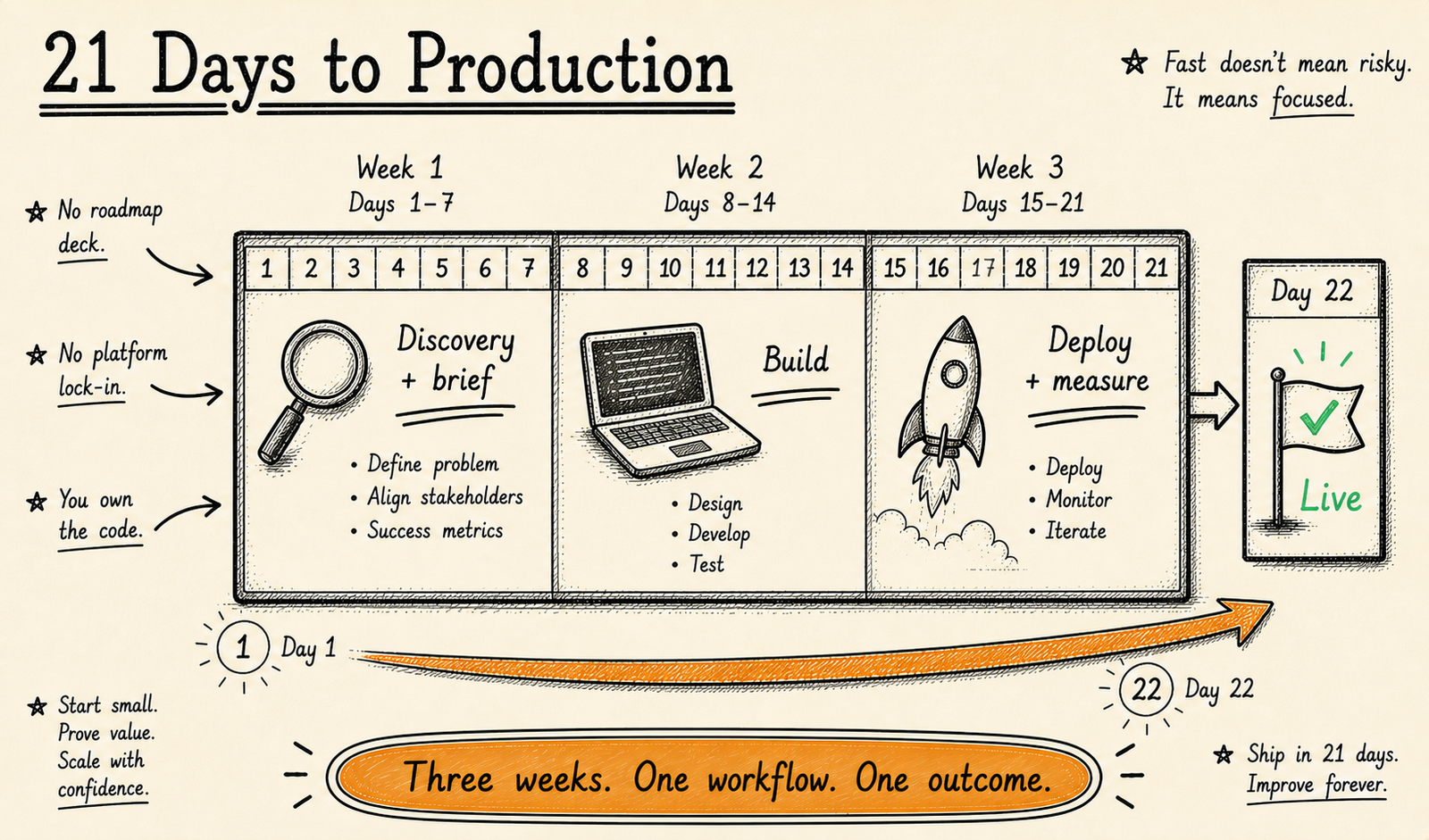
The 21-Day AI Pilot programme delivers a governed, production-grade AI system in three weeks: Week 1 discovery and governance design, Week 2 build and integration, Week 3 controlled deployment and handover. You own everything at the end — code, models, documentation, and runbooks.
We designed the 21-Day AI Pilot to compress the path from “we think AI could help here” to “we have a governed AI system running in production” into three weeks. Here is what each week looks like.
Week 1: Discovery and Governance Design
We start by identifying the single highest-impact use case. Not the most exciting one. Not the one your CEO saw at a conference. The one where AI will measurably improve a process your team runs every day. We map the current workflow, identify where AI fits, define success metrics, and design the governance framework: who monitors outputs, how decisions get audited, what triggers a rollback, and how the system degrades gracefully if something breaks.
This is the week most vendors skip. They go straight to building. We have learned that the governance design is what separates pilots that reach production from pilots that get blocked by compliance three months later.
Week 2: Build and Integration
With a clear scope and governance model, we build the AI capability and integrate it with your existing systems. This is not a standalone tool that lives in isolation. It connects to your data sources, your workflows, and your team’s daily operations. We build monitoring and observability in from the start, not as an afterthought.
Every component is built to be auditable. Your compliance team can see what the AI is doing, why it made a specific decision, and what data it used. This is what we mean by governed AI — not AI with a policy document attached, but AI with governance built into the architecture.
Week 3: Controlled Deployment and Handover
We deploy into your environment under controlled conditions. Your team runs it alongside existing processes so you can compare outputs and build confidence. We train your operators, document everything, and run the handover. By the end of week three, your team is operating the system independently.
What You Own at the End
- A production-grade AI capability running in your workflows
- Full governance documentation: monitoring, audit trails, rollback procedures
- Operator training and runbooks for your team
- Performance benchmarks against your pre-AI baseline
- A clear recommendation for what to scale next (and what not to)
This is not a report recommending what you should do. It is a working system your team is already using.
Who the AI Pilot Programme Is Designed For
The AI pilot programme is designed for enterprise teams with budget approval, a specific process to improve, and a decision-maker available for three weeks. It is not for teams still exploring what AI could do or organisations without stakeholder access during the engagement.
The 21-Day AI Pilot works well for specific types of teams and situations. It does not work for everyone, and we are upfront about that.
It is designed for:
- Enterprise teams evaluating AI seriously. You have budget approval, stakeholder buy-in, and a genuine intent to deploy if the pilot proves value. You are past the “should we do AI?” question and into the “how do we do this without the usual risks?” question.
- CTOs and technical leaders tired of proofs-of-concept that go nowhere. You have seen vendors demo impressive capabilities that never survive contact with your production environment. You want something that works in your stack, with your data, under your compliance requirements.
- Teams with a specific process to improve. You can point to a workflow and say “this is where we lose time, accuracy, or money.” Document processing, data extraction, lead qualification, compliance checks, customer routing — any well-defined process with clear inputs and outputs is a strong candidate.
It is not designed for:
- Teams without a defined use case. If you are still in the “what could AI do for us?” phase, you need a discovery engagement first, not a pilot. We are happy to help with that separately, but the 21-Day programme requires a starting point.
- Organisations without stakeholder access. The pilot requires decisions from people with authority over the process being automated. If your decision-makers are unavailable for three weeks, the timeline does not work.
- Companies looking for a cheap experiment. This is a production-grade engagement. The cost of AI implementation reflects the fact that you get a working system, not a throwaway prototype.
If you are unsure whether you are ready, our AI readiness assessment will help you evaluate where you stand before committing to a pilot.
The best pilot use cases have clear inputs, clear outputs, and a measurable cost you are paying today. If you can describe the process in one sentence, it is probably a good candidate. If it takes a paragraph, scope it down first.
One of our pilots was with a service business that wanted to automate lead qualification and routing from their website. Within the first week we mapped their sales workflow and integrated their CRM data, then deployed an AI-based qualification and routing system during the second week. By the end of the 21-day pilot the system was already handling incoming leads automatically and assigning them to the right sales reps — a process that had previously taken the team hours of manual triage every day.
What Makes This Different from a Typical AI Proof-of-Concept
Unlike a typical proof-of-concept, the 21-Day AI Pilot programme is governed from day one, built to production-grade standards, and fully owned by your team at handover. PoCs treat governance as a later problem and rarely survive contact with real compliance requirements.
The market is full of AI proofs-of-concept. Vendors will happily build you a demo in a few days that shows AI doing something impressive with sample data. The problem is that demos do not ship. Here is what separates the 21-Day AI Pilot from that approach.
Governed from day one. Most proofs-of-concept treat governance as a later problem. “We will add monitoring after we prove the concept works.” In practice, this means governance never gets built, and the system never gets approved for production. We build observability, audit trails, and rollback mechanisms into the system from the start. When your compliance team reviews the pilot, the answers are already there.
Production-grade, not demo-grade. A demo works with clean data in a controlled environment. A production system works with your actual data, handles edge cases, fails gracefully, and recovers without manual intervention. We build for production because the goal is not to impress a room — it is to run in your operations.
Your team owns it at the end. We do not build systems that require us to operate them. The handover in week three is not ceremonial. Your team receives training, documentation, and runbooks. You own the system, the data, and the decision about what to do next. If you want to scale it yourself, you can. If you want our help scaling it, that is a separate conversation.
Fixed scope, fixed timeline. Twenty-one days. One use case. No scope creep, no “we discovered it is more complex than we thought, so we need another quarter.” The fixed constraint forces clarity. It forces us to pick the right use case, design the right governance model, and build only what matters. Constraints are not limitations — they are what make the pilot succeed.
A company initially assumed any meaningful AI project would take several months because their previous technology vendor had quoted a long development timeline. During the discovery call we explained that the pilot focuses on one tightly scoped use case rather than a full platform rebuild. Once they saw the system working within the pilot timeline, they understood the value of validating AI quickly before scaling it.
Want to See If the Pilot Fits Your Team?
Free consultation. No commitment. 30 minutes. We will tell you honestly whether the 21-Day Pilot is the right approach for your situation.
Book a Discovery Call →Real Results from KORIX AI Pilots
KORIX AI pilot programmes have delivered 98.3% document processing accuracy across 2,847 documents. That is a measured production result, not a projection from test data.
We measure pilots by the numbers they produce, not by how impressive they look in a presentation. Here are results from pilots we have delivered, which you can explore in more detail on our work page.
Document AI for Financial Services
A document processing system achieving 98.3% accuracy, processing thousands of documents daily. The client’s previous manual process was slower by orders of magnitude and more error-prone. The governed architecture means every extraction decision is auditable — critical in financial services where regulatory scrutiny is constant.
Lead Intelligence System
An AI-powered lead qualification and routing system that delivered a 3x improvement in ROI on sales operations. The system evaluates inbound leads against historical conversion patterns, scores them, and routes them to the right team. Before the pilot, this was a manual process driven by gut feel and tribal knowledge.
These are not hypothetical projections. They are measured results from systems running in production. We are careful about the numbers we share because inflated claims are one of the reasons enterprise teams are sceptical of AI vendors in the first place. What we report is what the systems actually deliver.
Document Extraction at Scale
Another pilot involved a client in the operations-heavy services sector who was manually processing several thousand documents every month, extracting data into spreadsheets for internal reporting. The process required multiple staff members and still produced frequent data-entry errors. We implemented an AI-driven extraction system that automatically structured the data and pushed it into their reporting workflow, reducing manual processing time significantly and improving accuracy across the board.
During one pilot handover we walked the client’s operations team through the dashboard showing how the AI system processed incoming data and triggered actions. After a short training session, their team started adjusting workflow rules and reviewing the decision logs themselves. That moment was important because the system stopped being “our AI tool” and became something the client’s team could operate confidently. That is the whole point of the pilot — you own it, you run it, you extend it.
Inflated claims are one of the reasons enterprise teams are sceptical of AI vendors. What we report is what the systems actually deliver in production, not peak performance on test data.
How to Know If You Are Ready for an AI Pilot
You are ready for an AI pilot programme if you can identify a specific process costing you time or money, have a decision-maker available for three weeks, and your data is accessible. If you tick most of those boxes, the 21-Day AI Pilot is likely a good fit.
Before you commit to a pilot, ask yourself these questions:
- Can you identify a specific process that is costing you time or money? The more defined the process, the better the pilot. “We want to use AI” is not a use case. “We spend 40 hours a week manually extracting data from supplier invoices” is a use case.
- Do you have a stakeholder who can make decisions in real time? The 21-day timeline only works if decisions do not get stuck in committee. You need someone with authority over the process who is available and engaged throughout.
- Is your data accessible? We do not need perfect data, but we need access to the data the AI will work with. If your data is locked behind months of procurement and security review, the timeline will not hold.
- Are you prepared to measure results honestly? We set baseline metrics in week one and compare against them in week three. If the AI does not deliver measurable improvement, we will tell you. A pilot that proves a use case is not viable is still a successful pilot — it saves you from a much larger failed investment.
- Do you have a plan for what happens if it works? The pilot is designed to prove value and build confidence. If it succeeds, you need to know whether you will scale it, extend it to other processes, or integrate it more deeply. Having that conversation before the pilot starts means you can move quickly when the results come in.
If you answered yes to most of these, you are likely ready. Take our AI readiness assessment for a more detailed evaluation, or book a discovery call to discuss your specific situation.
The 21-Day AI Pilot exists because enterprise teams deserve a better way to evaluate AI.
One that respects your time, your compliance requirements, and your need for real results. Three weeks. One use case. Governed, production-grade, and yours to keep. If that sounds like what your team needs, we should talk.
Getting started with AI: the full series
This guide is the starting point for Getting started with AI. Each article below goes deeper on one part of it.
- 7 signs your business is ready for AIThe signs you are set up to adopt AI, and the red flags that mean wait.
- AI readiness assessmentScore your data, processes, team and goals, and see the gaps to close first.
- Preparing your data for AIWhat your business data needs before any AI project can use it.
- Why AI projects failUnclear goals, poor data, no ownership and weak governance, and how to avoid each.
- Why most AI pilots never reach productionThe industry numbers on stalled pilots, and the decisions that change the outcome.
- When not to adopt AIThe honest signals that you should wait, and why adopting too early costs more.
- AI workflow automation for service businessesWhich workflows to automate first, with real tool comparisons.