Who are the best AI implementation partners for UK businesses in 2026? The top firms include Faculty AI (government and defence), Peak AI (retail and supply chain), Cambridge Consultants (deep tech R&D), Polymath Consulting (enterprise strategy), Deeper Insights (NLP and computer vision), Datatonic (Google Cloud ML), KORIX (governed AI for regulated industries), and Satalia/WPP (optimisation problems). This guide covers all 8 with honest assessments of who each is best for — and who each is not suited for.
We’ve ranked nobody as “number one.” That’s deliberate. The right AI partner depends entirely on your specific situation. A £2M government defence project and a £30K document automation build for a mid-size logistics firm need fundamentally different companies.
If you already have a clear project brief, jump to the comparison table or the decision framework at the end.
Not sure you need a consultancy at all? Compare governed AI vs consultancy first.
Why We’re Writing This (And Why We’re Including Competitors)
We’re an AI implementation company. Writing a “best of” list that includes companies who compete with us for the same projects seems like the worst marketing decision possible.
We’re doing it anyway for three reasons:
- If you’re searching for this, you deserve honest options. Most “best AI company” lists are paid placements or thinly-veiled ads. You can tell because they never mention limitations.
- The right partner for you might not be us. If you need a 50-person on-site team for a multi-year NHS transformation, we physically cannot deliver that. Someone on this list can.
- The fastest way to earn trust is to give useful information with nothing to gain. If you read this, find the right partner from our list, and hire them — that’s a good outcome. You’ll remember where you found the recommendation.
Full disclosure: KORIX is on this list (at number 7). We’ve been as honest about our limitations as everyone else’s.
How We Evaluated
Every firm on this list was assessed against six criteria. No company paid to be included, and no company was excluded for competitive reasons.
- Proven AI track record — shipped AI systems that run in production, not just proofs of concept
- UK presence or understanding — either headquartered in the UK or with deep UK market experience (regulatory, cultural, timezone)
- Transparency — willingness to discuss methodology, limitations, and pricing openly
- Range of services — from strategy through implementation to ongoing support
- Pricing clarity — whether you can get a ballpark figure without a month of discovery calls
- Client reviews — independent reviews on Clutch, G2, or equivalent platforms where available
The 8 Firms
1. Faculty AI
What they do: Faculty AI is one of the UK’s most established AI consultancies, founded in 2014 in London. They specialise in applied AI and data science, with particular depth in the public sector, defence, and national security. Faculty built and operates the AI infrastructure behind several high-profile government programmes and has worked with the NHS, Ministry of Defence, and multiple police forces.
Headquarters: London. Team of approximately 200–300.
Best for: Large enterprises and government bodies with complex data science challenges. If your project involves national-scale datasets, sensitive environments, or needs SC/DV-cleared engineers, Faculty has the depth. Their Fellowship programme also produces strong data science talent.
Not ideal for: Small or mid-size businesses with straightforward automation needs. Faculty’s typical engagement is large in scope and cost. If you need a chatbot for your customer service team or an ML model to predict churn on a 50K-row dataset, you’re overpaying for their capability.
Pricing tier: £££ — Expect six-figure minimum engagements.
Notable work: NHS COVID-19 data modelling, UK government AI strategy support, work with the National Crime Agency.
2. Polymath Consulting
What they do: Polymath Consulting focuses on AI strategy and enterprise digital transformation. They work at the intersection of AI, data, and business strategy — helping organisations define where AI fits in their operations before building anything. Their strength is guiding executives through the decision of what to build, not just how to build it.
Headquarters: London. Boutique team, typically brings in specialist delivery partners for implementation.
Best for: Enterprise leaders who know they need AI but aren’t sure where to start. If you’re a FTSE 250 company that needs a board-level AI strategy before committing to a £500K implementation, Polymath provides the strategic layer. They’re strong at translating technical possibility into business cases.
Not ideal for: Teams that already know exactly what they want built. If you have a defined brief and need someone to write the code, Polymath’s strategy-first approach adds an expensive layer before implementation starts. Also not suited for quick MVPs or small projects.
Pricing tier: £££ — Strategy engagements are premium; implementation is often subcontracted.
3. Peak AI
What they do: Peak AI is a Manchester-based Decision Intelligence company. Rather than offering bespoke consulting, they provide a platform — the Decision Intelligence platform — that helps businesses optimise decisions across supply chain, pricing, demand forecasting, and customer management. They raised over £100M in funding and work with major retail and manufacturing brands.
Headquarters: Manchester. Approximately 200–250 employees.
Best for: Retail, manufacturing, and supply chain businesses that need AI-driven demand forecasting, inventory optimisation, or dynamic pricing. Peak’s platform approach means faster time-to-value than building from scratch. Companies like PepsiCo, KFC, and Speedy Hire are among their client base.
Not ideal for: Custom application development. Peak is a platform company, not a development agency. If you need a bespoke AI system that doesn’t fit their platform’s domain — say, a custom NLP engine for legal documents — this isn’t the right fit. Also not ideal if you want to own and self-host the entire technology stack.
Pricing tier: ££–£££ — Platform licensing plus implementation fees. Mid-range entry point but costs scale with data volume.
Notable work: Demand forecasting for PepsiCo, customer lifetime value modelling for retail brands.
4. Cambridge Consultants
What they do: Cambridge Consultants is a deep technology R&D consultancy — part of the Capgemini Group since 2020. Founded in 1960, they work at the cutting edge of AI, robotics, wireless communications, and industrial design. Their AI work spans from neural network architecture research to deploying AI in medical devices and industrial systems.
Headquarters: Cambridge, UK. 900+ engineers and scientists across the group.
Best for: Organisations that need AI at the frontier — edge AI in hardware devices, AI for medical diagnostics, AI combined with novel sensor technology. If your project involves something that hasn’t been done before, Cambridge Consultants has the R&D depth to figure it out. They’re also strong when AI needs to be integrated into physical products.
Not ideal for: Standard business automation, workflow AI, or budget-conscious projects. Cambridge Consultants is an R&D firm — their expertise is overkill (and overpriced) for tasks like integrating an LLM into your customer service pipeline or building a document classifier. Their minimum engagement is substantial.
Pricing tier: £££ — R&D rates. Expect significant investment.
Notable work: AI-powered medical devices, edge computing for industrial IoT, autonomous vehicle systems.
5. Deeper Insights
What they do: Deeper Insights is a London-based AI consultancy specialising in natural language processing, computer vision, and machine learning for data-rich environments. They work across healthcare, financial services, and media, building bespoke AI models that extract intelligence from unstructured data.
Headquarters: London. Team of approximately 40–60 data scientists and engineers.
Best for: Organisations sitting on large volumes of unstructured data — text, images, video — that need to extract structured intelligence from it. Healthcare companies analysing clinical notes, financial services firms processing research reports, or media organisations automating content classification. Deeper Insights has real depth in NLP and computer vision.
Not ideal for: Simple integrations, website or app development, or projects where AI is a small component of a larger software system. They’re a data science firm, not a full-stack development agency.
Pricing tier: ££–£££ — Mid-range to premium depending on project complexity.
6. Datatonic
What they do: Datatonic is a Google Cloud Premier Partner specialising in machine learning engineering, MLOps, and data platform modernisation. They help organisations build and operationalise ML models at scale, with particular strength in deploying on Google Cloud’s Vertex AI platform. They also hold AWS and Azure partnerships but are best known for their Google Cloud expertise.
Headquarters: London. Approximately 100–150 employees.
Best for: Enterprises already in or committed to the Google Cloud ecosystem that need production-grade ML pipelines. If you need to go from experimental notebooks to reliable, monitored ML systems running in production, Datatonic’s MLOps expertise is strong. They’re also good for data platform migrations.
Not ideal for: Cloud-agnostic requirements or organisations that need flexibility across providers. Their deepest expertise is Google Cloud; if you’re committed to AWS or Azure, other partners may serve you better. Also not ideal for small projects — their sweet spot is enterprise-scale ML infrastructure.
Pricing tier: ££–£££ — Typical for cloud consultancies.
Notable work: ML platforms for HSBC, data modernisation projects for global brands.
7. KORIX (That’s Us)
What we do: KORIX is a founder-led AI and software engineering practice founded in December 2025. We build AI systems with a focus on human-in-the-loop governance — meaning every automated decision has clear oversight, audit trails, and human override capability. Our core philosophy is BYOS (Bring Your Own Software) — we build custom AI agents inside the software your team already uses, rather than selling a new platform. Our work spans document AI, process automation, and custom AI applications for regulated industries.
Headquarters: Ahmedabad, India. Serving UK and global clients remotely. You work directly with the founder, with the team staffed to your workflow.
We’re including ourselves because it would be dishonest not to. We’re also going to be more critical of ourselves than anyone else on this list, because we know our limitations better than anyone else’s.
Best for: Defined AI projects where governance and responsible deployment matter — particularly in regulated industries (financial services, healthcare administration, legal). Projects in the £10K–£80K range where you want direct access to the person building your system, not a rotating team of juniors. Clients who value transparency over polish.
Not ideal for:
- Projects needing large dedicated teams. We are a specialist team, not a large agency. If you need 5 engineers working in parallel for 6 months, we are not the right fit.
- 24/7 support requirements. We don’t offer round-the-clock SLAs. We provide robust handover and documentation so your team can operate independently.
- Projects requiring on-site UK presence. We work remotely from India. The 4.5–5.5 hour time zone difference covers most of the UK working day, but if you need someone in your London office three days a week, we’re not the right fit.
- Organisations that need brand-name reassurance. We’re new. We have one Clutch review (5.0) and no Fortune 500 logos. If your procurement process requires three years of company accounts, we won’t qualify.
Pricing tier: ££ — Significantly lower than the consultancies above, because there’s no office, no middle management, and no sales team to fund. See our full cost breakdown.
What we bring: a founder with 19 years of hands-on software and AI engineering across 150+ projects. Full ownership transfer on every engagement — you own the code, the models, the documentation. A governance-first approach that’s built in from day one, not bolted on at the end.
Honest assessment: If your project is clearly defined, budget-conscious, and you want a senior practitioner rather than a large team, we deliver well. If you need scale, on-site presence, or the comfort of a large brand, we’re not the right choice — and we’ll tell you that on the first call. Not sure if you’re ready for AI at all? Try our free AI Readiness Assessment — 10 questions, instant score.
8. Satalia (Now Part of WPP)
What they do: Satalia is an AI optimisation company acquired by WPP (the global advertising group) in 2021. They specialise in solving complex optimisation problems — workforce scheduling, logistics routing, resource allocation — using AI. Post-acquisition, they’ve increasingly focused on applying AI to advertising, media planning, and creative optimisation within WPP’s ecosystem.
Headquarters: London. Part of the broader WPP group (100,000+ employees globally), though the Satalia team itself is more focused.
Best for: Organisations with genuine mathematical optimisation problems — routing thousands of delivery vehicles, scheduling a workforce of 10,000, or optimising advertising spend across channels. Also strong if you’re already a WPP client and want AI capabilities integrated into your marketing stack.
Not ideal for: Standalone AI projects outside the WPP ecosystem may find the engagement complex post-acquisition. Non-WPP clients report that the sales process can feel oriented toward the wider group’s services. Also not ideal for straightforward ML tasks that don’t involve optimisation.
Pricing tier: £££ — Enterprise pricing, particularly for non-WPP clients.
Notable work: BT workforce scheduling optimisation, PwC resource allocation, Tesco delivery routing.
Quick Comparison Table
| Firm | Team Size | Best For | Pricing | Sector Focus |
|---|---|---|---|---|
| Faculty AI | 200–300 | Government, defence, large enterprise data science | £££ | Public sector, defence, health |
| Polymath Consulting | Boutique | AI strategy, enterprise transformation | £££ | Cross-sector (strategy layer) |
| Peak AI | 200–250 | Retail, manufacturing, supply chain | ££–£££ | Retail, CPG, manufacturing |
| Cambridge Consultants | 900+ | Deep tech R&D, hardware + AI | £££ | Medtech, industrial, automotive |
| Deeper Insights | 40–60 | NLP, computer vision, unstructured data | ££–£££ | Healthcare, finance, media |
| Datatonic | 100–150 | Google Cloud ML, MLOps | ££–£££ | Finance, enterprise |
| KORIX | 1 | Defined AI projects, governance, regulated industries | ££ | Financial services, legal, healthcare admin |
| Satalia (WPP) | WPP group | Optimisation problems, marketing AI | £££ | Logistics, advertising, workforce |
Not sure which partner fits your project?
Book a free 30-minute consultation. We’ll help you evaluate your options — even if we recommend someone else from this list.
Book a Free Consultation →How to Choose the Right Partner for Your Project
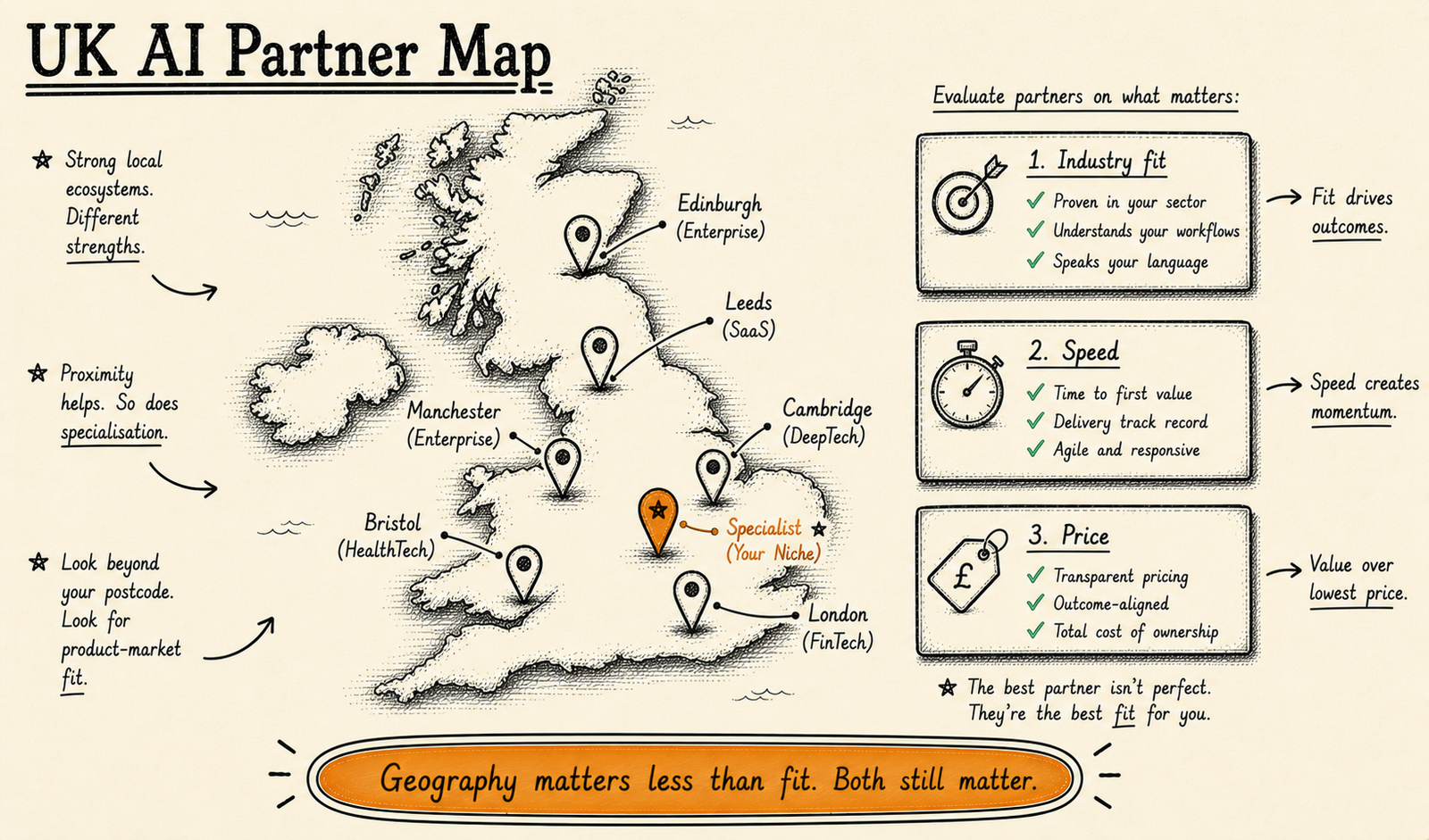
Forget rankings. The right AI partner depends on five variables specific to your situation:
Budget
Be honest about what you can invest. A £30K budget eliminates Faculty, Cambridge Consultants, and most large consultancies immediately — and that’s not a bad thing. It means you need a firm that can deliver within your constraints rather than one that will scope a £300K project and then negotiate down. Our AI cost guide has detailed ranges.
Project Size and Complexity
A clearly defined project (e.g., “automate invoice processing for 3 document types”) needs a different partner than an ambiguous one (e.g., “figure out where AI fits in our business”). Defined projects suit implementation firms. Ambiguous ones suit strategy consultancies.
Industry and Regulation
If you’re in financial services, healthcare, or government, your AI partner needs to understand compliance from the start — not treat it as an afterthought. Ask specifically about their experience with FCA, ICO, or NHS DTAC requirements before signing anything.
Timeline
Large consultancies often have 4–8 week lead times before work begins. Smaller firms can start within days. If time matters, factor in onboarding speed, not just delivery speed. For context, our 21-Day AI Pilot goes from kick-off to production in three weeks — that’s the fastest model on this list.
In-House Capability
If you have a strong engineering team that just needs AI expertise, a specialist consultant or small firm makes sense. If you have no technical team and need end-to-end delivery plus ongoing support, you need a larger partner. Our build vs buy guide covers this decision in detail.
“If this AI partner disappeared tomorrow, could we maintain what they built?” If the answer is no, make sure your contract includes knowledge transfer, documentation, and training. This applies to every firm on this list — including us.
Red Flags to Watch For in Any AI Partner
These apply to every company on this list, including KORIX. If any firm exhibits these behaviours, proceed with caution regardless of their reputation:
- No clear methodology. If they can’t explain their development process in plain English — how they discover requirements, validate data, test models, deploy systems — they’re either winging it or hiding it.
- Won’t discuss failures. Every AI firm has had projects that underperformed. If they claim a 100% success rate, they’re either lying or defining “success” very loosely. Ask about a project that didn’t go as planned and what they learned.
- Locks you into proprietary technology. If the only way to maintain your AI system is through their ongoing contract, you’re a hostage, not a client. Insist on open standards, documented APIs, and full code access.
- Can’t explain outcomes in business terms. “Our model achieved 0.94 AUC” means nothing to a business leader. Good AI partners translate technical metrics into business outcomes: time saved, cost reduced, revenue generated, risk mitigated.
- No governance or ethics framework. In 2026, any AI partner without a clear stance on responsible AI, bias testing, and human oversight is behind the curve. This isn’t a nice-to-have — the EU AI Act and UK AI regulatory framework are making this a legal requirement.
- Vague pricing. “It depends” is fair for a first conversation. “We can’t give you a range until we do paid discovery” is a red flag. Any experienced firm can give you a ballpark based on a 30-minute conversation about your project. See our pricing factors guide for what to expect.
The right AI partner depends on your project, budget, and industry — not a ranking list.
A £2M government programme and a £30K automation project need fundamentally different partners. Define your scope, be honest about your budget, check for red flags, and prioritise firms with genuine experience in your industry. Start with a pilot to validate the relationship before committing to a full build.
Choosing an AI partner: the full series
This article is part of our Choosing an AI partner series. The pillar guide covers the whole topic; the others each go deeper on one part.
- Pillar guideHow to evaluate an AI implementation partnerStart here: the proof to ask for, the red flags, and the questions that separate operators from sales decks.
- AI agent development companies reviewedAn honest review on price, code ownership, governance and production record.
- AI agency vs in-house vs consultancyCost, speed, ownership and risk compared, and when each route is the wrong fit.
- AI consultancy vs AI deploymentTwo different products, and a four-question test for which one you need.
- How to write an AI project RFPThe requirements, questions and scope to include so you can compare vendors fairly.
- Buyer's guide to custom softwareHow to scope the work, brief a partner, and control cost and risk.
- Build vs buy AI agentsBuy the commodity; build only what touches your data or regulated actions.
- Build vs buy softwareA framework for when to build, when to buy, and the real total cost of each.
- Custom AI vs off-the-shelf toolsWhen a packaged product is enough and when you need something built.
Recommended Reading
How do I choose the right AI partner for my UK business?
Start with five variables: your budget, project size and complexity, industry regulation requirements, timeline, and in-house capability. A £30K budget eliminates large consultancies — and that’s fine. Match the partner to your specific situation rather than chasing brand names. Our decision framework above walks through this in detail.
How much do AI implementation partners charge in the UK?
Pricing varies enormously. Large consultancies like Faculty AI and Cambridge Consultants start at six figures. Mid-size firms like Deeper Insights and Datatonic range from mid five figures to six figures. Smaller practices like KORIX work in the £10K–£80K range. Read our full AI cost breakdown for detailed numbers.
Should I hire a large AI consultancy or a smaller specialist firm?
Large consultancies suit ambiguous, enterprise-scale projects needing 50+ person teams. Smaller firms suit defined projects where you want direct access to the person building your system. If you have a clear brief and a budget under £100K, a specialist firm will typically deliver faster and with less overhead. Our build vs buy guide has a full decision framework.
What are the red flags when evaluating AI partners?
Watch for: no clear methodology, unwillingness to discuss failures, proprietary technology lock-in, inability to explain outcomes in business terms, no governance or ethics framework, and vague pricing. These apply to every firm regardless of size or reputation. See our full red flags section above.
Can I work with an AI partner based outside the UK?
Yes, provided they understand UK regulatory requirements (FCA, ICO, NHS DTAC) and can work within your timezone constraints. Remote delivery is standard in 2026. The key question is whether they have genuine UK market experience, not just a UK mailing address.