
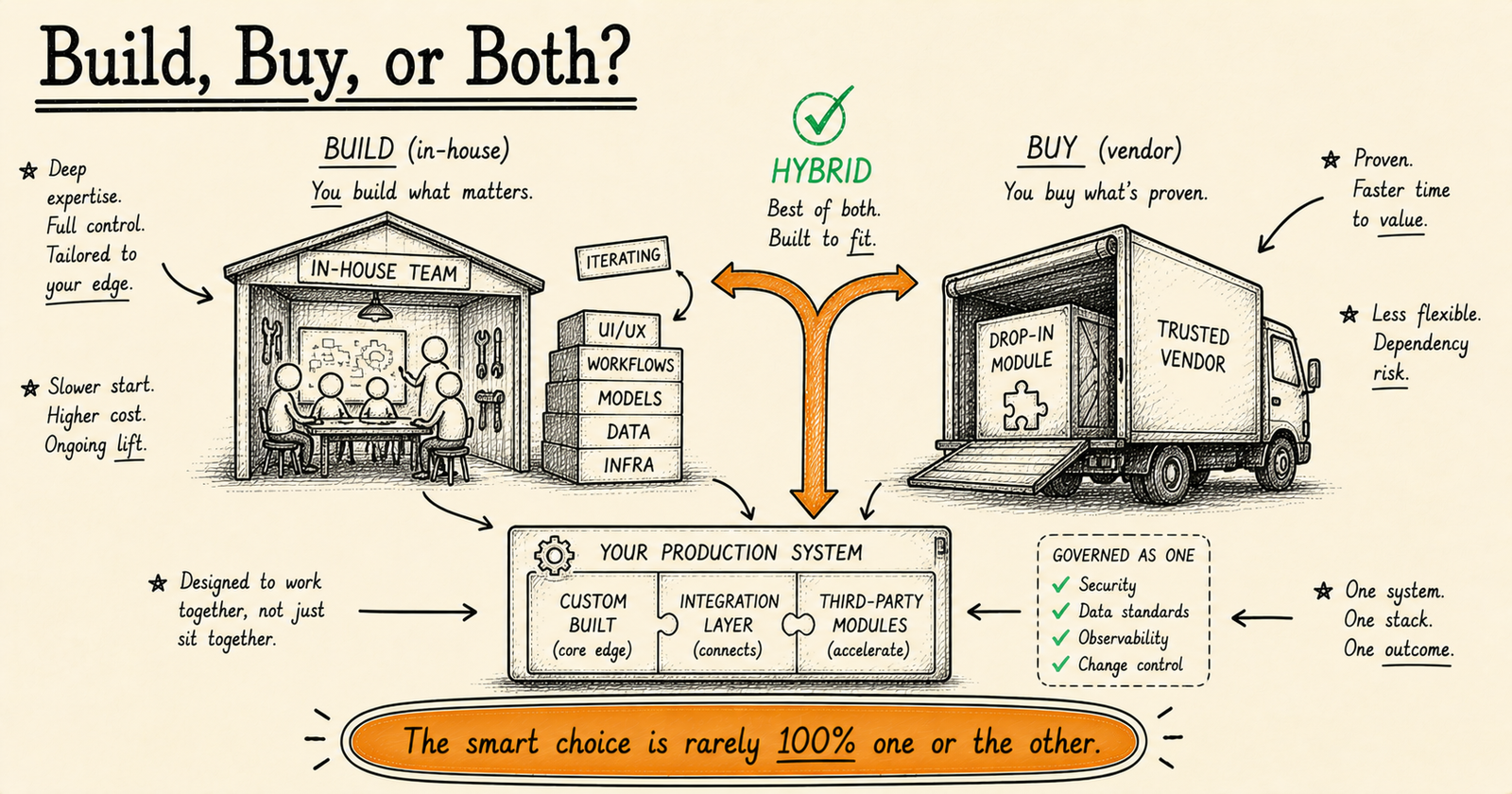
I run a software agency, so you’d expect me to say agencies are better. Here’s what I actually believe: for most companies with ongoing development needs, an in-house team is the better long-term investment. Agencies like mine are better for specific situations — and this article helps you figure out which applies to you.
Should you build an in-house development team or hire a software agency? For most companies with ongoing development needs — meaning you need developers working on your product most weeks of the year — build an in-house team. If you have a defined project with a clear scope, need specialist skills you won’t use again, or need to move fast without a 3–6 month recruitment process, an agency is more cost-effective. Many companies find the best model is a small in-house team for ongoing work plus an agency for specialist or overflow projects.
When In-House Development Wins
| Factor | In-House Team | Agency | Winner |
|---|---|---|---|
| Ongoing availability | Full-time, dedicated | Project-based | In-house |
| Specialist skills | Limited to who you hire | Access to full team | Agency |
| Speed to start | 3–6 month recruitment | 1–2 weeks | Agency |
| Cost (8+ months/year) | More cost-effective | More expensive | In-house |
| Cost (<8 months/year) | Paying idle time | Pay only for work done | Agency |
| Product knowledge | Deep, accumulates over time | Needs onboarding each project | In-house |
| Management overhead | 10–20% of a manager | 5–10% of a stakeholder | Agency |
| Best for | Software companies, ongoing dev | Defined projects, specialist work | Depends |
In-house teams have structural advantages that agencies cannot replicate, no matter how good the agency is. If any of the following describe your situation, hiring your own developers is likely the better investment:
Your core product IS software
If you’re a SaaS company, a tech platform, or any business where the software product is the thing you sell, your development team should be in-house. Full stop. The people building your core product need to live and breathe it every day, understand your customers deeply, and iterate at the speed of conversation. An agency cannot replicate that level of immersion.
You need continuous iteration
If your development cycle involves weekly or daily releases, constant A/B testing, and rapid response to user feedback, the overhead of communicating this through an external agency slows you down. In-house developers can walk to the product manager’s desk, discuss a change, and ship it the same afternoon. With an agency, the same change goes through a brief, a ticket, a sprint, and a review cycle.
Long-term cost efficiency
A senior developer in the UK costs £100K–£150K per year fully loaded (salary, benefits, equipment, office space, management time). That same developer at agency rates would cost £120K–£200K per year if billed full-time. If you need a developer working for you 8+ months per year, every year, in-house is cheaper. The maths is straightforward.
Deep institutional knowledge
After a year in your company, an in-house developer understands your codebase, your customers, your business logic, and the weird edge cases that only come up in practice. That institutional knowledge is enormously valuable and almost impossible to transfer to an external team. Every time you switch agencies or start with a new one, you pay a knowledge-transfer tax.
Full alignment with business objectives
In-house developers attend your all-hands meetings, hear your quarterly goals, understand why revenue is down this month, and know which customer accounts are most important. This context shapes hundreds of small decisions every week. An agency only knows what you tell them in briefs — and briefs can never capture everything.
Companies with in-house development teams ship 40–60% more iterations per quarter than those relying solely on agencies, according to a 2025 McKinsey study on software delivery performance. Speed of iteration is the primary advantage — not code quality, which tends to be comparable.
When an Agency Makes More Sense
Agencies exist because there are real, common situations where hiring in-house is the wrong move. Here’s when external help is genuinely the better option:
Defined projects with a clear start and end
You need a mobile app built. A customer portal redesigned. An AI model trained for a specific use case. These are projects, not ongoing functions. Hiring a full-time developer for a 3-month project means you’re paying them for the 9 months after the project ends too — or going through the cost and disruption of letting them go. An agency delivers the project and the engagement ends cleanly.
Specialist skills you don’t need permanently
You need someone who understands computer vision, or natural language processing, or blockchain, or a specific compliance framework. These specialists command £80K–£130K salaries. If you only need that expertise for one project, hiring full-time makes no sense. An agency gives you access to specialist skills for the duration you need them and not a day longer.
Speed to market
Recruiting a good developer takes 3–6 months in the current UK market. Sourcing, interviewing, offer negotiation, notice period, onboarding. An agency can start next week. If your market window is closing or your competitor just launched something similar, the speed advantage of an agency is worth a premium.
Cost efficiency for one-off projects
A £60K–£120K agency project looks expensive until you compare it to the fully loaded cost of hiring, managing, and eventually parting ways with an in-house team for the same work. The agency fee includes recruitment, management, HR, equipment, office space, and employment risk. You just pay the invoice.
Risk reduction
If you hire a developer who turns out to be wrong for the role, you’re looking at 3–6 months of underperformance, a difficult conversation, potential legal considerations, and then starting the recruitment process again. With an agency, if the work isn’t meeting standards, you have contractual recourse and can switch providers without employment law complications.
The True Cost Comparison
These are real UK numbers as of early 2026. They account for the costs that most comparison articles conveniently leave out:
| Cost Factor | In-House (per year) | Agency (per project) |
|---|---|---|
| Base cost | £70K–£100K salary | £60K–£120K per project |
| Employer NI + pension | £12K–£18K | Included in agency fee |
| Equipment + software | £3K–£5K (Year 1), £1K–£2K ongoing | Included |
| Office / remote setup | £4K–£8K | Included |
| Recruitment cost | £10K–£25K (agency fees or internal time) | £0 |
| Management overhead | 10–20% of a manager’s time (£8K–£20K equivalent) | 5–10% of a stakeholder’s time (£4K–£10K) |
| Fully loaded annual cost | £100K–£150K per developer | £60K–£120K per project (not annual) |
| Productive days per year | ~220 (after holiday, sick, training) | Scoped to project deliverables, not days |
If you need development work for more than 8 months of the year, every year, hiring in-house is cheaper. If you need less than 8 months of work annually, an agency is more cost-effective. If you’re right around 8 months, the decision should be based on the other factors in this article rather than cost alone.
The Hybrid Model That Often Works Best
The build-vs-buy debate assumes you must choose one or the other. In practice, the most effective companies do both — and they’re deliberate about which work goes where.
Pattern 1: In-house core + agency for specialist projects
Keep a small in-house team (2–4 developers) for your core product. When you need AI integration, a mobile app, a complex data pipeline, or any specialist skill outside your team’s expertise, bring in an agency for that specific project. Your in-house team maintains the codebase and integrates the agency’s work into the broader product.
Pattern 2: In-house for maintenance + agency for new builds
Your in-house developer handles day-to-day maintenance, bug fixes, small features, and user support. When you need a significant new system or feature, an agency builds it and hands it off. This keeps your in-house developer focused on keeping things running while the agency handles the heavy lifting of new development.
Pattern 3: Agency first, then transition to in-house
If you’re a startup or early-stage company, use an agency to build your MVP or first product version. This gets you to market fast without the overhead of recruitment. Once the product is validated and you know you need ongoing development, hire in-house and have the agency do a structured handover. This is increasingly common and often the most pragmatic path.
A fintech company with 3 in-house developers needed an AI fraud detection model. They didn’t have ML expertise in-house and wouldn’t need it permanently. They hired an agency for the 10-week AI project (£45K), then their in-house team took over maintenance and iteration using the documentation and training the agency provided. Two years later, the model is still running and the in-house team has made 30+ improvements to it without any further agency involvement.
A Decision Framework
Answer these questions honestly. The right path will become clear:
- Is your core product software? If yes, you need an in-house team. There is no debate. Your product team should not be external.
- How many months per year do you need active development? Over 8 months: lean in-house. Under 8 months: lean agency. If you’re unsure, track your development needs for a quarter and extrapolate.
- Is this a defined project or ongoing work? Defined project with clear deliverables: agency. Open-ended, evolving work: in-house.
- Do you need specialist skills? If you need AI, machine learning, specific frameworks, or niche expertise for one project, don’t hire for it. Use an agency and let them bring the specialist.
- How quickly do you need to start? Recruitment takes 3–6 months. If you need to start within weeks, an agency is the only realistic option.
- Can you attract and retain talent? Top developers have choices. If you’re not a tech company, not in a tech hub, or can’t offer competitive salaries, you may struggle to hire and keep good developers. An agency bypasses this problem entirely.
- Do you have technical leadership? Developers need technical direction. If nobody in your company can evaluate code quality, make architectural decisions, or set technical standards, your first in-house hire needs to be a senior/lead — or you need an agency to provide that oversight.
If you answered “in-house” to most of these, hire. Don’t let an agency (including me) convince you otherwise. Your money is better spent on recruitment and salaries.
KORIX is a specialist practice, and we’re not the right fit if you need a dedicated team working 40 hours per week indefinitely. We work best for defined AI and software projects where deep expertise matters more than team size — typically £15K–£80K engagements lasting 6–16 weeks. If you need an in-house team, I can help you write the job descriptions, define the technical requirements, and set up the interview process — even though it means you won’t hire us. I’d rather you make the right decision than the one that benefits our invoicing.
Need development 8+ months/year? Hire in-house. Defined project? Use an agency.
The biggest factors are continuity of need, specialist skills, and speed requirements. Most growing companies end up with a hybrid model — a small in-house team for ongoing work plus an agency for specialist or overflow projects. Start by tracking how many months per year you actually need development, and the right answer will become clear.
Choosing an AI partner: the full series
This article is part of our Choosing an AI partner series. The pillar guide covers the whole topic; the others each go deeper on one part.
- Pillar guideHow to evaluate an AI implementation partnerStart here: the proof to ask for, the red flags, and the questions that separate operators from sales decks.
- Best AI implementation partners in the UKPartners working in the UK side by side, and the criteria that actually separate them.
- AI agent development companies reviewedAn honest review on price, code ownership, governance and production record.
- AI agency vs in-house vs consultancyCost, speed, ownership and risk compared, and when each route is the wrong fit.
- AI consultancy vs AI deploymentTwo different products, and a four-question test for which one you need.
- How to write an AI project RFPThe requirements, questions and scope to include so you can compare vendors fairly.
- Buyer's guide to custom softwareHow to scope the work, brief a partner, and control cost and risk.
- Build vs buy AI agentsBuy the commodity; build only what touches your data or regulated actions.
- Custom AI vs off-the-shelf toolsWhen a packaged product is enough and when you need something built.
Recommended Reading
When is hiring in-house better than an agency?
When software development is a continuous, core function of your business — meaning you need developers working most weeks of the year. If your core product is software, you need continuous iteration, or you need deep institutional knowledge, in-house is the better investment.
What does a UK developer cost fully loaded?
A senior developer in the UK costs £100K–£150K per year fully loaded — including salary, employer NI, pension, equipment, office space, recruitment, and management overhead. See the full cost breakdown for more detail.
How long does it take to hire a developer in the UK?
Recruiting a good developer takes 3–6 months in the current UK market. That includes sourcing, interviewing, offer negotiation, notice period, and onboarding. An agency can typically start within 1–2 weeks.
What is the hybrid development model?
The hybrid model combines a small in-house team (2–4 developers) for core product work with an agency for specialist projects, new builds, or overflow work. It’s often the most effective approach for growing companies that need both continuity and specialist capabilities.
Can KORIX help if I decide to hire in-house instead?
Yes. We can help you write job descriptions, define technical requirements, and set up the interview process. If in-house is the right answer for your situation, we’d rather help you make that work than sell you something that doesn’t fit. Get in touch to discuss.