We build custom AI systems for a living. So yes, we have a financial incentive to tell you custom is better. We’re not going to do that. Because the honest truth is: off-the-shelf solutions are the right choice for most businesses. This article helps you figure out which camp you’re in.
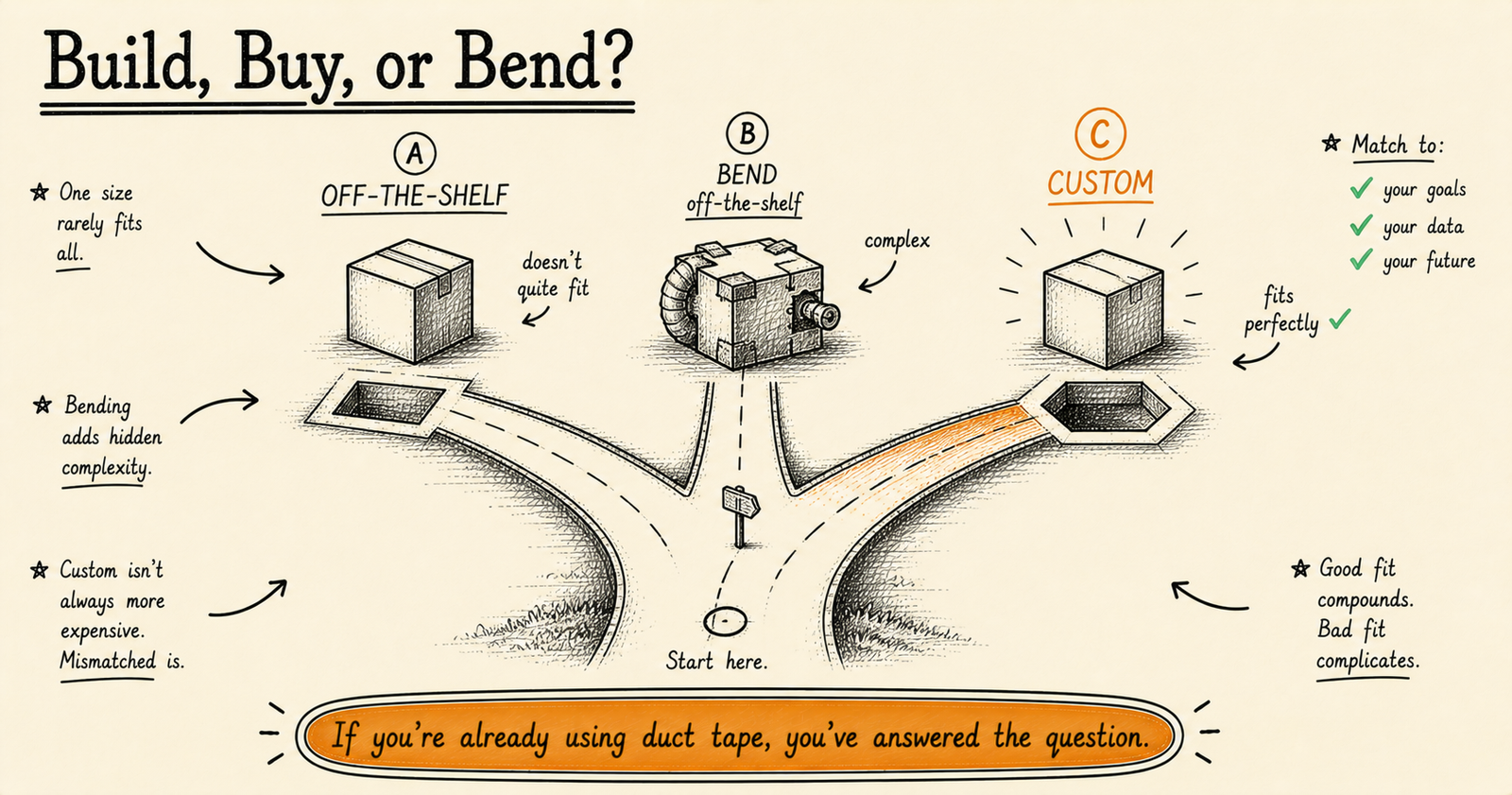
Should you build custom AI or buy off-the-shelf? For most businesses, off-the-shelf is the right choice. If an existing SaaS product covers 80% or more of what you need, buy off-the-shelf and customise the remaining 20% with integrations. If your competitive advantage depends on a process that no existing tool handles — or if you have regulatory, data privacy, or scaling requirements that off-the-shelf products can’t meet — then a custom AI solution is worth the investment. For most businesses, the right answer is a hybrid of both.
When Off-the-Shelf Is the Better Choice
| Factor | Off-the-Shelf | Custom AI | Winner |
|---|---|---|---|
| Upfront cost | Low (£0–£500) | High (£15K–£80K+) | Off-the-shelf |
| Long-term cost at scale | Rises with users/data | Fixed hosting costs | Custom |
| Time to value | Days to weeks | 6–16 weeks | Off-the-shelf |
| Customisation | Limited to vendor roadmap | Unlimited | Custom |
| Data ownership | Vendor-controlled | You own everything | Custom |
| Compliance fit | Generic controls | Built to your requirements | Custom |
| Maintenance burden | Vendor handles it | Your responsibility | Off-the-shelf |
| Best for | Standard processes, small teams | Competitive advantage, regulated industries | Depends |
Off-the-shelf software exists because certain business problems are universal. Thousands of companies need CRM, project management, email marketing, and basic analytics. When a problem is common, the market produces good solutions — often excellent ones. Here are the situations where buying beats building:
Standard workflows that every business shares
If you need a CRM, use HubSpot or Salesforce. If you need project management, use Asana or Monday. If you need customer support ticketing, use Zendesk or Freshdesk. These tools have been refined over years by teams of hundreds of engineers. You will not build something better with a custom project, and you shouldn’t try.
Your budget is under £10K
A meaningful custom AI project rarely costs less than £15K–£25K. If your total budget for solving a problem is under £10K, you almost certainly cannot afford a custom build — and you don’t need one. At this budget level, there is likely a SaaS tool at £50–£200 per month that handles your use case well enough. For more on AI cost ranges, see our detailed breakdown.
Speed matters more than customisation
Off-the-shelf tools are available today. Custom AI takes 6–16 weeks minimum for a useful first version. If your problem needs solving this week, not this quarter, buy something off the shelf and iterate later.
Your team lacks the technical capacity to use custom tools
A custom AI system still needs someone who can manage it, interpret its outputs, and flag when something goes wrong. If your team is entirely non-technical, off-the-shelf tools with support teams and community forums will serve you better than a bespoke system that nobody internally understands.
The 80% rule
This is the most practical test. If an existing tool covers 80% or more of your requirements, buy it. Use its API, Zapier, or Make.com to handle the remaining 20%. This gets you 95% of the value at 20% of the cost of a full custom build.
A logistics company needed AI to optimise delivery routes. They nearly commissioned a custom system at £40K. We recommended they use Routific (£149/month) with a custom integration layer (£3K one-off) to connect it to their existing dispatch software. It handled 90% of what they needed at roughly 10% of the cost.
When Custom Is Worth the Investment
Custom AI makes sense in specific, identifiable situations. If any of the following apply, off-the-shelf tools will frustrate you eventually — and switching later always costs more than building right the first time.
Your unique process IS your competitive advantage
If the way you do something is what sets you apart from competitors, packaging that into a generic tool defeats the purpose. A proprietary pricing algorithm, a unique underwriting model, a differentiated customer matching system — these are competitive moats that deserve custom engineering. When you use the same tools as everyone else, you get the same results as everyone else.
Regulatory requirements that off-the-shelf tools don’t address
Heavily regulated industries — healthcare, finance, legal, defence — often have compliance requirements that SaaS tools weren’t built for. If you need audit trails in a specific format, data residency in particular jurisdictions, or processing that meets sector-specific standards (HIPAA, FCA, GDPR Article 22 for automated decision-making), custom is often the only option that fully satisfies regulators.
Integration needs that exceed what APIs can connect
If you need four or five tools to share data in real time, with complex transformation logic between them, you’ll spend more on integration middleware and workarounds than you would on a custom system that does it natively. The tipping point is usually around 3–4 critical integrations that require bidirectional real-time sync.
Scale requirements beyond SaaS tier limits
SaaS pricing models charge per user, per record, or per API call. At moderate scale, this is fine. At high scale, costs escalate dramatically. If you’re processing millions of records, making thousands of API calls per minute, or need sub-100ms response times on custom logic, a custom system with fixed infrastructure costs often wins on economics.
Data privacy requirements demand on-premise or private cloud
Some organisations cannot — legally or contractually — send data to third-party SaaS providers. Government agencies, defence contractors, certain financial institutions, and companies handling sensitive personal data may need AI systems that run entirely within their own infrastructure. This almost always means custom. Our governed AI services are built for exactly this.
The Real Cost Comparison
Most comparison articles give you vague statements about costs. Here are actual numbers based on our founder’s experience across 150+ projects and current UK market rates:
Key insight: Off-the-shelf is almost always cheaper in year one. By year three, the gap narrows significantly — and for businesses at scale, custom often becomes the more economical option. The crossover point depends entirely on how much you pay in SaaS per-user and per-record fees as you grow.
Not sure which approach fits your situation?
Book a free 30-minute consultation. We’ll give you an honest recommendation — even if that recommendation is to use a SaaS tool instead of hiring us.
Get a Custom Estimate →The Hybrid Approach Nobody Talks About
The custom-vs-off-the-shelf debate is a false binary. The smartest companies we work with use both — and they’re strategic about which goes where.
Use off-the-shelf for commodity functions
Email marketing, CRM, project management, accounting, customer support ticketing — these are solved problems. Use best-in-class SaaS tools for each. Don’t build your own version of Mailchimp.
Build custom for competitive-advantage processes
The thing that makes your business different? The process that competitors can’t copy? The analysis that gives you an edge? That’s where custom AI earns its investment. A custom AI model that optimises your specific pricing strategy is worth building. A custom email-sending platform is not.
Connect them with a solid integration layer
The glue between your custom and off-the-shelf systems matters. A well-built integration layer (often £3K–£8K as a standalone project) lets your custom AI system pull data from and push results to the SaaS tools your team already uses. Your team doesn’t need to learn a new interface — results appear where they already work.
A recruitment firm uses Bullhorn (off-the-shelf CRM) for candidate management. They built a custom AI layer that analyses job descriptions, scores candidate fit, and predicts time-to-place — something no off-the-shelf recruitment tool does well for their niche. The AI pushes scores directly into Bullhorn. The recruiters never leave the tool they already know. Total custom cost: £28K. Annual value of reduced time-to-place: roughly £180K.
Questions to Ask Yourself Before Deciding
Work through these questions in order. Your answers should make the right path obvious:
- Can I name a specific SaaS tool that does what I need? If yes, trial it for 30 days before considering custom. If no existing tool addresses your core problem, custom may be the right path.
- Does this process give me a competitive advantage? If it’s a commodity process (invoicing, email, scheduling), always go off-the-shelf. If it’s what makes your business unique, consider custom.
- What happens in 3 years? Will you have 10x the users, records, or API calls? If SaaS pricing will scale painfully, factor in the long-term cost comparison. If you’ll still be at a similar scale, off-the-shelf stays cheaper.
- Do I have compliance or data residency requirements? If regulators or contracts require specific data handling, check whether SaaS providers can meet those requirements. Many can’t. That’s not a knock on them — they serve broad markets and can’t address every niche regulation.
- How many integrations do I need? One or two integrations via Zapier or standard APIs? Off-the-shelf. Three or more bidirectional, real-time integrations with complex data transformation? A custom integration layer (at minimum) makes sense.
- What is my realistic budget? Under £10K total? Off-the-shelf only. £10K–£25K? Possibly a hybrid approach with a targeted custom component. Over £25K? Custom becomes viable and should be evaluated honestly against off-the-shelf alternatives.
- How urgently do I need this? This week? Off-the-shelf. This quarter? Either option is realistic. Time pressure alone is a legitimate reason to choose off-the-shelf and revisit later.
If you answered “off-the-shelf” to most of these, that’s genuinely the right choice. Don’t let anyone (including us) talk you into a custom project you don’t need.
Start with off-the-shelf. Seriously. Find the best SaaS tool for your use case, use it properly for 3–6 months, and pay attention to where it falls short. If you hit the ceiling — the workflow that no tool handles, the integration that keeps breaking, the compliance requirement that doesn’t fit, the per-record pricing that’s eating your margins — that’s when custom makes sense. We’d rather you save money with a £99/month SaaS tool than overspend on a £40K custom build you don’t actually need. The best custom projects come from businesses that already understand their problem deeply because they’ve hit real limits with existing tools. See our no-code platforms review for where to start.
If off-the-shelf covers 80% of what you need, buy it.
Custom AI makes sense only when your competitive advantage, regulatory requirements, or scale demands exceed what SaaS can deliver. For most businesses, the smartest approach is hybrid: off-the-shelf for commodity functions, custom for the £3K–£8K integration layer that connects your unique process to the tools your team already uses.
Choosing an AI partner: the full series
This article is part of our Choosing an AI partner series. The pillar guide covers the whole topic; the others each go deeper on one part.
- Pillar guideHow to evaluate an AI implementation partnerStart here: the proof to ask for, the red flags, and the questions that separate operators from sales decks.
- Best AI implementation partners in the UKPartners working in the UK side by side, and the criteria that actually separate them.
- AI agent development companies reviewedAn honest review on price, code ownership, governance and production record.
- AI agency vs in-house vs consultancyCost, speed, ownership and risk compared, and when each route is the wrong fit.
- AI consultancy vs AI deploymentTwo different products, and a four-question test for which one you need.
- How to write an AI project RFPThe requirements, questions and scope to include so you can compare vendors fairly.
- Buyer's guide to custom softwareHow to scope the work, brief a partner, and control cost and risk.
- Build vs buy AI agentsBuy the commodity; build only what touches your data or regulated actions.
- Build vs buy softwareA framework for when to build, when to buy, and the real total cost of each.
Recommended Reading
Should I build custom or buy off-the-shelf?
For most businesses, off-the-shelf is the right choice. If an existing SaaS product covers 80%+ of what you need, buy it. Custom makes sense only when your competitive advantage, regulatory requirements, or scale demands exceed what SaaS can deliver.
How much does custom AI cost vs off-the-shelf?
Off-the-shelf: £0–£500 upfront, £50–£500/month. Custom AI: £15K–£80K+ upfront, £200–£800/month. By year three at scale, custom often becomes more economical. See our full cost breakdown.
What is the hybrid approach?
Use off-the-shelf SaaS for commodity functions and build custom AI only for competitive-advantage processes. Connect them with a solid integration layer (typically £3K–£8K). This gives you most of the value at a fraction of full custom cost.
When is off-the-shelf better?
When your workflow is standard, budget is under £10K, you need a solution this week, your team lacks technical capacity, or an existing tool covers 80%+ of your requirements.
When should I invest in custom AI?
When your unique process IS your competitive advantage, you have regulatory requirements off-the-shelf can’t address, you need 3+ complex real-time integrations, SaaS pricing will scale painfully, or data privacy requires on-premise deployment. Start with our 21-day AI pilot to validate before committing to a full build.